Credit Card Stacking Strategy: How to Build a 0% APR Stack

Updated: Sep 5
Credit card stacking combines multiple business credit cards into a larger pool of working capital. This playbook explains how a stack is structured, how application sequencing works, what can derail approvals, and how to manage 0% APR periods without turning cheap capital into expensive debt.
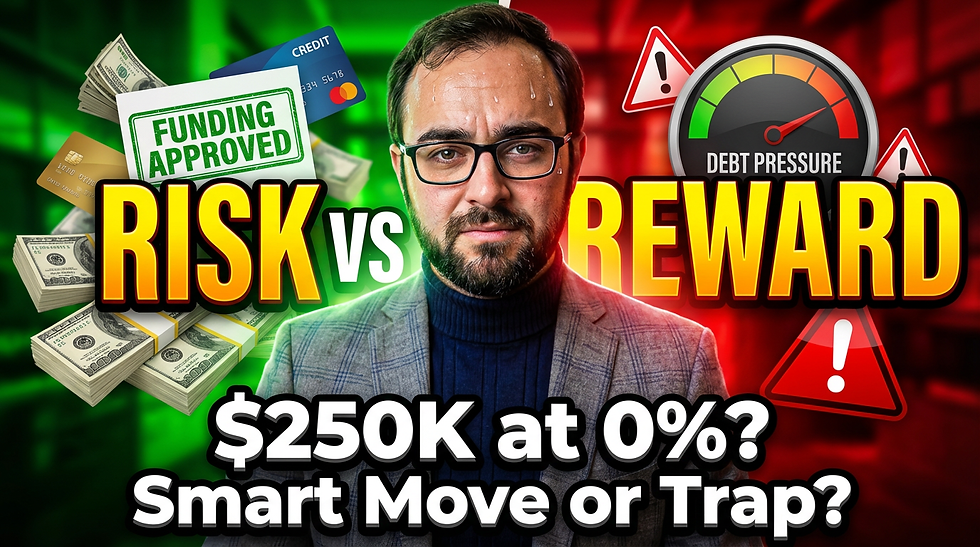
If you’ve built a real business and hit the point where growth is bottlenecked by cash, welcome to the part nobody glamorizes.
You do not need another motivational LinkedIn post about “betting on yourself.”You need capital.
And when banks move like sedated turtles, investors want a chunk of your company, and online lenders show up with interest rates that feel like organized crime with a logo, a lot of founders start looking at one option:
credit card stacking strategies
That phrase usually triggers two reactions.
The first crowd says it’s genius: fast capital, 0% intro APR offers, no equity lost, no collateral required.The second crowd says it’s financial Russian roulette dressed in fintech drag.
The truth is less sexy and more useful:
credit card stacking can be a powerful tool for established business owners trying to scale—but only when it’s used with discipline, timing, and a clear operating plan. Used wrong, it becomes expensive chaos in a nice leather wallet.
This article breaks down the real risk vs. reward behind credit card stacking, who it works for, where founders get burned, and how to decide whether this form of creative startup financing is a smart move—or a panic move in a blazer.
What Is Credit Card Stacking?
At its core, credit card stacking means applying for multiple business and/or personal credit cards in a compressed window to secure a larger combined funding amount.
Instead of getting approved for one card with a $15,000 limit, a business owner might secure several cards across issuers and assemble a larger pool of available capital—sometimes enough to cover inventory, marketing, payroll gaps, equipment, software, or expansion costs.
That is why founders search for phrases like:
credit card stacking strategies
0% interest business credit cards
business credit stacking reviews
fundandgrow alternative
creative startup financing
They are looking for speed, flexibility, and a way to fund growth without begging a bank loan officer to believe in their vision.
And to be fair, the appeal is obvious.
Why founders use stacking
Fast access to capital
Potential access to 0% interest business credit cards
No dilution of ownership
No hard collateral in many cases
Flexible use of funds compared to traditional business loans
Ability to bridge growth without taking predatory term debt
That’s the upside. The devil, naturally, lives in execution.
Still deciding whether stacking is right for your startup?
Read our Credit Card Stacking for Startups: Smart Funding or Risky Move article for the risk-versus-reward analysis.

Why Credit Card Stacking Looks So Attractive to Scaling Businesses
When you’re already operating a real company, the math gets more interesting.
You may not need capital because the business is failing. You may need capital because the business is working.
That is a huge difference.
Plenty of scaling businesses hit a wall because they need cash for things like:
1. Inventory expansion
You know demand exists, but you need to buy ahead to fulfill it.
2. Marketing that actually scales
You already know your customer acquisition channels work. You just need more budget to pour fuel on the fire.
3. Hiring and operations
Revenue is coming in, but execution capacity is the choke point.
4. Equipment, software, or fulfillment upgrades
The business is ready for the next level, but the bank wants last year’s tax return, your firstborn child, and a handwritten essay on “creditworthiness.”
This is where creative startup financing stops being a gimmick and starts becoming a strategic necessity.
For the right operator, stacking can act like a temporary growth bridge. It can buy time, expand capacity, and let you move before slower capital sources catch up.
That’s why some entrepreneurs swear by it.

The Reward Side: When Credit Card Stacking Actually Makes Sense
Let’s not pretend this is all doom and gloom. There are real advantages here.
1. You keep your equity
Every founder should tattoo this somewhere emotionally inconvenient:
Giving away ownership is expensive.If you can fund a growth phase without selling part of your company, that matters. A stack of cards with a promotional 0% APR can be dramatically cheaper than giving up a long-term ownership stake to investors who want upside forever.
If the capital helps you generate more profit than the financing costs, that’s leverage in its purest form.
2. Intro APR offers can create breathing room
Used properly, 0% interest business credit cards can create a temporary interest-free runway. That gives you a window to deploy funds into revenue-producing activity before interest kicks in.
That window matters.
A founder using 0% capital to fund:
tested ad campaigns,
short-term working capital,
inventory turnover,
or strategic hiring,
is playing a very different game than someone using it to finance vague hope and office furniture with “founder energy.”
3. Speed beats bureaucracy
Traditional funding is often too slow for real-world business timing.
Opportunities do not wait politely.
Inventory discounts expire.
Marketing windows close.
Competitors move.
The market doesn’t care that underwriting is “still reviewing your file.”
Credit card stacking is attractive because it can move faster than banks, SBA processes, and many institutional lenders.
4. Flexibility of use
Unlike many loans that come with tight use restrictions, card-based funding is often more flexible. That gives business owners room to allocate capital where it creates the highest return.
For disciplined operators, that flexibility is gold.
For undisciplined operators, it’s gasoline.

The Risk Side: How Founders Wreck Themselves with Bad Stacking
Here’s where the internet usually starts lying to people.
Stacking is often marketed like a cheat code.
Get approved.
Pull capital.
Scale fast.
Ride into the sunset wearing a linen shirt and fake humility.
That’s nonsense.
Credit card stacking is not free money. It is short-duration unsecured leverage.
If you don’t understand that, you should not touch it.
1. High utilization can hit your credit profile
Even if you secure strong limits, using a large portion of that available credit can spike utilization and pressure your credit profile. That can affect future approvals, refinancing options, and general borrowing power.
Translation: just because you got the money doesn’t mean you protected your position.
2. 0% offers expire
This is where people get folded like lawn chairs.
A 0% offer is temporary. If your repayment plan depends on “I’ll figure it out later,” you do not have a repayment plan. You have a fantasy with a due date.
Once promo periods end, interest can become brutal fast. That can turn a smart move into a cash flow ambush.
3. Cash advances and poor structuring can get expensive
Some owners secure cards and then immediately mishandle access to usable cash.
Depending on structure, fees and terms can change the economics dramatically.
This is one reason business credit stacking reviews are all over the map. Some people had strategic guidance. Others basically paid premium pricing to make amateur mistakes at scale.
4. Easy money can fund dumb decisions
This one is less financial and more psychological.
Capital amplifies judgment. It does not replace it.
If your business model is weak, stacking won’t save it. It just gives you a bigger runway to make expensive mistakes. Founders often confuse access to capital with proof of business viability.
It isn’t.
5. Personal guarantees and personal credit exposure
Many business credit products still connect back to the owner’s creditworthiness. That means sloppy execution doesn’t just hurt the company. It can come home and kick your personal profile in the teeth too.
That’s not abstract risk. That’s real.
Who Should Consider Credit Card Stacking?
This strategy is best suited for business owners who already have:
an operating business with revenue,
a defined use for capital,
a credible repayment strategy,
decent to strong personal credit,
and enough financial maturity not to treat available credit like a casino marker.
In plain English: stacking works better for businesses scaling something proven than for founders trying to fund a miracle.It may be a fit if:
You have a working offer and want to scale customer acquisition
You need short-term working capital for a predictable return
You want non-dilutive capital before seeking larger financing
You understand cash flow timing and debt management
It is probably a bad fit if:
Your revenue is unstable or declining
You need capital just to survive this month
You do not know your margins
You do not have a payoff strategy before promotional terms expire
You are already overextended
A lot of bad funding decisions come from emotional urgency wearing a business costume.
Don’t be that founder.

The Smart Way to Use Credit Card Stacking Strategies
If you’re going to use this play, use it like an operator—not like someone who watched three TikToks and declared themselves a capital strategist.
1. Tie every dollar to a purpose
Before you apply, define exactly where the capital will go.
Good uses:
inventory with clear turnover,
campaigns with known CAC and LTV,
equipment tied to delivery capacity,
short-term operational bottlenecks with measurable ROI.
Bad uses:
random overhead,
vanity upgrades,
speculative experiments with no model,
plugging chronic losses with unsecured debt.
2. Plan around the promotional clock
The phrase 0% interest business credit cards sounds amazing because it is amazing—until the clock runs out.
You should know:
when each promo period ends,
what the APR becomes after expiration,
what minimum payments look like,
and what your payoff or refinance path is well before the deadline.
3. Protect liquidity
Do not deploy 100% of available credit the second it hits.
That’s rookie behavior.
Leave breathing room for timing gaps, operational friction, and the fact that real businesses rarely move exactly according to spreadsheet fantasies.
4. Track utilization and payment cadence obsessively
This is not the place for “I’ll check it later.”
Use a real system. Spreadsheet, dashboard, finance manager, whatever. But track:
statement dates,
due dates,
balances,
promo expirations,
utilization by account,
and expected ROI by capital deployment.
5. Have an exit strategy before you enter
The cleanest stacks are used as temporary tools, not permanent life support.
Possible exit paths:
pay down from operating cash flow,
refinance into lower-cost term debt,
replace short-term revolving debt with revenue-based or institutional funding once business metrics strengthen.
If there is no exit, there is no strategy.

Business Credit Stacking Reviews: Why the Market Feels So Split
Search business credit stacking reviews and you’ll find a weird mix of praise, rage, hype, and disappointed people typing with the energy of someone who just discovered consequences.
Why?
Because the outcome usually has less to do with the concept and more to do with these variables:
The quality of the guidance
A solid advisor helps structure the timing, issuer mix, offer selection, and repayment strategy. A weak one basically sells optimism with admin fees.
The borrower’s readiness
A good profile going after the right amount for the right reason is a different case than an underqualified founder trying to force approvals.
Expectations
Some people think stacking is a magical ATM for broken businesses. Then reality punches back.
Post-funding discipline
Getting the approvals is only phase one. Managing the capital is where the adult work starts.
This is also why many founders start searching for a Fund&Grow alternative.
Not because stacking itself is fake—but because they want better alignment, better strategy, more transparency, and a partner that actually understands scaling businesses instead of just selling funding theater.
Why a Fund&Grow Alternative Appeals to Serious Business Owners
There’s a reason the phrase fundandgrow alternative keeps showing up in searches.
Business owners are not just looking for access. They’re looking for confidence.
They want to know:
Is this structured around growth or around fees?
Is the strategy tailored to my business?
Will someone help me think through risk, or am I just being processed?
Does the advisor care what happens after the approvals?
That’s where positioning matters.
A serious funding advisory should not just help you access capital. It should help you use capital intelligently.
That’s the difference between “here are some cards, good luck champ” and actual strategic financing support.


How Moonshine Capital Approaches Stacking More Intelligently
At Moonshine Capital, the goal isn’t to push debt for the dopamine hit of seeing big approval numbers.
The goal is to help established business owners secure funding in a way that actually supports scale.
That means looking at:
whether stacking is even the right move,
how much capital makes sense,
how to time the applications,
how to think about repayment,
and how to avoid turning a growth opportunity into a future cash flow mess.
Because here’s the hard truth:
More capital does not automatically make you more free.
Sometimes it just gives you more expensive ways to be undisciplined.
The right strategy is the one that matches your business model, your margins, your timing, and your tolerance for leverage.
If stacking fits, great. Use it deliberately.If another path is cleaner, smarter, or less risky, take that path instead.
That’s what a real fundandgrow alternative should look like: not louder hype, just better judgment.
A Simple Risk vs. Reward Framework
Before moving forward with credit card stacking strategies, run this quick filter.
The reward side
Ask:
Can this capital create measurable revenue growth?
Can I deploy it quickly and intelligently?
Does it let me avoid dilution or expensive short-term loans?
Do I have visibility into repayment before promo terms end?
The risk side
Ask:
Am I relying on future hope instead of present math?
Would this put dangerous pressure on cash flow?
Am I using debt to cover weakness rather than scale strength?
Do I fully understand the terms, timelines, and consequences?
If the reward case is vague and the risk case is obvious, the answer is no.
Simple. Brutal. Useful.

Final Verdict: Is Credit Card Stacking Worth It?
For established small business owners trying to scale, credit card stacking strategies can absolutely be worth it.
But only under the right conditions.
This is not a hack.
It is not free money.
It is not startup cosplay for people who like saying “leverage” on podcasts.
It is a funding tool.
And like every tool, it can build or destroy depending on who’s holding it.
Used well, stacking can help you:
access fast capital,
preserve equity,
bridge growth gaps,
and expand without collateral-heavy friction.
Used badly, it can:
wreck cash flow,
spike your exposure,
damage your credit position,
and leave you paying for a desperate decision long after the promo APR smile disappears.
The businesses that win with stacking are usually not the loudest. They are the most prepared.
They know their numbers.
They know their margins.
They know why they need the money.
And they know how they’re getting out.
If that sounds like you, this can be a strategic move.
If not, don’t romanticize debt. Debt does not care about your vision board.
FAQs
What are credit card stacking strategies?
Credit card stacking strategies involve applying for multiple credit cards within a focused period to secure a larger total amount of available funding. Business owners use this approach to access working capital, often with promotional APR offers, without giving up equity.
Are 0% interest business credit cards really useful for startup funding?
Yes—when used with a clear repayment plan. 0% interest business credit cards can provide temporary low-cost capital for inventory, marketing, and operational scaling. They become dangerous when founders ignore promo end dates or lack a payoff strategy.
Is business credit stacking risky?
Yes. The biggest risks include high utilization, expiring intro APRs, weak repayment planning, and misuse of funds. Stacking is leverage, not magic.
How do business credit stacking reviews vary so much?
Because results depend heavily on borrower profile, guidance quality, and post-funding discipline. Some founders use the capital strategically. Others treat approvals like a shopping spree with consequences.
What makes a good Fund&Grow alternative?
A strong Fund&Grow alternative should offer strategy, transparency, and business-specific guidance—not just access to credit. The best support helps you evaluate whether stacking is right in the first place.
Is credit card stacking better than giving up equity?
Sometimes, yes. If you can use the capital productively and pay it down responsibly, stacking can be cheaper than surrendering ownership. But bad debt is not automatically better than dilution. It depends on the business and the operator.

Ready to Fund Growth Without Guesswork?
If your business is already moving and you need capital to scale—not just survive—Moonshine Capital can help you assess whether credit card stacking is the right play and structure a smarter path to funding.
Apply for funding and get a strategy built for real operators, not financial thrill-seekers with a spreadsheet addiction.


Comments