Fora Financial Review: Costs, Terms & Alternatives

Fora Financial offers fast financing for established businesses, but the repayment structure deserves as much attention as approval speed. Compare factor rates, fees, eligibility, funding terms, customer complaints, and alternatives before accepting an offer.

Fora Financial offers fast business financing for established companies, with funding up to $1.5 million for qualifying applicants. But fast approval is only part of the equation. Before applying, understand the factor rates, fees, repayment frequency, eligibility requirements, and alternatives that could cost less.
A $100,000 funding approval sounds great.
A $100,000 funding approval with an expensive repayment structure that drains your operating account every week? That's a different conversation.
Our Fora Financial review finds that the company can be a legitimate option for established businesses needing quick working capital, particularly those that might struggle with traditional bank underwriting. Its strengths include fast decisions, substantial funding limits, and revenue-focused underwriting.
The tradeoffs are significant: potentially expensive factor-rate financing, short repayment periods, frequent withdrawals, and qualification requirements that exclude many smaller businesses.
The question isn't simply whether Fora Financial will approve your business. It's whether the financing makes economic sense after you account for every dollar you must repay.
Fora Financial Review: At a Glance
Feature | Fora Financial |
|---|---|
Company | Fora Financial |
Financing types | Small business loans, revenue advances, and other financing solutions |
Core funding amount | Up to $1.5 million |
Small business loan term | Generally 4–18 months |
Minimum credit score | 570 FICO |
Minimum time in business | 6 months |
Revenue requirement | $240,000+ annual revenue on current requirements page |
Repayment | Daily or weekly for core small business loans and revenue advances |
Published factor-rate range | 1.13–1.50 |
Origination fee | As low as 2.5%, according to Fora |
Initial credit inquiry | Soft credit check; later hard inquiry possible |
Approval speed | As little as 4 hours after required documentation |
Funding speed | As little as 24 hours after offer acceptance |
Collateral | No pledged collateral required for qualifying core financing; review contract security provisions |
Best for | Established, revenue-generating businesses needing fast working capital |
Not ideal for | New startups, low-revenue businesses, or borrowers seeking inexpensive long-term financing |
These figures reflect Fora Financial's published information as reviewed in October 2026. Product-specific terms and actual offers vary.
Our Verdict: Is Fora Financial Worth It?
Fora Financial is worth considering when speed and access to capital are important, but it should not be your only quote.
A business with healthy sales, a time-sensitive opportunity, and enough cash flow to handle frequent repayments may find value in Fora's funding model.
However, its published factor rates can produce substantial financing costs. A business that qualifies for a conventional bank loan, SBA-backed loan, or competitively priced revolving line of credit should compare those options before accepting a short-term offer.
Our position:
Best for: Established businesses with strong deposits, urgent capital needs, and a clearly identified return on funding.
Potentially attractive for: Owners with imperfect personal credit but solid business revenue.
Not ideal for: Early startups, companies with thin operating margins, or businesses already struggling with debt payments.
Biggest advantage: Fast access to substantial working capital.
Biggest drawback: The combination of financing costs and potentially demanding repayment schedules.
Want to see whether you qualify?
What Is Fora Financial, and Is It Legitimate?
Fora Financial is a U.S. business financing company that provides working capital and related funding solutions to small and midsize businesses.
Founded in 2008, the company operates in the alternative business financing market, serving businesses that need funding outside the traditional bank lending process.
Fora offers financing directly and through relationships with other capital providers.
Importantly, its financing disclosures explain that business loans and revenue advances may be issued by Fora Financial, Celtic Bank, or unaffiliated third-party providers. The actual capital provider should be identified in your agreement before you sign.
That distinction matters when evaluating your offer.
Is Fora Financial a direct lender or broker?
Fora Financial operates as a direct provider of business working capital but may also connect applicants with third-party financing providers.
According to the company's official FAQ, it offers direct financing while acknowledging that some transactions involve other funding sources.
For borrowers, this means you should confirm:
Which company is actually providing your capital.
Which company will collect your payments.
Who holds or services your financing agreement.
Whether another funding provider has separate requirements.
Who is responsible for payoff statements, disputes, and account servicing.
A recognizable brand name is useful. Knowing which legal entity controls your financing is more useful.
Is Fora Financial a bank?
No. Fora Financial should not be confused with a traditional deposit-taking bank.
Its primary business is helping operating businesses obtain financing, using underwriting models that can place substantial weight on business revenue, deposits, cash flow, and repayment capacity.
Some available financing may involve regulated banks or other third-party providers.
The specific provider and legal structure are determined by the financing agreement.
What Types of Business Financing Does Fora Financial Offer?
Fora Financial markets several different funding solutions. They should not be treated as interchangeable.
A short-term business loan with fixed weekly withdrawals operates differently from an advance tied to actual revenue. A revolving credit line is different again.
Financing option | How it works | Best suited for |
|---|---|---|
Small Business Loan | One-time funding with a scheduled repayment obligation | Defined working-capital needs |
Revenue Advance | Upfront funds repaid from a percentage of business receipts | Businesses with meaningful, sometimes variable, sales |
Business Line of Credit | Revolving access to capital, with borrowing as needed | Recurring working-capital needs |
Term Loan | Lump-sum financing repaid over a defined period | Planned purchases or investments |
Equipment Financing | Financing associated with qualifying equipment | Machinery, vehicles, and equipment purchases |
SBA Financing | SBA-backed business financing through participating providers | Qualified businesses prioritizing longer terms |
Receivables / Invoice Financing | Funding related to outstanding customer invoices | Businesses waiting for customer payments |
Availability, eligibility, providers, and contract terms vary by program.
Source: Fora Financial's financing products.
Fora Financial Small Business Loans
Fora's core small business loan provides a lump sum of capital that can be used for qualifying business purposes.
Published characteristics include:
Funding up to $1.5 million.
Terms of up to 18 months.
Daily or weekly scheduled repayments.
An initial application process that uses a soft credit check.
Potential early-repayment discounts.
Unlike a revolving line of credit, the loan is disbursed once. Repaying it does not automatically restore borrowing capacity.
Best use case: A business has a specific project, knows how the capital will create or protect revenue, and can support the repayment schedule.
For example, a contractor financing materials for signed projects may have a clearer repayment strategy than a struggling business borrowing simply to cover recurring losses.
Fora Financial Revenue Advance
Fora's revenue advance is structured around business receipts.
Rather than using the same fixed payment regardless of sales, its published model ties repayments to an agreed percentage of daily or weekly revenue.
In principle:
Higher sales produce larger repayments.
Lower sales produce smaller repayments.
The total repayment obligation is established by the agreement.
The actual repayment timeline may change with business performance.
Fora currently advertises revenue advances up to $1.5 million, with an expected term of up to 18 months.
However, borrowers should confirm exactly how sales-based adjustments are calculated, whether a reconciliation process applies, and what happens if revenue decreases substantially.
A financing product described as revenue-based is not automatically risk-free during a sales decline.
For more context on these structures, read our Merchant Cash Advance vs. Bank Loan comparison.
Compare MCA Versus Bank Loans
Understand how cost, speed, and repayment structure differ before using short-term capital.

Fora Financial Line of Credit and Longer-Term Options
Fora also markets revolving lines of credit, term loans, SBA financing, and equipment-related financing.
For example, its business line of credit page advertises access to up to $100,000 and repayment terms of up to 12 months.
Its specialized term loan page discusses financing up to $500,000 with potentially much longer terms.
These are not necessarily subject to the same underwriting standards as the company's core short-term products.
Some product pages also present different minimum operating-history requirements in different sections. Confirm the actual eligibility requirements for the specific product you are considering.
Fora Financial Loan Requirements: Who Qualifies?
Fora Financial's core published requirements include at least six months in business, a personal FICO score of 570 or higher, and $240,000 or more in annual business revenue. Applicants also generally need a U.S.-based operating business and a qualifying business checking account.
These are minimum screening requirements, not approval guarantees.
Minimum Qualification Requirements
Requirement | Published standard |
|---|---|
Time in business | At least 6 months |
Credit score | 570+ FICO |
Annual revenue | $240,000+ |
Business checking account | Required |
Business location | United States |
Bank statements | Generally 3 recent months |
Existing financing | Must be acceptable under underwriting |
Bankruptcy | Active bankruptcies can prevent qualification |
Source: Official Fora Financial requirements.
Important: Fora's Published Revenue Minimums Differ
There is an inconsistency worth addressing.
Fora's main requirements page and core product pages currently advertise $240,000 in annual revenue, equivalent to an average of $20,000 monthly.
Its general FAQ separately refers to $17,000 in monthly gross sales.
Those thresholds are not identical.
Rather than assuming a business generating $17,000 per month qualifies for every product, prospective applicants should confirm the current minimum applicable to their requested financing.
Businesses operating near the threshold should also ask how seasonal revenue, uneven deposits, and recent growth affect eligibility.
Does Fora Financial Accept Bad Credit?
Potentially.
Fora's published minimum credit score of 570 can make it accessible to some business owners who struggle to qualify with traditional banks.
But weak credit does not guarantee approval, even when the business generates substantial revenue.
Fora may consider:
Recent bank deposits.
Revenue consistency.
Time in business.
Existing debt obligations.
Cash flow available for repayment.
Credit history.
Industry and business stability.
A business owner with a 580 credit score and strong, stable sales may present a different risk profile from an owner with the same credit score but declining revenue and repeated overdrafts.
The qualification decision involves more than a single number.
Does Fora Financial Fund Startups?
Not generally under its core financing requirements.
Fora states that businesses need at least six months of operating history.
A company that opened last month, has no established deposits, or has not yet generated meaningful business revenue is unlikely to qualify for its standard working-capital products.
Likewise, an entrepreneur planning to purchase a business should not assume Fora's standard loan can be used for the acquisition. Fora's FAQ specifically states that its financing is intended for a business the applicant already owns.
If you're buying an existing business, see our Small Business Acquisition Loan Guide instead.
Buying a Business Instead
Explore acquisition-specific financing rather than applying working-capital funds to a business purchase.

How Much Does Fora Financial Cost?
Fora Financial publishes factor rates ranging from 1.13 to 1.50 for its small-business financing, along with a one-time origination fee that can be as low as 2.5% and a wire-transfer fee. Actual pricing depends on the offer and product.
The most important distinction is that a factor rate is not the same as an annual percentage rate (APR).
A factor rate determines an agreed repayment amount.
It does not automatically account for how quickly the business must repay the money.
Understanding Fora Financial Factor Rates
A factor rate is a multiplier used to calculate total repayment.
The basic formula is:
Funding amount × Factor rate = Total scheduled repayment
For example:
Funding amount | Factor rate | Total scheduled repayment | Factor-rate cost |
|---|---|---|---|
$25,000 | 1.15 | $28,750 | $3,750 |
$50,000 | 1.25 | $62,500 | $12,500 |
$100,000 | 1.30 | $130,000 | $30,000 |
$150,000 | 1.40 | $210,000 | $60,000 |
These are mathematical illustrations, not personalized Fora Financial offers. Origination, wire-transfer, and other applicable fees are excluded.
The larger the multiplier, the more the borrower repays relative to the original funding amount.
But the factor rate alone does not reveal the financing's complete annualized cost.
Worked Example: The Real Cost of $50,000 in Funding
Imagine your business receives the following hypothetical offer:
Approved funding: $50,000.
Factor rate: 1.25.
Repayment period: 12 months.
Payment frequency: Weekly.
Assumed origination fee: 2.5%.
Here's how the numbers work.
Step 1: Calculate total scheduled repayment.
$50,000 × 1.25 = $62,500
Step 2: Calculate the factor-rate financing cost.
$62,500 − $50,000 = $12,500
Step 3: Calculate the assumed origination fee.
$50,000 × 2.5% = $1,250
Step 4: Calculate total financing cost.
$12,500 + $1,250 = $13,750, excluding the wire fee.
Step 5: Estimate weekly payments.
$62,500 ÷ 52 = approximately $1,201.92 per week.
If the origination fee is deducted from proceeds, the business would receive approximately $48,750 in its account before any wire fee, while still owing the scheduled $62,500.
If the fee is collected separately instead, the disbursement and fee-payment mechanics would differ.
Item | Illustrative amount |
|---|---|
Contract funding amount | $50,000 |
Amount received if 2.5% fee is withheld | $48,750 before wire fee |
Scheduled total repayment | $62,500 |
Factor-rate cost | $12,500 |
Origination fee | $1,250 |
Combined financing cost | $13,750 plus applicable wire fee |
Approximate weekly repayment | $1,201.92 |

That $13,750 is more useful for budgeting than simply hearing the phrase "1.25 factor rate."
And because the principal is being repaid throughout the term, the effective annualized cost can be substantially higher than a casual interpretation of a 25% markup.
A 1.25 factor rate is not equivalent to a 25% APR.
The actual annualized cost requires the repayment dates, payment amounts, net proceeds, and applicable fees.
Fora itself explains the distinction in its Factor Rate vs. APR guide.
Does Fora Financial Charge Origination Fees?
Yes, according to its published FAQ.
Fora describes an origination fee that can be as low as 2.5%, plus a one-time wire-transfer fee.
"As low as" is important: 2.5% is not necessarily the fee every borrower receives.
Before signing, request written confirmation of:
The factor rate or stated interest rate.
Every upfront fee.
The exact dollar amount deposited.
Total required repayment.
Payment frequency.
Early-payoff terms.
Potential default-related charges.
Any additional costs associated with the actual financing provider.
Compare financing offers using net cash received, total repayment, and effective APR where applicable.
A low-looking factor rate can become far less attractive after accounting for short repayment periods and upfront deductions.
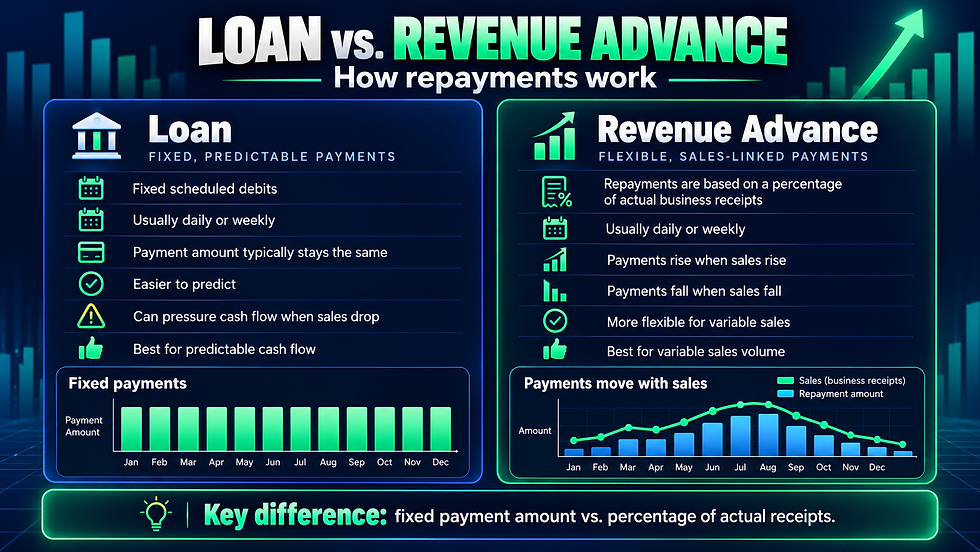
How Do Fora Financial Repayment Terms Work?
Fora Financial's core small-business loans generally use scheduled daily or weekly repayments. Its revenue advances are marketed with payments tied to a percentage of business receipts.
That distinction can determine whether the funding helps your business or creates another cash-flow problem.
Fixed Repayment vs. Revenue-Based Repayment
Feature | Small Business Loan | Revenue Advance |
|---|---|---|
Funding disbursement | Lump sum | Lump sum |
Payment calculation | Scheduled amounts | Percentage of eligible receipts |
Payment frequency | Generally daily or weekly | Generally daily or weekly |
Payment amount changes with sales | Usually no | Designed to fluctuate |
Cost structure | Contract-based; may use factor pricing | Contract-based; commonly factor pricing |
Best suited for | Predictable available cash flow | Meaningful but variable business receipts |
The contract controls how each financing arrangement actually operates.
Why Repayment Frequency Matters
Consider two businesses each generating $30,000 in monthly revenue.
Business A has $12,000 in available monthly operating cash flow after normal expenses.
Business B has only $3,000.
A weekly repayment of approximately $1,200 represents about $5,200 over an average month.
For Business A, this might be manageable if the financing produces enough additional value.
For Business B, that same financing could create an immediate cash shortfall.
Revenue is not the same as profit. And profit is not necessarily the same as cash available for debt service.
Before accepting an offer, model repayments against actual deposits, payroll, taxes, rent, vendor payments, and existing debt.
Does Fora Financial Offer Early-Payment Discounts?
Yes, potentially.
Fora states that it does not charge a prepayment penalty and that some qualifying offers include early-repayment discounts.
Its FAQ also describes early-payback provisions that may reduce the applicable factor rate under certain arrangements.
However, borrowers should not assume paying early automatically eliminates all remaining financing costs.
Ask for a written payoff example showing what you would owe after 30, 60, and 90 days.
Also determine how an early payoff interacts with scheduled automatic withdrawals.
Does Fora Financial Require Collateral or File a UCC?
Fora advertises no pledged collateral requirement for qualifying core business financing.
However, collateral and security provisions are different issues.
Its FAQ reserves the right to file a Uniform Commercial Code (UCC) financing statement under certain circumstances, including specified payment problems or breaches of the agreement.
Borrowers should also confirm whether their individual financing requires a personal guarantee.
Do not interpret "no pledged collateral" as a promise that the contract contains no security, guarantee, or collection provisions.
Read the actual documents before accepting funding.
How Fast Can You Get Money From Fora Financial?
Fora Financial advertises approval decisions in as little as four hours after receiving necessary documentation, with funding possible as soon as 24 hours after an offer is accepted.
Those are advertised best-case timelines, not guarantees.
How the Application Process Works
Complete the application. Submit information about your business, ownership, requested capital, and revenue.
Provide financial documentation. Most core applicants start with three recent business bank statements.
Complete the initial credit review. Fora generally performs a soft credit check during early evaluation.
Review your financing offer. Confirm the financing amount, provider, rate, fees, repayment obligations, and contract terms.
Accept the offer and receive funds. If final requirements are satisfied, disbursement may occur as soon as the next business day.
Additional documentation, underwriting questions, payment-processing schedules, and third-party providers can extend the timeline.
Does Applying to Fora Financial Affect Your Credit?
Fora states that its initial application uses a soft credit inquiry, which does not affect your credit score.
However, its requirements page acknowledges that a hard credit inquiry may occur later in the process.
Ask when and under what circumstances a hard inquiry would be authorized, particularly if the financing involves an external provider.
Fora Financial Pros and Cons
Advantages | Limitations |
|---|---|
Fast advertised approval and disbursement | Factor-rate financing can be expensive |
Core funding amounts up to $1.5 million | Daily or weekly repayments can strain cash flow |
Initial soft credit check | Later hard inquiry may occur |
Considers businesses with imperfect credit | $240,000 annual-revenue threshold excludes many small businesses |
Streamlined initial documentation | Core funding requires an operating history |
Multiple financing structures | Terms differ significantly across products/providers |
Potential early-payoff discounts | Discounts depend on the agreement |
Flexible use of core working capital | Core financing is not for purchasing an existing business |
The main advantage is access.
The main risk is taking expensive capital without verifying whether the business can comfortably repay it.
Neither point cancels the other.
Fora Financial Customer Reviews and Complaints: What Should You Know?
Fora Financial has an established operating history and a public customer-review footprint.
But borrower experiences should be considered alongside financing terms—not substituted for them.
The Better Business Bureau's Fora Financial profile includes customer complaints relating to issues such as marketing communications and payment or payoff disputes.
These are individual complaints, not proof that every applicant will encounter the same problems. The BBB also notes that complaint information may be incomplete and should be assessed in context.
For prospective borrowers, the useful lesson is to verify important servicing details before funding.
What Borrowers Should Watch For
1. Confusion about total borrowing cost
A factor rate may appear straightforward, but it does not communicate annualized cost or the effect of frequent repayments.
2. Unexpected cash-flow pressure
Automatic withdrawals can create problems when a business's deposits fluctuate or its operating margins are thin.
3. Early-payoff misunderstandings
Borrowers need a written explanation of payoff amounts, discount conditions, and when scheduled debits stop.
4. Marketing or communication concerns
Keep copies of all communications, offers, disclosures, and consent records.
5. Confusion about the actual provider
Where a third party funds the transaction, the contracting and servicing entity may differ from the brand through which the application began.
These issues are not unique to Fora Financial. They are common areas of risk across alternative business financing.
Does Fora Financial Report Payments to Business Credit Bureaus?
Fora's FAQ states that its core financing does not build business credit because it does not report those payments to credit bureaus.
That matters if your objective includes building a documented business borrowing history.
If credit-building is an important goal, ask every prospective lender whether positive payments are reported, which bureaus receive the information, and whether reporting applies to your exact product.
Who Should Consider Fora Financial?
Fora Financial may fit an established business that needs funding for a specific, measurable opportunity.
Examples include:
A contractor buying materials for already-signed projects.
A restaurant purchasing equipment expected to increase operating capacity.
A retailer buying inventory with demonstrated demand.
A transportation company covering expenses tied to confirmed contracts.
A service business bridging timing differences between completed work and incoming customer payments.
An operating company funding expansion with a realistic cash-flow forecast.
The strongest case for short-term financing exists when the capital creates or protects value that justifies its cost.
A business buying $40,000 of profitable inventory for a predictable sales cycle may have a defensible reason to accept short-term financing.
A business borrowing $40,000 to cover the same recurring losses it had last quarter faces a different problem.
The money arrives either way.
Only one business has a credible path to repaying it without borrowing again.
What Are the Best Alternatives to Fora Financial?
Fora Financial is one option in a broader business funding market.
The right alternative depends on your credit profile, time in business, revenue, funding urgency, and intended use of proceeds.
Provider or financing route | Potential advantage | Main tradeoff |
|---|---|---|
Fora Financial | Large core funding limits, fast advertised decisions, 570+ credit-score threshold | Potentially high costs and frequent repayments |
OnDeck | Term loans and revolving credit; reports qualifying payments to business credit bureaus | Pricing and underwriting vary; may still be expensive |
Bluevine | Revolving credit designed for borrowing as needed | Higher credit and operating-history requirements |
SBA 7(a) financing | Potentially longer repayment terms and competitive borrowing costs | More documentation and a lengthier application process |
Traditional bank credit line | Potentially lower costs for strong borrowers | More demanding credit, cash-flow, and documentation standards |
Receivables financing | Funding tied to qualifying unpaid invoices | Fees, customer eligibility, and invoice quality matter |
Comparison is based on published product structures, not individualized quotes. The cheapest eligible offer cannot be determined without actual pricing and terms.
1. OnDeck: Another Fast-Funding Option
OnDeck offers business term loans and revolving lines of credit.
Its published term loans range from $5,000 to $400,000, with repayment terms up to 24 months.
OnDeck also advertises business credit reporting, which may matter to businesses trying to establish stronger borrowing histories.
Best reason to compare: You want to evaluate an established online lender with a different combination of repayment terms, loan sizes, and credit-reporting practices.
OnDeck is not automatically cheaper. Compare actual offers.
2. Bluevine: Consider a Revolving Line of Credit
Bluevine markets revolving business lines of credit that allow borrowers to draw from an approved credit limit.
Rather than borrowing a full lump sum for a single project, a revolving facility may be more appropriate for ongoing working-capital fluctuations.
Bluevine's published direct line-of-credit requirements include:
At least 12 months in business.
A personal FICO score of 625 or higher.
At least $10,000 in monthly revenue.
An eligible LLC or corporation.
Its line of credit may appeal to businesses with stronger credit but lower revenue than Fora's published core minimum.
Best reason to compare: You need reusable access to capital instead of a one-time advance.
3. SBA 7(a): Consider It When Time and Qualification Allow
An SBA 7(a) loan may offer a better financing structure for businesses seeking longer repayment periods or lower-cost capital.
The U.S. Small Business Administration's 7(a) program supports eligible business financing through participating lenders.
SBA financing generally involves more extensive underwriting, documentation, and eligibility requirements than short-term alternative funding.
For some businesses, that tradeoff is worthwhile.
If your project can wait and the business is financially strong, compare SBA terms before committing to expensive short-term capital.
SBA loans may also support eligible business acquisitions, unlike Fora's standard working-capital product.
4. Other Alternative Funding Providers
Other commercial financing providers and broker platforms may offer different repayment frequencies, contract structures, qualification standards, and loan programs.
There is no reliable way to declare one company universally better without seeing actual offers.
Compare the money your business receives, the money it must return, how payments affect cash flow, and the restrictions in each agreement.
For a broader overview, explore Business Funding Options Explained.
Compare Funding Options
Compare bank loans, SBA programs, credit lines, and alternative financing before choosing capital for your business.

Ten Questions to Ask Before Accepting a Fora Financial Offer
Use this checklist before signing a financing agreement.
How much cash will actually reach my bank account? Account for any deducted origination or transfer fees.
What is my total repayment obligation? Request the exact dollar amount rather than relying only on the factor rate.
What is the effective APR or comparable annualized cost? Compare financing on the same cost basis where possible.
How much will be withdrawn daily, weekly, or monthly? Model the payments against actual cash flow.
Does repayment adjust when my revenue falls? Ask how adjustments work and whether reconciliation is available.
What happens if I repay early? Request examples of payoff amounts and any available discounts.
Are there personal guarantees, UCC filings, or other security provisions? Do not rely exclusively on marketing descriptions.
Can I take other financing while this agreement is outstanding? Understand restrictions on additional borrowing and potential default triggers.
Who is the legal funding provider? Confirm the contract counterparty and servicing company.
Will this money create more value than it costs? Calculate the expected financial benefit, not just the amount offered.
The last question is the most important.
Financing should improve the company's position, not merely postpone a cash-flow problem.
Should You Apply for Fora Financial?
Apply only after determining that the amount, purpose, cost, and repayment schedule fit your business.
If you're an established operator with substantial revenue, meaningful funding needs, and a clear plan for using the proceeds, Fora Financial may be worth evaluating.
If your business qualifies for less expensive capital and can wait for the underwriting process, that alternative may be better.
And if existing repayments already consume most of your free cash flow, borrowing more deserves serious scrutiny.
Explore the Offer Before You Commit
Review the specific offer, including net proceeds, fees, payment schedule, repayment total, and the identity of the funding provider before signing.
Need to compare more than one funding route?
A broader review can help identify possible financing routes based on your business's circumstances. Submission does not guarantee funding or approval.
Frequently Asked Questions About Fora Financial
Is Fora Financial legit or a scam?
Fora Financial is an established U.S. business financing company operating since 2008. It offers working-capital financing directly and through third-party providers. Its legitimacy does not mean every financing offer is appropriate or inexpensive. Borrowers should review total repayment costs, contractual obligations, and independent customer complaints before accepting an offer.
What credit score do you need for Fora Financial?
Fora Financial publishes a minimum personal FICO score of 570 for its core business financing. Credit history is only one part of underwriting. Revenue, bank deposits, business age, existing obligations, and overall repayment capacity can affect approval and offer terms. Individual products or third-party providers may have different requirements.
How much revenue do you need for Fora Financial?
Fora's current requirements page advertises at least $240,000 in annual revenue for core business loans. Its FAQ separately references $17,000 in monthly gross sales. Applicants near either threshold should verify the applicable requirement with Fora directly. Higher revenue does not guarantee approval or a particular funding amount.
Does Fora Financial do a hard credit check?
Fora Financial states that its initial application involves a soft credit inquiry that does not affect your credit score. However, a hard credit inquiry may occur later in the process. Applicants should confirm when additional credit authorization may be requested, especially when a third-party funding provider is involved.
What interest rates does Fora Financial charge?
For its factor-priced small-business financing, Fora publishes rates ranging from 1.13 to 1.50. These multipliers are not equivalent to annual interest rates or APRs. Actual borrowing cost depends on the repayment period, payment frequency, upfront fees, and contract terms. Borrowers should request a full repayment disclosure before accepting an offer.
Can I pay off a Fora Financial loan early?
Yes. Fora states that it does not charge a prepayment penalty and that eligible borrowers may qualify for early-payoff discounts. However, the amount saved depends on the specific contract. Request a written payoff schedule before assuming an early payment will eliminate future financing costs.
How long does Fora Financial take to fund?
Fora advertises approval decisions in as little as four hours after receiving necessary documentation and funding as soon as 24 hours after offer acceptance. Actual processing times depend on underwriting, document completeness, business hours, the financing provider, and the specific offer.
Can I use Fora Financial to buy an existing business?
Not through its standard working-capital loan according to its current FAQ. Fora states that applicants must be seeking funds for a business they already own. Business buyers should explore acquisition-specific lending, including appropriate SBA 7(a) financing and other acquisition-loan structures.
Does Fora Financial report payments to credit bureaus?
Fora's FAQ says its core funding products do not report payments in a way that builds business credit. Applicants whose objective includes establishing business credit should confirm reporting practices for their actual financing agreement and compare providers that report eligible payment activity.
Is Fora Financial better than a bank loan?
It depends on the business and its funding needs. Fora may provide faster decisions and more accessible underwriting for some applicants, while qualifying bank borrowers may obtain longer terms and lower financing costs. Compare actual dollar costs, repayment schedules, qualification requirements, and timing rather than assuming one financing model is universally better.
Final Verdict: Is Fora Financial a Good Business Funding Option?
Fora Financial can be a useful financing option for established businesses that need capital quickly and have enough cash flow to manage the repayment terms.
Its published funding limits and relatively accessible credit requirements make it worth considering.
But approval speed should never distract from the cost of capital.
For some businesses, the financing will support a profitable project, protect revenue, or fund an opportunity that would otherwise be missed.
For others, short repayment terms and large financing costs could create more pressure than the capital resolves.
The right funding is not necessarily the money you can get fastest. It's the money your business can afford to use.
If Fora Financial fits your business profile, review the available offer and compare its actual repayment terms against competing financing options.
Additional Resources
Fora Financial — Official Qualification Requirements — Current baseline credit, revenue, business-history, and documentation standards.
Fora Financial — Frequently Asked Questions — Published factor rates, fees, early repayment provisions, and servicing policies.
Fora Financial — Factor Rate vs. APR — Explanation of how financing multipliers compare with annualized borrowing costs.
Better Business Bureau — Fora Financial Complaints — Independent complaint records and company responses.
Business Funding Options Explained — Moonshine Capital — An overview of traditional and alternative business funding.
Merchant Cash Advance vs. Bank Loan — Moonshine Capital — A closer comparison of costs, speed, and repayment structures.
Small Business Acquisition Loan Guide — Moonshine Capital — Financing routes when purchasing an existing business.
Disclaimer: This article is for general informational and educational purposes and is not financial, legal, tax, or lending advice. Financing availability, eligibility requirements, rates, fees, and contract terms may change. Moonshine Capital is not guaranteeing approval or specific terms. Always review the applicable financing documents and consult qualified advisers when appropriate.
Comments