AI Finance Tools for Ecommerce Sellers: Inventory, Cash Flow, and the Funding Cliff Nobody Warns You About

Most ecommerce sellers don't fail because of bad products—they fail because they run out of cash at the worst possible moment. AI finance tools now predict inventory needs, forecast cash flow gaps, and identify funding cliffs before they become fatal. Learn which tools actually work and how to avoid the capital mistakes that sink six-figure brands.

You are pulling $50,000 a month in sales. Your margins look good on paper. Your Shopify dashboard is glowing green. Your Amazon seller account says you are profitable.
And yet somehow, your bank account is gasping for air.
You have inventory sitting in a warehouse. You have invoices unpaid. You have ad spend hitting your credit card before the revenue clears. You are staring at a Q4 buy deadline, a restock window closing, and a cash position that looks like a tightrope walk over a pit of debt collectors.
This is the funding cliff.
And most ecommerce sellers do not see it coming until they are already falling.
The problem is not that your business is failing. The problem is that your cash flow is doing parkour while you are trying to scale. Revenue is lumpy. Expenses are immediate. Platforms pay on their schedule, not yours. Inventory decisions require capital months before you see a return.
And most sellers are flying blind — using gut instinct, spreadsheets that are six weeks out of date, and hope as a financial strategy.
AI finance tools will not fix a broken business model. But they can predict the cliff, show you where the gaps are, help you decide when to restock, and tell you when you need capital before desperation makes you take the wrong funding at the wrong time.
Let's talk about how to use them without becoming a software janitor.
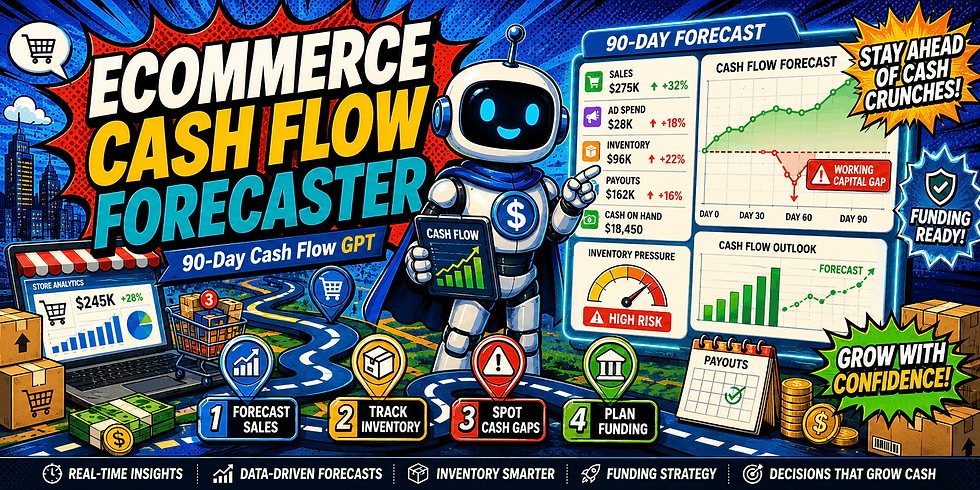
Ecommerce Cashflow Forecaster
Forecasts 90-day ecommerce cash flow, inventory pressure, & working capital gaps.
Why Most AI Finance Advice for Ecommerce Is Garbage
Most AI content aimed at ecommerce sellers falls into one of three categories:
Tool worship disguised as strategy. Lists of dashboards with zero explanation of what you are supposed to do with them.
Prompts without context. "Ask ChatGPT to analyze your business!" — using data you do not have, in a format that does not exist, for outcomes that are not defined.
Hype with no grounding in ecommerce reality. Articles written by people who have never had to decide whether to restock or make payroll.
Here is the truth:
AI works for ecommerce finance when it is tied to a specific decision, a repeatable workflow, and clean input data. It does not work when you throw a messy spreadsheet at a chatbot and hope for a miracle.
The best use cases are not sexy. They are practical:
Forecasting cash flow gaps based on order cycles, payment terms, and ad spend.
Predicting when you will run out of inventory before it happens.
Identifying when you need working capital and how much.
Organizing financial documents so you do not look like a dumpster fire when you apply for funding.
Tracking unit economics so you know which products are profitable and which ones are just keeping you busy.
AI is not going to replace your accountant. But it can help you see around corners before you hit the wall.
The Ecommerce Cash Flow Reality Framework
Most ecommerce sellers do not have a cash flow problem. They have five cash flow problems happening at once:
1. Revenue Timing Mismatch
You spend money today. Platforms pay you in 14 days. Amazon holds reserves. Shopify has payout delays. PayPal might freeze your account because someone reported a chargeback.
2. Inventory Capital Lock
You have to buy inventory months before you sell it. That cash is not liquid. It is sitting in boxes. And if it does not sell, it is not cash — it is expensive storage.
3. Ad Spend Front-Loading
Facebook and Google charge your card immediately. The sales those ads generate do not hit your account for days or weeks. Your credit card is doing all the heavy lifting.
4. Seasonal Volatility
Q4 might do 50% of your annual revenue. But you have to fund inventory buys in Q2 and Q3. If you do not have capital or credit, you miss the window.
5. Growth Requires Capital
Scaling is not free. More inventory. More ads. More overhead. More employees. More software. Growth burns cash before it generates profit.
AI finance tools help you model these dynamics, predict when the gaps will happen, and understand when you need to raise working capital before you are begging for it.
3 Actionable AI Finance Plays for Ecommerce Sellers
Play 1: Build a Rolling 90-Day Cash Flow Forecast
What it is
A living forecast that projects your cash position over the next 90 days based on order volume, ad spend, inventory buys, and platform payout schedules.
Why it works
Most sellers do not know they are running out of cash until it is too late. A rolling forecast gives you a 30- to 60-day warning before the cliff. That is enough time to secure working capital, adjust ad spend, or delay a restock.
How to do it
Step 1:
Gather your data sources.
Bank account balance
Expected revenue by week (based on order history and seasonality)
Scheduled ad spend
Upcoming inventory purchases
Recurring expenses (software, payroll, rent, fulfillment fees)
Platform payout schedules
Step 2:
Build a simple spreadsheet or Notion table with these columns:
Date
Expected revenue in
Expected expenses out
Net cash movement
Projected bank balance
Step 3:
Use AI to automate the update. Feed your weekly sales data, ad spend, and upcoming costs into a tool like Cashflow Copilot or a custom GPT trained on your business model.
Prompt example:
"I run a Shopify store doing $50K/month in revenue. Shopify pays me every Tuesday for the prior week's sales. I spend $12K/month on Facebook ads, charged daily. I have a $15K inventory restock due in 3 weeks. I have $18K in my bank account today. My recurring monthly expenses are $8K. Build me a 90-day cash flow forecast and flag any weeks where I will drop below $10K in cash."Step 4:
Review weekly. Adjust for actual sales, ad performance, and any surprises.
Step 5:
Set a funding trigger.
Example: "If projected cash drops below $10K in the next 30 days, start exploring working capital options."
Play 2: Use AI to Predict Inventory Needs Without Guessing
What it is
An AI-powered demand forecast that tells you how much inventory to order, when to order it, and how much cash you will need to fund the buy.
Why it works
Ordering too much inventory locks up cash and creates storage fees. Ordering too little causes stockouts, kills momentum, and hands your customers to competitors. AI can analyze historical sales velocity, seasonality, and trend shifts to predict demand more accurately than gut instinct.
How to do it
Step 1:
Export your sales data by SKU for the past 12 months. Include:
Units sold per week
Revenue per SKU
Seasonal spikes
Marketing campaign impact
Step 2:
Feed the data into an AI tool or custom GPT with this structure.
Prompt example:
"I sell [product category] on Amazon and Shopify. Here is my sales data by SKU for the past 12 months. Q4 typically does 2.5x my average monthly sales. I need to place my Q4 inventory order by July 1. My supplier requires a 60-day lead time. Based on this data, predict how many units of each SKU I should order, when I should place the order, and how much cash I will need to fund the purchase."Step 3:
Cross-check the AI output against:
Your supplier's minimum order quantities
Your available credit or cash
Your storage capacity
Your risk tolerance
Step 4:
Adjust for risk. If the AI says order 1,000 units and you are nervous, order 700 and plan a second smaller batch mid-season.
Step 5:
Use the cash requirement to inform your working capital strategy. If the buy is $30K and you only have $15K, start exploring funding options 60 days before the order is due.
Play 3: Build a Funding Readiness Dashboard So You Do Not Look Like Chaos When You Need Capital
What it is
A centralized system that organizes your financial documents, tracks key metrics, and makes it easy to apply for working capital, revenue-based financing, or inventory financing without scrambling.
Why it works
When you need funding, speed matters. Lenders and funding platforms want to see clean financials, consistent revenue, healthy margins, and organized documentation. If you cannot produce that in 48 hours, you lose deals or settle for worse terms.
AI can help you organize and maintain a funding-ready profile before you need it.
How to do it
Step 1:
Build a Notion database or Google Sheet with these fields:
Business legal name
EIN
Bank account information
Monthly revenue (last 6 months)
Monthly gross profit (last 6 months)
Monthly ad spend (last 6 months)
Average order value
Customer acquisition cost
Lifetime value
Top 3 SKUs by revenue
Inventory on hand (units and dollar value)
Outstanding liabilities (credit cards, loans, payables)
Step 2:
Upload your bank statements, profit-and-loss statements, and sales reports.
Step 3:
Use AI to summarize and flag any issues.
Prompt example:
"Here are my bank statements and sales reports for the last 6 months. Summarize my monthly revenue, gross profit, and cash burn. Flag any months where my expenses exceeded revenue. Identify any red flags a lender might see."Step 4:
Keep the dashboard updated weekly. Treat it like a living document.
Step 5:
When you need funding, you can export a clean summary in minutes instead of spending three days digging through chaos.
Bonus
Use a tool like Business Vulnerability Deep Dive to audit your business and identify weaknesses before a lender does.

Practical Asset: The Ecommerce Funding Readiness Checklist
Use this checklist to prepare for working capital applications, revenue-based financing, or inventory financing.
📋 Business legal name and EIN documented
📋 Last 6 months of bank statements downloaded and organized
📋 Last 6 months of platform sales reports (Shopify, Amazon, etc.)
📋 Profit-and-loss statement for the last 6–12 months
📋 Current inventory value and SKU breakdown
📋 Monthly revenue and gross profit tracked
📋 Monthly ad spend and CAC tracked
📋 Outstanding liabilities listed (loans, credit cards, payables)
📋 Top 3 revenue-driving SKUs identified
📋 Seasonal sales patterns documented
📋 Projected cash flow for the next 90 days
📋 Funding amount needed and purpose defined
📋 Backup plan if funding is delayed or denied
Reality Check: What AI Can and Cannot Do for Ecommerce Finance
AI can: | AI cannot: |
|---|---|
Organize and summarize financial data | Guarantee funding approval |
Predict cash flow gaps based on historical patterns | Replace an accountant, bookkeeper, or CFO |
Forecast inventory demand using sales velocity and seasonality | Fix a broken business model |
Identify trends you might miss manually | Predict Black Swan events (supply chain collapse, platform bans, viral competitor) |
Draft financial summaries for funding applications | Make strategic decisions for you |
Automate repetitive data entry and reporting | Overcome bad unit economics |
AI is a decision-support tool. You still need to interpret the output, apply business judgment, and take action.
And if your data is messy, your AI output will be messy. Garbage in, garbage out.
How This Connects to Ecommerce Funding and Growth
Most ecommerce sellers wait until they are desperate to seek funding. By then, they have weak cash positions, inconsistent revenue, or red flags in their financials that make lenders nervous.
AI finance tools help you avoid that spiral by:
Predicting cash shortfalls before they become emergencies
Organizing your financials so you can move fast when opportunities appear
Helping you understand your real unit economics so you do not scale unprofitable products
Giving you the data to negotiate better terms with lenders or investors
Better financial visibility means you can seek working capital proactively, at the right time, for the right reasons.
That is the difference between growth and survival mode.
If you are funding inventory with credit cards, missing restock windows because you do not have cash, or guessing at profitability, you are one bad quarter away from the cliff.
AI will not save you. But it can show you where the cliff is before you step off.
Simple Next Steps
If you are an ecommerce seller staring at lumpy cash flow, uncertain inventory decisions, or a looming capital gap, start here:


Or explore Moonshine Capital's ecommerce funding options and see what fits your growth stage. Do not wait until you are out of cash to figure out your options.
The cliff does not wait for anyone.


Comments