Primary Tradelines vs Net-30 Accounts: What Actually Builds Business Credit?

Net-30 accounts get most of the attention in business-credit circles, but the payment term is not what builds credit. Reporting does. Here’s the difference between primary tradelines, Net-30 vendor accounts, authorized-user strategies, and the accounts that actually strengthen a business credit profile.

Business-credit advice has developed its own mythology.
👉 Open five Net-30 accounts.
👉 Buy office supplies you do not need.
👉 Pay everything early.
👉 Wait for the magical PAYDEX score.
Then banks supposedly start throwing money at your LLC.
There is a piece of truth buried in there.
But Net-30 accounts are not a special class of credit that automatically builds business credit.
A Net-30 account simply describes when an invoice is due.
A primary tradeline describes the credit relationship itself.
And what actually matters for business credit building is whether a real account belonging to your business generates payment history that reaches the business credit reporting ecosystem.
Quick Answer: Primary Tradelines vs Net-30 Accounts
A primary business tradeline is a credit account for which your company is the actual borrower or account holder. Net-30 describes payment terms—usually payment due within 30 days. A Net-30 vendor account can therefore be a primary tradeline if the account belongs to your business and the vendor reports its payment experience.
Experian defines a tradeline as a reported line of credit and notes that tradeline data can show early, on-time, or late payment patterns. Dun & Bradstreet likewise uses supplier and vendor payment experiences when building portions of a company's commercial credit profile.
That distinction changes the entire conversation.
Credit Account | Primary Tradeline? | Net-30? | Can Help Business Credit? |
|---|---|---|---|
Reporting vendor account with 30-day terms | Yes | Yes | Potentially |
Reporting vendor account with Net-60 terms | Yes | No | Potentially |
Reporting business credit card | Yes | No | Potentially |
Reporting commercial loan or line of credit | Yes | No | Potentially |
Net-30 vendor that does not report | Yes as an obligation, but no reported tradeline | Yes | Not at that bureau |
Personal authorized-user card | No business-owned account | No | Primarily a personal-credit strategy |
The important word in that table is reporting.
What Is a Primary Tradeline for a Business?
A primary tradeline is a credit relationship established in the business's own name where the company is the borrower, purchaser, or responsible account holder.
That could include a vendor account, business credit card, commercial line of credit, equipment account, lease, or business loan.
The format matters less than many business-credit gurus suggest.
What matters is that:
the business actually owns the account → the business uses the credit → payment behavior is generated → the creditor reports that activity → the information becomes part of the business's commercial credit history.Experian specifically recommends establishing accounts in the business name and working with creditors and suppliers that report business payment history.
That is fundamentally different from buying access to somebody else's account history.
You are building your company's own financial reputation.
What Is a Net-30 Vendor Account?
A Net-30 account is trade credit.
Instead of requiring payment when goods or services are purchased, a vendor invoices your company and gives it a defined period—typically 30 days—to pay.
For example:
Your company buys $500 of supplies on September 1.
The vendor issues an invoice.
Payment is due within 30 days.
That is Net-30.
The exact same concept can exist as Net-15, Net-45, Net-60, or another negotiated payment term.
Dun & Bradstreet describes trade credit as a valuable form of business financing and notes that payment experiences with suppliers can contribute to a company's record of financial behavior when those experiences are reported and accepted.
Here Is the Part People Get Wrong
Net-30 itself does not build credit.
Reporting does.
You could have ten vendors happily giving your company 30 days to pay every invoice.
If none of them reports the payment experience to the commercial bureaus, those accounts may be useful operationally—but they are doing very little for the credit file you are trying to build.
That is why opening random vendor accounts is a terrible business-credit strategy.
The better question is not:
“Does this company offer Net-30?”
Ask:
“Does this company report my type of business account, which commercial credit agencies receive the data, and how frequently is it reported?”
That question eliminates a spectacular amount of Internet nonsense.
So Can a Net-30 Account Be a Primary Tradeline?
Yes.
In fact, many traditional vendor accounts used for business credit building are both.
The business is the primary account holder.
The vendor extends trade credit.
The invoice carries Net-30 terms.
The vendor reports the payment experience.
That creates a reported business tradeline.
So “Primary Tradelines vs Net-30 Accounts” is technically a false choice.
The useful comparison is:
reported primary accounts vs. non-reporting accounts.
That is where business-credit building actually happens.
What Actually Builds a Business Credit Profile?
Commercial credit files are not identical copies of one universal database.
Different business credit reporting agencies and data networks can receive information from different suppliers, lenders, card issuers, public records, and other sources.
Experian says its business reports include trade-payment information and lending relationships, while Dun & Bradstreet uses trade experiences from vendors and suppliers in products including PAYDEX.
There is another layer most “open these five vendors” tutorials barely mention: the Small Business Financial Exchange, or SBFE.
SBFE collects commercial payment-performance data from participating lenders. Its commercial credit bureau partners currently include Dun & Bradstreet, Equifax, Experian, and LexisNexis Risk Solutions. Businesses do not report their own accounts directly to SBFE; participating financial institutions contribute the data.
That means a serious business-credit strategy should eventually move beyond starter vendor accounts.
A mature commercial profile may contain payment experience from suppliers, cards, loans, lines of credit, leases, and other genuine commercial obligations.
Net-30 Accounts Are the Training Wheels, Not the Motorcycle
Net-30 vendor accounts remain useful.
They can be easier for young businesses to obtain than conventional financing, they can create actual supplier relationships, and reporting vendors may help establish initial trade history.
That makes them useful starter credit.
But there is a strange corner of the business-credit industry where entrepreneurs keep opening starter vendors forever.
That misses the point.
The objective is not to own the world's most impressive collection of office-supply invoices.
The objective is to develop a credible business credit profile that increasingly demonstrates your company's ability to manage meaningful commercial obligations.
Ideally, your credit profile evolves.
Vendor trade credit → stronger trade accounts → revolving commercial credit → financing relationships → larger commercial obligations.The credit should grow with the company.
How Net-30 Accounts Affect the D&B PAYDEX Score
The Dun & Bradstreet PAYDEX score is specifically focused on payment performance.
D&B describes PAYDEX as a dollar-weighted indicator based on Trade Experiences submitted by suppliers and vendors. Scores range from 1 to 100, and D&B states that an index of 80 reflects prompt payment according to agreed terms.
That tells you two important things.
First, reported vendor payment history matters.
Second, a PAYDEX score is not simply a counter measuring how many Net-30 accounts you opened.
The underlying payment experiences matter.
D&B also explicitly states that payment experiences it does not receive cannot be considered when calculating its business credit scores and ratings.
So if your supposedly brilliant Net-30 strategy consists of vendors that never report, you may be building excellent relationships with office-supply companies and absolutely nothing else.
Is Paying Net-30 Accounts Early Better?
Pay according to the agreement and avoid late payments.
With PAYDEX specifically, D&B indicates that an index above 80 can reflect payment ahead of agreed terms.
That does not mean every business should turn “pay everything absurdly early” into a religion.
Cash management still matters.
If a company has healthy cash flow and wants to pay suppliers ahead of schedule, fine.
But business credit exists to support the business—not to make the business sacrifice working capital simply to chase a number.
Payment consistency and financial discipline matter more than performing credit-building rituals because somebody on YouTube said “PAYDEX 100” seventeen times.
What About Authorized User Tradelines for Business Credit?
This is where personal-credit terminology often gets lazily imported into business credit.
On the consumer side, an authorized user is someone added to another person's credit-card account. If the issuer reports authorized users, account history can appear on that person's consumer credit report even though the primary cardholder remains responsible for the debt.
Experian describes authorized-user credit building in exactly that context.
That should not be confused with establishing commercial credit in your company's own name.
If someone is selling an “aged authorized user tradeline” and promising that it will magically manufacture a mature D&B, Experian Business, or Equifax commercial file, understand what you are actually buying.
A legitimate commercial credit profile is built around the business's identity and financial relationships.
For business credit, the cleaner strategy is boring but durable:
Have the company establish its own accounts. Have the company make the payments. Have legitimate creditors report those relationships.
Boring wins surprisingly often in finance.
Primary Tradelines vs Authorized User Tradelines
The difference comes down to ownership and responsibility.
With a primary tradeline, your business obtained the account and developed its own payment history.
With an authorized-user arrangement, you are piggybacking on an account primarily belonging to somebody else.
That may have legitimate applications in consumer credit.
It is not a substitute for building your company's own commercial payment history.
If your long-term goal is business financing, vendor terms, equipment financing, credit cards, or larger lines of credit, you want lenders looking at a company with real operating history—not financial cosplay.
Which Business Credit Accounts Should You Build First?
Do not start with a magic number such as “five Net-30s.”
Start with reporting.
A practical progression is to establish one or more legitimate vendor relationships your company actually needs, verify that those accounts report, pay according to terms, monitor the relevant commercial credit files, and then graduate toward stronger forms of business credit as the company qualifies.
Experian's current business-credit guidance emphasizes trade relationships, payment history, credit utilization, and ongoing monitoring rather than a single trick or account type.
The goal is not merely getting something to appear.
It is building enough real financial behavior that lenders and suppliers can evaluate the company with something better than crossed fingers.
Why Your Net-30 Account Might Not Be Helping
A vendor can extend genuine credit without reporting it to every bureau—or to any bureau.
That creates the most common frustration in business credit:
You open the account.
You buy something.
You pay the invoice.
You check the credit report.
Nothing.
That does not necessarily mean the account is fake.
It may simply mean the creditor does not furnish the information you expected, reports to a different bureau, reports on a different schedule, or has not yet furnished your account.
Experian distinguishes between newly reported and continuously reported trade experiences, reinforcing that appearing and continuing to update are separate issues.
That deeper guide explains when to check, when to follow up, and when waiting becomes a poor troubleshooting strategy.
The Business-Credit Builder Checklist That Actually Matters
Before opening another account, verify:
The account is opened under the correct business identity.
The company is responsible for the obligation.
The creditor currently reports your specific account type.
You know which business credit bureau or data network receives it.
You understand the creditor's reporting frequency.
You can actually use the account for a legitimate business purpose.
You can comfortably make every payment according to terms.
You monitor the business credit profile afterward to verify that reporting occurred.
Everything else is secondary.
A $20,000 “tradeline” that never reaches the commercial credit file is less useful for credit building than a modest real account that consistently reports responsible payment behavior.
Primary Tradelines vs Net-30 Accounts: Which Is Better?
Neither.
That is the wrong question.
A primary tradeline describes your relationship to the account.
Net-30 describes how quickly an invoice must be paid.
The strongest starter account can be both.
What you actually want is a legitimate primary business account that:
reports + updates + reflects responsible payment behavior + grows into stronger commercial credit over time.That could be Net-30.
It could be Net-60.
It could be a revolving business account.
It could eventually be a business card, line of credit, equipment obligation, or commercial loan.
Stop optimizing for account labels.
Optimize for a stronger financial profile.
Net-30 Accounts vs Other Business Tradelines
Account Type | Typical Purpose | Credit-Building Value |
|---|---|---|
Net-30 vendor | Supplies/services | Useful starter account if reported |
Net-60 vendor | Larger supplier relationship | Useful if reported |
Revolving vendor credit | Reusable purchasing capacity | Can demonstrate ongoing credit management |
Business credit card | General business spending | Potentially stronger revolving history if commercially reported |
Business line of credit | Working capital | More meaningful financing relationship |
Equipment financing | Asset purchase | Can add deeper commercial borrowing history |
Commercial loan | Larger capital need | Can demonstrate repayment of meaningful obligations |
Notice the pattern.
The reporting relationship matters more than the marketing label.
Do More Tradelines Automatically Mean Better Business Credit?
No.
More legitimate payment history can make a commercial credit file more informative. Experian specifically notes that, generally, more reporting tradelines provide more information for payment analysis.
But opening accounts just to inflate the count is not the same thing as developing strong business credit.
A lender may evaluate considerably more than a vendor count.
Depending on the financing product, underwriting can also involve revenue, cash flow, time in business, existing obligations, industry, collateral, guarantor strength, and other risk information.
Business credit helps.
It is not a cheat code that deletes underwriting.
The Better Business Credit Strategy
👉 Build credit like an operating company rather than someone trying to beat a video-game level.
👉 Establish the business correctly.
👉 Use real commercial accounts.
👉 Verify reporting before assuming anything.
👉 Pay obligations according to terms.
👉 Monitor D&B, Experian Business, Equifax, and other relevant commercial-credit data.
Then graduate from starter trade credit toward larger and more useful financing relationships. Top Vendors That Report to Dun & Bradstreet
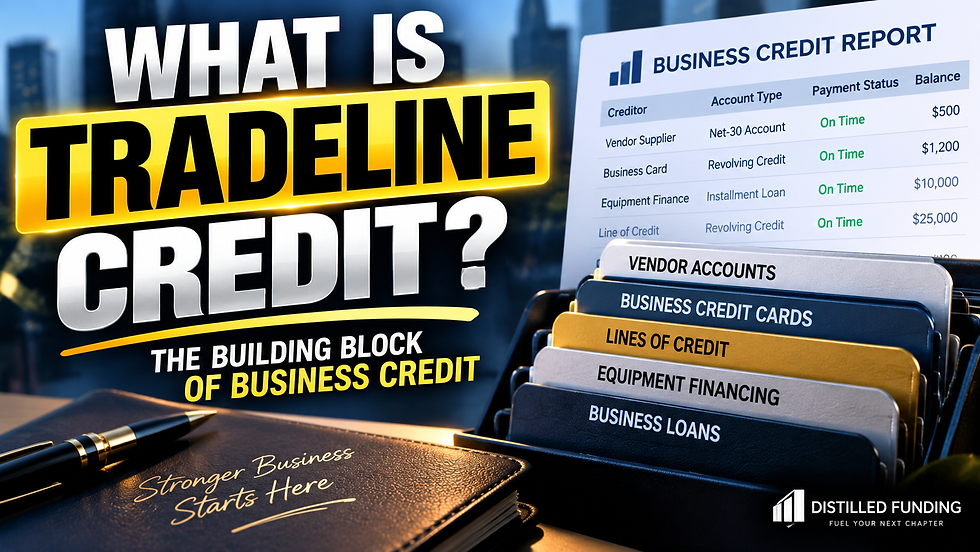
Use that resource to research vendor accounts—but verify current reporting directly before applying because creditor policies can change. What Is Tradeline Credit?
Use this for readers who need the broader tradeline terminology before comparing specific account types. What Are the Tiers of Business Credit?


Final Verdict: What Actually Builds Business Credit?
Forget the artificial fight between primary tradelines vs Net-30 accounts.
A Net-30 account can be a primary tradeline.
The account becomes useful for business credit building when it creates legitimate payment history in your company's name and that information actually reaches the commercial credit reporting system.
That is the formula:
Real business account + real obligation + real payment history + real reporting + time.
Not five magic vendors.
Not an aged tradeline somebody rented you.
Not a D-U-N-S Number sitting alone in a database.
And definitely not buying $700 worth of printer toner for a company that has never owned a printer.
Build the profile your company should have—not the one an Internet credit hack says you can manufacture overnight.
Frequently Asked Questions
Are Net-30 accounts primary tradelines?
They can be. If your business is the account holder and the vendor reports the payment relationship, a Net-30 vendor account can function as a primary business tradeline. “Net-30” refers to payment terms, while “primary tradeline” describes the company's relationship to the account.
Do Net-30 accounts automatically build business credit?
No. A vendor may extend Net-30 terms without reporting the payment history to a commercial credit bureau. Verify whether the creditor reports your account type, where it reports, and how frequently before relying on it for business credit building.
What are primary tradelines for business?
Primary business tradelines are credit relationships belonging to the company itself. Examples can include reporting vendor accounts, revolving commercial accounts, business credit cards, lines of credit, equipment financing, leases, and loans.
Do authorized user tradelines build business credit?
Authorized-user tradelines are primarily associated with consumer credit, where someone is added to another person's credit-card account. They should not be treated as a replacement for commercial credit accounts established and reported in the business's own name.
Do Net-30 accounts improve a Dun & Bradstreet PAYDEX score?
Reported supplier payment experiences can contribute to PAYDEX. Dun & Bradstreet states that PAYDEX reflects payment performance based on Trade Experiences submitted by suppliers and vendors, subject to D&B's processes. An unreported payment experience cannot contribute to the score.
Is a PAYDEX score the same as a business credit score?
PAYDEX is one Dun & Bradstreet business-credit metric focused heavily on payment performance. A business can have other scores and risk indicators from D&B and separate commercial-credit information maintained by Experian, Equifax, and other credit-risk providers.
How many Net-30 accounts do I need to build business credit?
There is no universal number that guarantees a strong business credit profile. Focus first on legitimate accounts that report, accurate business information, consistent payment history, and eventually a broader mix of useful commercial credit relationships.
What is better than Net-30 accounts for business credit?
Net-30 accounts can be useful when starting. As a company develops, reporting revolving accounts, business cards, larger supplier accounts, lines of credit, equipment financing, and other commercial obligations may create a deeper picture of how the business manages credit.
How do I know if a vendor reports to the business credit bureaus?
Ask the vendor directly which business credit reporting agencies receive your specific account type and how often information is furnished. Then monitor the appropriate business credit report to verify that the account actually appears.
Which business credit reporting agencies should I monitor?
Dun & Bradstreet, Experian Business, and Equifax are major commercial-credit sources commonly encountered by small businesses. Commercial lenders can also contribute payment data through SBFE, whose credit-bureau partners include D&B, Equifax, Experian, and LexisNexis Risk Solutions.
Additional Business Credit Resources
Building business credit is less about collecting random accounts and more about building the right reported credit relationships over time. If you want to go deeper on primary tradelines, business credit cards, credit stacking, and establishing a fundable business credit profile, continue with these guides:
Ready to move beyond the definition of a tradeline? This guide breaks down three types of primary tradeline accounts businesses can use to establish stronger commercial credit history.
Start with the bigger picture. Learn how to establish and strengthen a business credit profile, from setting up the company correctly to developing credit relationships that can support future financing.
Vendor accounts aren't the only way businesses use credit. This guide explains credit card stacking for startups, how the strategy works, and where revolving business credit can fit into a company's broader capital strategy.
Take a deeper look at using multiple business credit cards and introductory 0% APR offers as a potential source of working capital, including how the strategy differs from relying on Net-30 vendor credit.
Business credit ultimately matters because businesses need access to capital. This case-study-style guide explores an alternative path to business funding when conventional bank financing isn't available.
The bigger picture
Net-30 accounts can help establish reporting history, but they are only one part of business credit building. The goal is to progress from starter vendor relationships toward a deeper, more useful credit profile that can support larger accounts, revolving credit, and business financing.


Comments