Short Term Business Funding Explained: Quick Funding Options for Hustlers Who Need Cash Now

You’re running a business that doesn’t have time for slow banks, polite rejection letters, or “we’ll get back to you in 3–6 business centuries.” When cash gets tight, you need short term business funding that moves fast—so you can cover payroll, materials, repairs, inventory, or the random emergency that tries to take your business hostage.
This guide breaks down quick funding options, what they actually cost, what to avoid, and how to choose the right one without signing a deal that eats your cash flow alive.

Let’s cut through the noise and get real about how you can get money in your hands fast, without the usual runaround.
Quick Answer: What “Short Term Business Funding” Really Means
Short term business funding is money you can access quickly—often within 24–72 hours—designed to cover cash flow gaps (not fund your entire “someday I’ll be rich” vision board).
It’s best for:
Payroll gaps
Materials and supply purchases
Emergency repairs (vehicles, equipment)
Inventory and short-term growth pushes
Bridging slow customer payments (invoices/net terms)
It’s NOT ideal for: long-term expansions, hiring sprees, or anything that won’t generate payback fast.
Start Here: Pick the Right Quick Funding Option
If you need money in 24–72 hours:
✅ Online working capital / short-term loan
✅ Merchant Cash Advance (MCA) (fastest, often pricier)
✅ Line of credit (if you qualify)
If you’re waiting on invoices (net 30/60/90):
✅ Invoice factoring (turn invoices into cash)
If you want the “lowest cost” option:
✅ Line of credit or short-term loan (but approval can be stricter)
If your credit file is thin but revenue is solid:
✅ Revenue-based underwriting options (online lenders, some working capital products)
Want to skip the guessing and see real options?
This is the fastest way to get a realistic range based on your profile—then pick the right funding tool without wasting a week.

What Quick Funding Options Actually Mean for Your Business
Quick funding options are exactly what they sound like: ways to get money into your business quickly—often same day or within a few days. This isn’t about long-term bank loans with a 40-page application and a personality test. It’s about solving the cash gap problem when money is tied up but expenses are due.
Traditional banks want perfect credit, years of tax returns, and the blood type of your accountant. If you’re a contractor, gig worker, or solopreneur, you usually need a lender who underwrites based on cash flow and real business activity, not vibes.
Some of the most common quick funding options include:
Merchant Cash Advances (MCAs): Lump sum upfront; repayment is usually daily/weekly based on sales. Fast. Often expensive.
Short-Term Business Loans: Short repayment (typically under 12 months), quicker approvals than banks.
Invoice Factoring: Sell unpaid invoices to get cash now; the factor collects from your customer.
Online Working Capital Lenders: Fast approvals with lighter paperwork; terms vary widely.
Lines of Credit: Flexible access to funds; best for repeat needs if you qualify.
Business Credit Cards: Instant access, but interest can sting if you carry balances.
Each option has pros and cons. The key is knowing which one fits your situation without trapping you in debt you can’t handle.
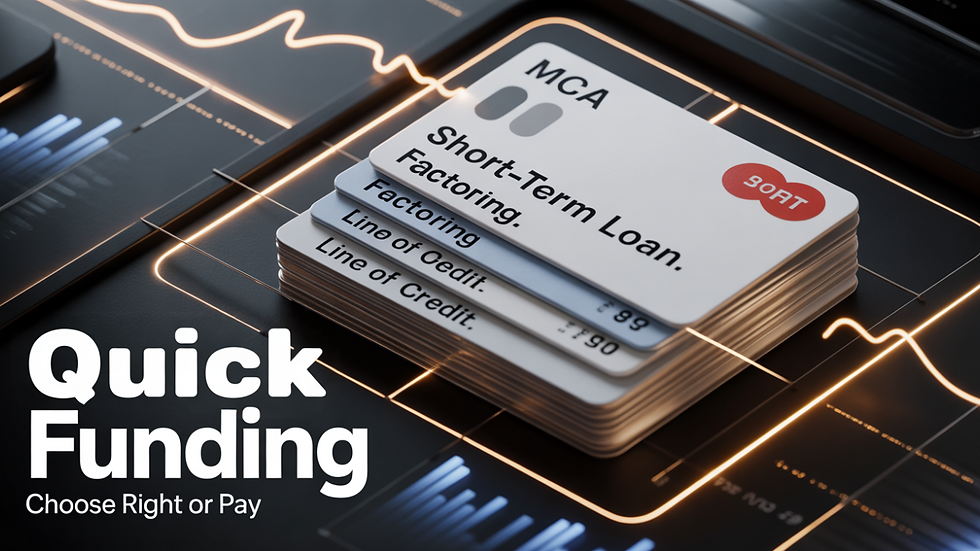
Quick Funding Options Compared (Speed, Best Use, Repayment, Watch Outs)
Option | Typical Speed | Best For | Repayment Style | Watch Outs |
|---|---|---|---|---|
MCA | Same day–48 hrs | Emergency cash, fast approvals | Daily/weekly pull | High cost, stacking risk |
Short-Term Loan | 1–3 days | Materials, payroll gaps | Daily/weekly/monthly | Fees + short payback window |
Invoice Factoring | 1–3 days | Net terms / slow-paying clients | Factor takes invoice payment | Customer-facing, fees vary |
Line of Credit | 1–7 days | Ongoing flexible needs | Only pay on what you draw | Harder approval sometimes |
Business Credit Card | Same day–few days | Small purchases, bridge gaps | Monthly | Interest if carried |
Pro move: Don’t pick based on “fastest.” Pick based on repayment fit. A daily payment can be fine for high-volume businesses—but a slow week can turn it into pain.

Quick Funding Options That Work for Trades and Gig Workers
Cash flow in the real world is messy. Contractors get paid in chunks. Gig workers get paid after the platform decides it feels like it. Solopreneurs get paid when clients remember invoices exist.
For Contractors (Electricians, HVAC, Plumbers, Builders)
You often need materials, labor, and permits before you get paid.
Net terms can crush momentum.
Examples of good-fit quick funding:
Short-term loans for materials + payroll gaps
Invoice factoring if you’re waiting on receivables
A line of credit if you have repeat cycles
Example: You land a $10,000 job but need $3,000 in materials today.
A short-term option can get you moving without losing the job—or your reputation.
For Gig Workers (Rideshare, Delivery, Mobile Services)
Your vehicle is your business. When it breaks, your income stops immediately.
Examples of good-fit quick funding:
Online working capital options based on deposits
Credit tools for emergency repairs
Micro funding options for smaller cash needs
Example: Your car needs a $1,200 repair.
Waiting a week isn’t “being patient.” It’s losing a week of income.
For Solopreneurs with Thin Credit Files
You may have consistent revenue but minimal credit history. Traditional lenders don’t love that. Many online lenders care more about bank deposits and cash flow trend.
Gig worker or solo operator and want a fast “best option” recommendation?

Instant Micro Funding GPT
Same-day business cash for the bold — unlock $300–$25,000 today with zero hassle!
Use it to sanity-check which funding path fits your situation before you apply (and before you accidentally pick a payment schedule that strangles your cash flow).
Short Term Business Funding Requirements (What Lenders Actually Look At)
Most fast lenders care less about your TED Talk and more about whether you have consistent deposits.
Common requirements:
3–6 months of bank statements (sometimes 12)
Proof of business ownership / basic entity info
Minimum monthly revenue (varies by product)
Time in business (some fund startups, many prefer 3–6+ months)
ID + basic compliance checks
Sometimes a credit pull (often soft first, depends on lender)
Reality: “Bad credit” doesn’t always kill deals—weak cash flow does.
The Real Cost of Fast Money (Fees, Factor Rates, and Red Flags)
Short term business funding isn’t evil. It’s just not free. The problem is when people don’t understand the math and get surprised later.
Fees you’ll see (and should understand)
Origination fees
Factor rates (common with MCAs)
Underwriting or processing fees
Late fees (can be brutal)
Prepayment terms (sometimes helpful, sometimes pointless)
Red flags to avoid
Stacking (multiple advances at once) unless you have the cash flow to handle it
“Too good to be true” approvals with no mention of cost
Aggressive daily payments that don’t match your deposit pattern
Hidden fees and unclear payoff terms

Prefer funding that rewards payoff discipline (instead of punishing you for needing speed)?
If you’re going to use short-term funding, structure it like a grown-up: clear payoff path, less chaos.
How to Choose the Right Quick Funding Option (Without Regrets)
Ask these five questions before you apply:
How fast do I actually need the money? (Today vs 72 hours matters.)
What’s the total cost—not just the rate? (Fees + repayment structure.)
Can I survive the repayment schedule? (Daily vs weekly vs monthly.)
What’s the purpose? (One-time emergency vs ongoing need.)
What happens if revenue dips for 2 weeks? (Reality test.)
Rule: If you don’t know how you’ll repay it, you’re not borrowing—you’re gambling.
How to Get the Best Offer Fast (In 15 Minutes of Prep)
Before applying, do this quick prep:
Pull the last 3–6 months of bank statements
Know your average monthly revenue and deposit pattern
List your exact use of funds (materials, payroll, repairs, inventory)
Confirm your business basics (entity, EIN, address, ownership %)
Decide what repayment schedule you can handle (daily/weekly/monthly)
This small prep can improve approvals and reduce the chance you get shoved into the wrong product.

FAQs
What is short term business funding?
Short term business funding is fast-access capital designed to cover immediate needs and cash flow gaps, usually repaid within weeks to under 12 months depending on the product.
How fast can I get short term business funding?
Many online options fund within 24–72 hours, sometimes same day depending on underwriting, documents, and bank verification.
Can I get short term business funding with bad credit?
Often yes—some lenders focus more on revenue and deposits than credit score. Bad credit may increase cost or narrow options.
What documents do I need?
Usually 3–6 months of bank statements, business/entity info, and ID. Some lenders request additional documents depending on the funding type.
What’s the difference between an MCA and a short-term loan?
An MCA is an advance repaid from sales (often daily) and priced with factor rates; a short-term loan is typically structured with set payments and clearer amortization.
Is invoice factoring a loan?
Not exactly. You’re selling invoices (receivables) for immediate cash. The factoring company collects from your customer.
Are daily payments risky?
They can be if your business has uneven deposits. Daily repayment works best when deposits are steady and predictable.
What fees should I watch out for?
Origination fees, processing fees, factor rates, late fees, and unclear payoff terms are the big ones.
What’s the best option for contractors?
Often short-term loans for materials/payroll or factoring if you’re waiting on invoices. The best fit depends on how you get paid and how predictable deposits are.
How do I avoid getting trapped?
Borrow only what you need, match the repayment schedule to your cash flow, and understand total cost before signing.
Get Your Best Funding Offer (Fast)
If you’re done waiting and want the fastest path to a real offer, go here:
You’ll either:
get routed to apply,
get routed to prep (so you don’t waste inquiries),
or get told “no” before you burn time chasing the wrong product.
Quick funding is a tool.
Let’s use it like one—clean, strategic, and aligned with your cash flow.


Comments