AI Content Refresh Automation: How to Update Old Funding Articles Before Rankings Rot

Old funding articles do not die. They quietly leak rankings, clicks, trust, and leads. This guide shows how AI content refresh automation can help you identify stale claims, weak snippets, outdated CTAs, internal-link gaps, and compliance risks before your best articles become SEO zombies.
Old funding articles do not usually die in a dramatic explosion.
They rot quietly.
One month, the article is pulling impressions.
Then the clicks soften.
Then the title stops matching the search intent.
Then the CTA points to an old offer.
Then the article still says “2025” like a digital fossil wearing business casual.
That is where AI content refresh automation comes in.
AI content refresh automation is the process of using AI to identify, prioritize, update, and maintain old blog content before it loses rankings, clicks, trust, and conversion value. For funding articles, that means catching stale claims, weak snippets, outdated CTAs, internal-link gaps, compliance risks, and missing answer blocks before search traffic starts ghosting you like a borrower who forgot the bank-link email.

Direct Answer
AI content refresh automation helps funding brands update old articles by scanning performance data, stale claims, outdated CTAs, weak snippets, broken internal links, and missing FAQ opportunities. It does not replace human SEO judgment, but it can speed up audits, prioritize refreshes, and turn old content into cleaner ranking, trust, and conversion assets.
At a Glance
Refresh Area | What AI Can Help Find | Why It Matters |
|---|---|---|
Search performance | Low CTR, declining clicks, stale queries | Helps prioritize articles worth saving first |
Snippet mismatch | Weak titles, vague meta descriptions, missing direct answers | Improves click potential from existing impressions |
Stale claims | Old years, outdated product language, expired offers | Protects trust and reduces compliance risk |
Internal links | Missing pillar links, orphaned spokes, weak anchors | Strengthens topical authority |
Funding CTAs | Broken, vague, or irrelevant calls to action | Turns traffic into leads instead of digital window shopping |
AI citation gaps | No definition, no summary box, weak FAQ, thin structure | Makes the page easier for answer engines to quote |
Best For / Not For
Best for
AI content refresh automation is best for:
Funding blogs with old articles that still get impressions
Broker sites with outdated “AI tools” or “business funding” posts
Fintech brands trying to improve AI citation readiness
Wix, WordPress, Notion, or Webflow blog libraries with inconsistent SEO metadata
Teams that need a repeatable refresh workflow instead of random acts of content violence
Not for
It is not ideal for:
Brand-new websites with no content history
Articles with no impressions, no links, no strategic role, and no conversion path
Pages that should be consolidated, redirected, or noindexed instead of refreshed
Teams expecting AI to magically fix bad positioning, bad offers, or bad underwriting language
AI is a power tool. It is not a priest. It cannot absolve your content sins without a human doing the work.


Why the Usual Content Refresh Advice Is Trash
Most content refresh advice sounds like this:
“Update old blog posts regularly.”
Cool. With what? A scented candle and a spreadsheet?
Generic refresh advice usually fails because it does not tell you:
Which articles to refresh first
Which pages are cannibalizing each other
Whether the issue is title, intent, freshness, structure, CTA, or trust
Whether the page should be refreshed, merged, redirected, or left alone
How to connect the refresh to revenue, funding readiness, or lead conversion
Funding content needs a sharper workflow.
A stale recipe blog post is annoying.
A stale funding article can create real trust problems. If your page mentions outdated requirements, old product claims, expired offers, unsupported “fast funding” language, or vague approval language, the issue is not just SEO. It is credibility.
And in finance-adjacent content, credibility is the whole game.
How AI Content Refresh Automation Works
The simplest version looks like this:
Pull your current content performance data.
Identify articles with ranking, impression, CTR, or conversion problems.
Use AI to audit each article for freshness, intent, structure, links, claims, and CTA gaps.
Decide whether to refresh, merge, redirect, noindex, or leave alone.
Update the content with a human review layer.
Track the article after reindexing and compare results.
That is the machine.
Not “write more blogs.”
Not “ask ChatGPT to make it better.”
Not “sprinkle keywords like SEO parmesan.”
A real refresh system turns old pages into a prioritized maintenance queue.

The 5-Part AI Content Refresh Framework
1. Find the Pages Already Showing Signs of Life
Do not start with your favorite article. Start with the data.
The best refresh candidates usually fall into one of these buckets:
High impressions, low clicks
Page-one or near-page-one ranking, weak CTR
Declining clicks over the last 3–6 months
Old articles with backlinks or internal links
Articles ranking for queries that no longer match the title
Articles with strong business intent but weak conversion paths
For Moonshine-style funding content, examples might include:
“AI tools for loan brokers”
“same-day business funding”
“business credit builder”
“ecommerce business funding”
“funding agency automation”
“AI cash flow forecasting”
“prompt engineering for finance pros”
The goal is not to refresh everything.
The goal is to find pages where improvement has leverage.
A page with impressions and low clicks is not dead. It is waving from the side of the road with a busted tire.
2. Diagnose the Real Problem
Refreshing content without diagnosis is how you end up rewriting paragraphs that were never the problem.
Most underperforming articles have one or more of these issues:
Problem | Symptom | Likely Fix |
|---|---|---|
Snippet mismatch | Impressions but weak CTR | Rewrite SEO title, meta description, intro, answer block |
Intent drift | Ranking for queries the article does not answer well | Add missing sections or retarget the page |
Freshness decay | Article references old years, tools, rates, offers, or trends | Update claims, dates, examples, and screenshots |
Thin usefulness | Article is mostly generic advice | Add workflow, checklist, examples, templates |
Cannibalization | Multiple pages ranking for the same keyword | Consolidate or assign one king URL |
Weak authority structure | No links to/from pillar pages | Add internal links and consistent anchors |
Weak conversion path | Traffic comes in but does not move | Add CTA blocks, lead magnets, calculators, or GPT assets |
Compliance risk | Funding claims are too aggressive | Soften language and clarify limits |
This is where AI helps.
Give AI the article, target keyword, search queries, current title, meta description, and internal-link map. Ask it to diagnose the page before rewriting anything.
No diagnosis, no surgery.
That is the rule.
3. Refresh for Search Intent, Not Just Keywords
Old SEO habits die hard.
The lazy move is to add the primary keyword three more times and call it a refresh.
That is not strategy. That is keyword taxidermy.
A real content refresh asks:
What is the searcher trying to do?
Are they researching, comparing, troubleshooting, applying, or buying?
Does the article answer the question in the first 100 words?
Does the H1 match the query?
Do the H2s cover the actual decision path?
Is the CTA aligned with the reader’s stage?
Does the article help a human make a cleaner decision?
For funding articles, intent often splits into four lanes:
Intent Type | Reader Question | Best Content Upgrade |
|---|---|---|
Readiness | “Can I qualify?” | Scorecard, checklist, eligibility explainer |
Comparison | “Which option makes sense?” | Pros/cons, alternatives, use-case table |
Urgency | “How fast can I get funding?” | Timeline, document checklist, next steps |
Workflow | “How do I automate this?” | SOP, prompt, CRM fields, n8n/Zapier workflow |
If the article ranks for urgency queries but reads like a philosophy essay, fix the structure.
The reader is not there for your TED Talk. They need a map.
4. Upgrade for AI Citation and Answer Engines
Search is no longer just ten blue links and a dream.
Funding content now has to be easy for Google, ChatGPT, Gemini, Perplexity, and other answer surfaces to understand, summarize, and cite.
That does not mean writing for robots.
It means making the article clean enough that a robot cannot misunderstand it unless it is actively choosing violence.
Add these elements during refresh:
A 40–60 word direct answer near the top
A clear definition in the first 100 words
An at-a-glance summary box
“Best for / not for” sections
Comparison tables
FAQ using real search phrasing
Concrete examples
Step-by-step workflow sections
Clear disclaimers around funding, underwriting, credit, tax, legal, and compliance topics
Internal links to relevant pillar and spoke articles
For example, an old article titled:
“10 AI Assistants Every Commercial Loan Broker Should Deploy in 2025”
could be refreshed into something more useful:
"AI Tools for Loan Brokers: What to Automate, What to Keep Human, and What Still Needs Review"
That moves it from a dusty roundup into an evergreen implementation guide.
Less tool worship. More operational leverage.
5. Tie Every Refresh Back to Conversion
A refreshed article should not just rank.
It should move the reader somewhere useful.
That could be:
Funding readiness scorecard
Business funding application
AI cash flow checklist
Content Refresh SOP
Broker automation pack
Custom GPT
Notion template
YouTube explainer
Newsletter signup
Funding strategy session
For funding content, the CTA should match the article’s intent.
Examples:
Article Type | CTA Match |
|---|---|
Funding readiness article | Take the Funding Readiness Scorecard |
Cash-flow article | Download the AI Cash Flow Checklist |
Broker automation article | Download the Funding Agency Automation Pack |
Ecommerce funding article | Compare ecommerce funding options |
Business credit article | Explore business credit builder resources |
SEO/content ops article | Download the Content Refresh SOP |
Traffic without a next step is just analytics cosplay.
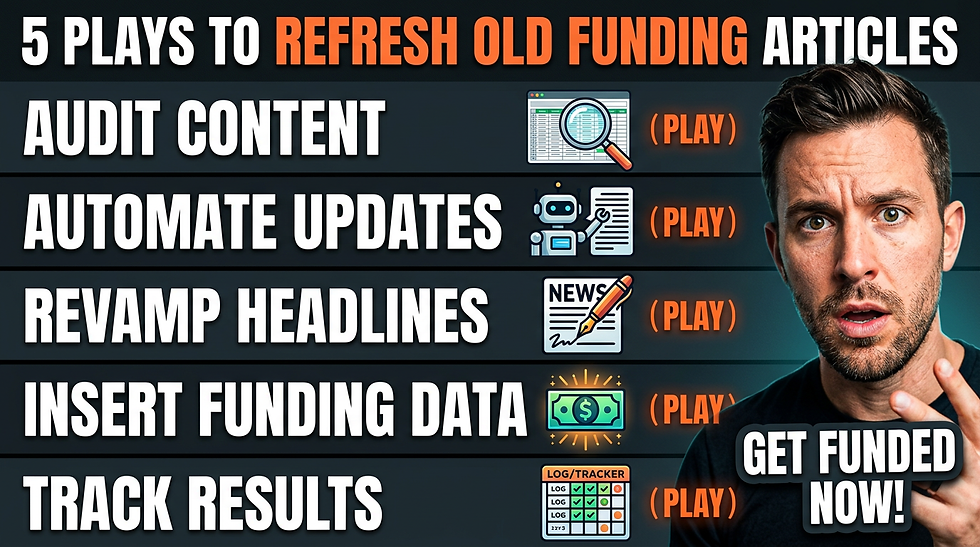
Tactical Plays: How to Use AI to Refresh Old Funding Articles
Play 1: Build a Refresh Priority List From Search Console
What it is:
A repeatable process for identifying which pages deserve attention first.
Why it works:
You do not want to refresh based on vibes. You want to refresh pages where better titles, stronger answers, or cleaner CTAs could unlock existing demand.
How to do it:
Export your Search Console data with:
Page URL
Query
Clicks
Impressions
CTR
Average position
Date range
Search appearance, where useful
Then create a simple priority score.
Suggested formula:
Refresh Priority = Impressions + Ranking Opportunity + CTA Value + Content RiskUse a 1–5 score for each factor:
Factor | Score 1 | Score 5 |
|---|---|---|
Impressions | Almost none | Strong visibility |
Ranking opportunity | Position 30+ | Position 4–15 |
CTA value | No business tie | Clear lead/funding tie |
Content risk | Evergreen and accurate | Stale, risky, outdated |
Refresh the articles with the highest combined score first.
Example:
If an old funding article ranks in position 8 with 4,000 impressions and a 0.8% CTR, that is not a “write a new article” problem.
That is a “fix the snippet before the page dies in public” problem.
Play 2: Use AI to Audit the Page Before Rewriting
What it is:
A structured AI prompt that reviews the article for SEO, intent, compliance, freshness, links, and conversion gaps.
Why it works:
AI is strong at pattern detection and checklist-based review. Let it find the mess. Do not let it make final strategic decisions without human review.
How to do it:
Use this prompt:
You are an SEO content refresh strategist for a business funding and AI finance operations blog.

Audit the article below for refresh opportunities.

Primary keyword:
[Insert primary keyword]

Current SEO title:
[Insert title]

Current meta description:
[Insert meta]

Search Console queries:
[Paste top queries]

Target audience:
[Insert audience]

Business goal:
[Insert CTA or conversion goal]

Article:
[Paste article]

Return:
1. Search intent diagnosis
2. Snippet mismatch issues
3. Outdated claims, dates, examples, tools, or offers
4. Missing H2/H3 sections
5. Weak or missing direct answer
6. Internal-link opportunities
7. CTA mismatch
8. Compliance-risk language
9. AI citation upgrades
10. Refresh recommendation: light update, heavy rewrite, merge, redirect, noindex, or leave alone
Do not ask AI to rewrite the article yet.
First, make it show you the battlefield.
Play 3: Rewrite the Title and Meta Like a Human With Rent Due
What it is:
A focused title/meta refresh for articles with impressions but low CTR.
Why it works:
Sometimes the article does not need a full rewrite. Sometimes the search result just looks like it was written by a committee trapped in a beige conference room.
How to do it:
Ask AI for 10 title options that:
Include the primary keyword
Match the search intent
Avoid hype
Stay concise
Include the specific pain point
Do not overpromise funding outcomes
Then manually choose or edit the best one.
Bad title: | “Leveraging AI for Enhanced Financial Success” |
Better title: | “AI Cash Flow Forecasting: Spot Funding Gaps Before Payroll Gets Weird” |
Bad meta description: | “Learn how AI can transform your business and help you unlock growth.” |
Better meta description: | “Use AI cash flow forecasting to spot funding gaps, payout delays, payroll pressure, and working capital problems before they turn expensive.” |
Specific beats fluffy.
Every time.
Play 4: Add the Missing Money Section
What it is:
A content upgrade that connects the article back to cash flow, funding readiness, lead conversion, or business credit.
Why it works:
Most AI articles fail because they talk about tools instead of business outcomes. Moonshine’s wedge is not “AI is cool.” The wedge is “AI helps you avoid expensive operational stupidity.”
How to do it:
Add one of these sections:
“How This Connects to Funding Readiness”
“How This Protects Cash Flow”
“How This Helps Brokers Qualify Better Leads”
“How This Helps Ecommerce Sellers Avoid a Cash Gap”
“How This Supports Business Credit Readiness”
“What to Review Before You Apply for Funding”
Example upgrade:
## How This Connects to Funding Readiness

A cleaner content system does not just help SEO. It helps business owners reach better next steps. If an article explains what documents are needed, what cash-flow signals matter, or what funding options may fit different situations, the reader is more likely to prepare before applying. That may support a cleaner funding conversation, though approval and terms still depend on the business profile and lender criteria.
That paragraph does more work than another 900 words of AI confetti.
Play 5: Create a Refresh Log So You Do Not Repeat Yourself Like a Haunted Printer
What it is:
A simple tracking system for content refreshes.
Why it works:
If you do not track what changed, you cannot tell whether the refresh helped.
How to do it:
Create a Notion, Airtable, Google Sheet, or Wix CMS support database with these fields:
Field | Purpose |
|---|---|
URL | Page being refreshed |
Primary keyword | One URL owner per keyword |
Cluster | Funding Readiness AI, Cash Flow AI, Broker Automation, etc. |
Current status | Published, refresh needed, refreshed, monitor, consolidate |
Refresh type | Light update, heavy rewrite, merge, redirect, noindex |
GSC clicks | Baseline clicks |
GSC impressions | Baseline impressions |
GSC CTR | Baseline CTR |
GSC average position | Baseline rank signal |
Primary issue | Snippet, freshness, intent, CTA, cannibalization, compliance |
Changes made | Summary of refresh |
CTA updated | Yes/no |
Internal links added | List anchors |
FAQ added | Yes/no |
Schema updated | Yes/no |
Date refreshed | Date of update |
Review again date | 30–90 days later |
Result | Improved, flat, declined, needs second pass |
This turns content into an operating system instead of a junk drawer with URLs.

Practical Asset: The Content Refresh SOP
Use this as the core workflow.
Step 1: Pull Performance Data
Export data from Search Console for the last 3 months and compare it to the previous 3 months.
Prioritize:
Pages with high impressions and low CTR
Pages with rankings in positions 4–15
Pages with declining clicks
Pages with strong business intent
Pages tied to current offers, tools, or funding products
Step 2: Assign Each Page a Refresh Decision
Use this decision table:
Situation | Action |
|---|---|
Ranking and converting well | Leave alone, monitor |
Ranking well but low CTR | Refresh title, meta, intro, answer block |
Ranking for wrong queries | Retarget structure and headings |
Multiple pages overlap | Consolidate or choose one primary URL |
Article is thin but strategic | Heavy refresh |
Article is outdated and risky | Rewrite with compliance review |
Article has no value, no traffic, no links | Consider noindex, merge, or redirect |
Article supports users but not search | Keep live, consider noindex if it competes |
Step 3: Run the AI Audit
Paste the page and performance data into your refresh audit prompt.
Ask for:
Intent diagnosis
Missing sections
Snippet mismatch
Stale claims
Internal-link opportunities
CTA issues
Compliance-risk language
AI citation upgrades
Step 4: Update the Page
Make the refresh in this order:
SEO title
Meta description
H1, if needed
First 100 words
Direct answer
At-a-glance summary
Missing H2s
Tactical examples
Internal links
CTA blocks
FAQ
Schema recommendation
Updated publish/modified date, where appropriate and truthful
Do not update the date if the content barely changed.
That is not freshness. That is putting cologne on a raccoon.
Step 5: Human Review
Before publishing updates, check:
No guaranteed funding approval language
No unsupported rates, terms, or timelines
No claims that AI replaces underwriting, legal, tax, lending, or accounting judgment
No fake testimonials or fake case studies
No deceptive urgency
No outdated partner/product claims
CTAs point to current offers
Internal links are relevant
Article still sounds human
Step 6: Monitor Results
After refresh, track:
Clicks
Impressions
CTR
Average position
Conversions or CTA clicks
Indexed status
Query changes
Pages competing for the same keyword
Review again in 30–90 days.
SEO is not a crockpot. You do not set it once and wander off forever.

AI Refresh Checklist for Funding Articles
Use this before updating any funding-related article.
SEO and Search Intent
◻ Primary keyword is clear
◻ One primary keyword maps to one primary URL
◻ Title matches current search intent
◻ Meta description is specific and clickable
◻ First 100 words define the topic clearly
◻ Direct answer appears near the top
◻ Article answers the reader’s next question
◻ H2s match real search phrasing
◻ FAQ section covers practical objections
Freshness and Trust
◻ Old years removed or updated
◻ Outdated tools removed or replaced
◻ Expired offers removed
◻ Broken links fixed
◻ Product or funding language reviewed
◻ Any current claims verified
◻ No fake stats added
◻ No unsupported “best” claims
Funding and Compliance
◻ No guaranteed approval claims
◻ No guaranteed funding claims
◻ No guaranteed income claims
◻ No promise that AI can determine final eligibility
◻ No claim that Moonshine Capital is a bank
◻ Lending, tax, legal, accounting, and underwriting limits are clear
◻ Terms may change language included where needed
◻ Eligibility varies language included where needed
Internal Links
◻ Link to business funding readiness
◻ Link to AI cash flow forecasting where relevant
◻ Link to business loan prequalification where relevant
◻ Link to n8n for loan brokers where relevant
◻ Link to funding agency automation where relevant
◻ Link to business credit builder where relevant
◻ Link to ecommerce business funding where relevant
◻ Link to same-day business funding where relevant
Conversion
◻ CTA appears above the fold or after the intro
◻ CTA appears mid-article
◻ CTA appears at the bottom
◻ CTA matches reader intent
◻ Lead magnet is relevant
◻ Form or tool link is current
◻ Article has one primary next step

AI Prompt: Funding Article Refresh Auditor
Copy and use this prompt.
You are an SEO content refresh auditor for a business funding and AI finance operations website.

Your job is to review an existing funding-related article and recommend practical refresh actions. Do not rewrite the article yet. Diagnose it first.

Context:
- Brand: [Insert brand]
- Audience: [Insert audience]
- Primary keyword: [Insert keyword]
- Target CTA: [Insert CTA]
- Current SEO title: [Insert title]
- Current meta description: [Insert meta]
- Current URL: [Insert URL]
- Search Console queries: [Paste top queries]
- Performance summary: [Clicks, impressions, CTR, average position]
- Internal links available: [Paste internal link anchors/pages]

Article:
[Paste full article]

Return the audit in this format:

1. Refresh priority score from 1–10
2. Recommended action: leave alone, light refresh, heavy refresh, merge, redirect, noindex, or split
3. Search intent diagnosis
4. Keyword cannibalization risk
5. Title and meta issues
6. Missing direct answer
7. Missing H2/H3 sections
8. Stale claims, dates, offers, or tools
9. Compliance-risk language
10. Internal-link opportunities
11. CTA mismatch
12. AI citation upgrades
13. Specific revision plan in order of execution
14. Three revised SEO title options
15. Three revised meta description options
What AI Can and Cannot Do in Content Refresh
AI can help:
Summarize old articles
Compare page content against target queries
Detect outdated years, claims, and vague language
Suggest new titles and meta descriptions
Identify missing sections
Build FAQ drafts
Find internal-link opportunities
Create refresh checklists
Convert messy notes into SOPs
Flag risky funding claims for human review
AI cannot:
Guarantee rankings
Guarantee traffic recovery
Guarantee funding conversions
Verify every current product, rate, requirement, or lender term without source review
Replace legal, tax, lending, accounting, or underwriting judgment
Decide whether a funding claim is compliant in every context
Know your private conversion data unless you provide it
Fix a bad offer, weak positioning, or broken funnel by rewriting paragraphs
The human still owns strategy.
AI just makes the audit faster, less painful, and less dependent on someone remembering which tab they left the content spreadsheet in.
Refresh, Merge, Redirect, or Noindex?
Not every old article deserves a refresh.
Some need a mercy killing.
Use this table:
Decision | Use When | Example |
|---|---|---|
Refresh | Page has rankings, links, or strategic value | Old AI broker tools article still gets impressions |
Merge | Two or more pages compete for the same keyword | Zapier vs Make and n8n vs Zapier vs Make overlap |
Redirect | Weaker page is obsolete and stronger page exists | Old 2025 tool roundup redirects to evergreen broker AI guide |
Noindex | Page is useful for users but should not compete in search | Internal resource, duplicate landing page, narrow campaign page |
Leave alone | Page performs well and remains accurate | Strong evergreen page with steady clicks and conversions |
This is where content ops gets real.
Publishing is fun. Maintenance is where adults earn their snacks.

How This Connects to Funding, Growth, and Lead Conversion
A funding article is not just a blog post. It is a trust bridge.
A business owner reads it because they are trying to understand whether they might qualify, what documents they need, how cash flow affects funding, whether business credit matters, or what type of working capital may make sense.
If that article is outdated, vague, overhyped, or poorly linked, the reader loses confidence.
If the article is clear, current, structured, and tied to the right next step, it can support:
Better funding preparation
Cleaner document collection
More informed funding conversations
Stronger lead qualification
Better business credit awareness
More useful cash-flow planning
Higher trust before a form submission
More efficient broker or partner follow-up
AI content refresh automation helps keep that trust bridge from turning into a rope swing over a compliance swamp.
Take Action: Simple Next Step
Start with 10 old articles.
Do not boil the ocean. The ocean has terrible SEO hygiene.
Pick 10 URLs with impressions, rankings, or business value. Run the AI refresh audit. Sort them into refresh, merge, redirect, noindex, or leave alone. Then update the top three articles with better titles, stronger direct answers, cleaner internal links, and current CTAs.
FAQ: AI Content Refresh Automation
What is AI content refresh automation?
AI content refresh automation is the use of AI to audit, prioritize, and update old content based on search performance, freshness, structure, internal links, CTAs, and compliance risks. It helps content teams move faster, but human review is still needed for strategy, accuracy, and funding-related claims.
How often should funding articles be refreshed?
Funding articles should be reviewed at least every 3–6 months if they mention current tools, rates, requirements, funding timelines, lender criteria, or compliance-sensitive topics. Evergreen articles can be reviewed less often, but performance drops, low CTR, or outdated CTAs should trigger a refresh sooner.
Can AI improve old blog rankings?
AI may help improve old blog performance by identifying weak titles, stale sections, missing answers, internal-link gaps, and outdated CTAs. It cannot guarantee rankings. Search performance depends on content quality, competition, technical SEO, user behavior, authority, and how well the page matches search intent.
What should I update first in an old funding article?
Start with the SEO title, meta description, first 100 words, direct answer, H2 structure, internal links, CTA, and any outdated funding claims. If the article overlaps another page, solve cannibalization before adding more content.
Should I rewrite old articles or create new ones?
Refresh old articles first when they already have impressions, rankings, backlinks, or business value. Create new articles when the topic is clearly net-new, has unique intent, and does not cannibalize an existing page. New content should not be used to avoid fixing a messy content library.
Can AI check funding content for compliance risks?
AI can flag risky phrases such as guaranteed approval, guaranteed funding, misleading speed claims, or unsupported lender language. It should not be treated as final compliance review. Funding, lending, tax, legal, accounting, and underwriting claims should still be reviewed by qualified humans where appropriate.
What is a content refresh SOP?
A content refresh SOP is a standard operating procedure for updating old articles. It usually includes performance review, page prioritization, AI audit prompts, freshness checks, internal-link updates, CTA review, schema recommendations, publishing steps, and post-refresh tracking.
How do I know if an article should be merged instead of refreshed?
Merge an article when it overlaps another stronger page, ranks for the same keyword, or splits authority across multiple similar URLs. Pick one primary URL, combine the best useful sections, update internal links, and consider redirecting the weaker page if appropriate.


Comments