Alternative Lending Software 2026: Platforms for Brokers & Funders

Alternative lending is moving fast, and the software powering it is moving faster. This guide breaks down the top platforms brokers and funders are using in 2026 — from loan origination systems to MCA tools and full-stack broker CRMs — so you can find what actually fits your operation.

Alternative lending is not just changing; it's transforming at lightning speed! The software driving this revolution is advancing even faster, reshaping the future of finance like never before.
But there is a problem with most “best lending software” lists: they compare products that are not actually built to do the same job.
A commercial loan broker shopping borrower files to outside lenders does not need the same operating system as a direct funder underwriting its own capital. An MCA shop managing daily ACH, syndication and renewals has different requirements than a fintech launching a custom revolving-credit product.
And a three-person brokerage trying to stop losing bank statements in email probably does not need to buy an enterprise lending core with 147 implementation meetings and a solutions architect named Chad.
The useful question is not: What is the best alternative lending software?
It is: What software matches the way your company actually acquires, evaluates, routes, funds and services deals?
That is what this guide is designed to answer.
Direct Answer: What Is the Best Alternative Lending Software in 2026?
The best alternative lending software depends on your operating model. For many commercial brokers and private lenders, LendingWise is one of the strongest starting points because it combines CRM, loan origination, borrower workflow, servicing and capital-provider functionality.
Centrex is particularly strong for hybrid alternative-finance businesses that may operate across brokerage, direct funding, MCA, ISOs, commissions and syndication. For Salesforce-centric lenders, FUNDINGO offers an origination-through-servicing operating system built directly on Salesforce.
TurnKey Lender and HES LoanBox are better fits for lenders that need configurable origination, underwriting, servicing and collections. LoanPro moves further toward API-first financial infrastructure and is best evaluated as a lending core rather than a broker CRM. For merchant cash advance operations, MCA Track and MCA Suite offer purpose-built workflows that generic CRMs usually do not understand.
Platform | Best For | Primary Strength | Operator Type |
|---|---|---|---|
LendingWise | Commercial brokers & private lenders | CRM + LOS + servicing + capital workflow | Broker / Hybrid |
Centrex | Brokers, funders, ISOs & syndicators | Finance-native CRM and operating system | Hybrid |
FUNDINGO | Salesforce-based lenders | Salesforce-native origination + servicing | Lender |
TurnKey Lender | Growing direct lenders | End-to-end lending automation | Lender |
HES LoanBox | Configurable lending programs | Modular architecture + customization | Lender / Fintech |
LoanPro | API-first lending programs | Lending core + servicing infrastructure | Fintech / Lender |
MCA Track | MCA direct funders | MCA servicing, ACH, syndication, renewals | Funder |
MCA Suite | MCA brokers, ISOs & funders | Submissions, commissions and syndication | Broker / Funder |
🧭 Operator rule: Do not compare platforms until you know whether you need a sales system, origination system, credit system, servicing system, or all four. That single distinction can eliminate half your vendor list before the first demo.
What Is Alternative Lending Software?
Alternative lending software is technology used to manage business financing workflows outside—or alongside—traditional bank lending infrastructure. Depending on the platform, it may support customer acquisition, borrower intake, loan origination, underwriting, lender placement, funding, servicing, payments, commissions, syndication, renewals, collections, reporting and automation.
➤ borrower acquisition and intake
➤ CRM and pipeline management
➤ loan origination
➤ document collection
➤ underwriting and decisioning
➤ lender submissions
➤ offer and stipulation tracking
➤ electronic signatures
➤ funding and disbursement
➤ ACH and repayment processing
➤ loan or advance servicing
➤ commissions
➤ syndication
➤ collections
➤ renewals
➤ portfolio reporting
➤ APIs and workflow automation
The phrase overlaps with several narrower software categories. Business lending software is the broad umbrella. Commercial lending software generally focuses on business rather than consumer credit. Loan origination software, or LOS, manages the journey from application through underwriting, approval and closing.
Loan broker software emphasizes borrower intake, lender placement, submissions, follow-up and commissions. MCA software handles merchant cash advance-specific mechanics such as factor rates, remittance, ACH, renewal eligibility and syndication. A broker CRM for lending sits somewhere between a sales platform and an origination system.
The category names overlap because the software has been converging. That makes buying decisions harder—not easier.

The Four Layers of a Modern Alternative Lending Stack
Instead of starting with vendor names, start with the jobs the software must perform.
Layer | Main Question | Typical Functions |
|---|---|---|
1. Acquisition & CRM | Where is the opportunity? | Leads, borrower records, communication, pipeline, tasks |
2. Origination & Decisioning | Should this deal move forward? | Application, documents, underwriting, scoring, approvals |
3. Capital & Placement | Where does the money come from? | Lender matching, submissions, offers, funding, syndication |
4. Servicing & Portfolio | What happens after funding? | Payments, ACH, balances, renewals, collections, reporting |
A brokerage may live heavily in Layers 1 and 3. A direct lender may need all four. A software company embedding credit into its product may care less about a traditional CRM and much more about APIs, ledger infrastructure and servicing.
💡 The Category-Mismatch Problem
A surprising amount of lending-software frustration is not caused by bad software. It is caused by buying the wrong class of software.
A broker buys an enterprise LOS and discovers that shopping a file to six funders is awkward. A funder buys a CRM and discovers that payments, balances and syndication require spreadsheets. A fintech buys a beautiful all-in-one platform and later discovers its API cannot support the product it actually wants to build.
The platform did not necessarily fail. The architecture decision did.
Broker Software vs. Funder Software

The easiest dividing line is whether your company is primarily placing capital or deploying capital.
🧑💼 Broker-Side Requirements
A commercial loan broker generally needs software that helps the team acquire, package and place opportunities. High-value capabilities include CRM, borrower intake, document collection, lender matrices, multi-lender submissions, offer tracking, follow-up automation, commission tracking and renewal reminders.
The key object is often the deal relationship: Borrower → Funding Request → Lender Submissions → Offers → Stips → Selected Offer → Commission. That is not a normal sales pipeline.
🏦 Funder-Side Requirements
A direct lender or funder inherits another layer of responsibility once its own capital enters the transaction. Now the platform may need underwriting rules, credit integrations, contract generation, disbursement, repayment processing, accounting logic, servicing, collections, portfolio analytics and audit controls.
The deal does not end at “funded.” That is when the balance-sheet work starts.
⚠️ The Hybrid Operator
Alternative finance creates plenty of businesses that sit awkwardly between those two worlds. Maybe you broker certain products. Maybe you directly fund others. Maybe outside ISOs send you transactions. Maybe syndicators participate in your deals.
That is where platforms such as Centrex become particularly interesting because the business itself does not fit neatly inside one software category.
The Best Alternative Lending Software Platforms for 2026
1. LendingWise — Best All-Around Platform for Commercial Brokers and Private Lenders
🧭 Best for: Commercial loan brokers, private lenders, hard-money lenders, CRE operators and hybrid lender/broker businesses.
⚠️ Less ideal for: Highly customized enterprise credit programs or MCA funders whose core requirements revolve around syndication and daily remittance.
LendingWise occupies one of the most useful positions in this comparison because it spans both broker and lender workflows without immediately turning into enterprise infrastructure.
Its platform combines CRM and productivity tooling with loan origination, borrower workflow, document management, automation, servicing and lending-marketplace functionality. Current public pricing starts at $119 per month, with Pro at $600, Elite at $1,595 and enterprise pricing available separately.
For a commercial brokerage, the more important benefit is architectural rather than cosmetic: the borrower, loan file, documents, workflow and capital-placement process can exist inside the same lending-oriented environment instead of being divided among a generic CRM, file folders, email threads and a lender spreadsheet maintained by whoever happens to remember the criteria.
⚙️ Where LendingWise Fits Best
Think of LendingWise as a strong candidate when the current operation sounds like this: “We have enough deal volume that email and spreadsheets are breaking down, but we are not trying to become a software company just to operate our brokerage.”
That is an important middle market. You get purpose-built lending structure without necessarily taking on the implementation burden of a full enterprise lending core.
💡 Operator Insight
Do not evaluate LendingWise only by asking whether it has the features you need. Run one real transaction through the demo: new borrower → application → missing document → lender submission → lender declines → second lender requests stips → borrower accepts offer → commission recorded.
If the platform makes that ugly path easier, it is valuable. Everybody demos the happy path. Your software makes its money on the exceptions.
Source: LendingWise platform and pricing
2. Centrex Software — Best for Hybrid Brokers, Funders, ISOs and Syndicators
🧭 Best for: Alternative-finance businesses that combine brokerage, funding, ISO relationships, commissions, servicing or syndication.
⚠️ Less ideal for: A simple brokerage that needs only lightweight CRM and lender-submission management.
Centrex is what happens when a CRM grows up inside the alternative-finance industry instead of being adapted to it afterward.
Its financial CRM is explicitly designed for brokers, funders and investors or syndicators. The platform includes multi-funder submissions, underwriting tools, payment integrations, customer portals, commission tracking, servicing functionality and syndication reporting.
That matters because many alternative-finance companies are operationally messy in ways traditional SaaS categories do not capture. A single organization might receive a transaction from an ISO, place it with an outside lender, directly fund another transaction, pay internal commissions, track a syndicator position and service an advance.
⚙️ The Real Centrex Advantage
Centrex lets the software model more of those relationships directly. Its broker and ISO management supports partner portals, submission ownership, communication triggers and multi-company management. Funder-side functionality extends into payments and portfolio servicing, while syndication functionality handles investor participation and reporting.
💡 Operator Insight
If your answer to “Are you a broker or a funder?” is “Depends on the deal,” your software architecture should know that before your accountant does.
Source: Centrex Financial CRM
3. FUNDINGO — Best for Lending Organizations Already Built Around Salesforce
🧭 Best for: CDFIs, small-business lenders, commercial real estate lenders, banks, credit unions and alternative lenders already committed to Salesforce.
⚠️ Less ideal for: Small independent brokerages that do not otherwise need the Salesforce ecosystem.
FUNDINGO follows a very different strategy from most products in this guide. It does not ask the lender to abandon Salesforce. It turns Salesforce into the lending operating system.
FUNDINGO currently positions the platform around loan origination, underwriting and servicing on Salesforce, with workflows for small-business lending, CDFIs, banks, credit unions and commercial real estate. Applications, documents, credit analysis, approvals, closing, ACH, draws, payoffs and portfolio reporting can remain tied to the same underlying Salesforce record.
⚙️ Why the Architecture Matters
One of the hidden costs of lending technology is system duplication. Marketing owns one contact record. Sales owns another. Origination creates another. Servicing gets its own account record. Then somebody builds a “360-degree customer dashboard” to reconcile the four databases everyone bought because none of them talked to each other.
A Salesforce-native lending layer can reduce that duplication.
💡 Operator Insight
This is less about whether FUNDINGO has the prettiest LOS screen and more about whether Salesforce is already strategic infrastructure. If Salesforce is deeply embedded in your operation, replacing it may create more integration debt than the new LOS eliminates. If Salesforce is not already part of your business, however, FUNDINGO means you are evaluating both a lending platform and an ecosystem decision.
4. TurnKey Lender — Best for End-to-End Lending Automation
🧭 Best for: Direct lenders, embedded-finance programs and fintech operators that want origination, underwriting, servicing and collections under one roof.
⚠️ Less ideal for: Pure broker businesses whose core workflow is lender placement rather than owning the credit lifecycle.
TurnKey Lender is positioned as full-cycle lending infrastructure rather than broker software.
Its platform covers digital application workflows, loan origination, underwriting, credit-risk management, servicing, payments, collections, reporting, KYC/AML and configurable commercial credit products. The company also advertises more than 75 preconfigured integrations across data providers and supporting systems.
⚙️ Where It Creates Leverage
A direct lender may otherwise stitch together separate tools for application intake, underwriting, decisioning, servicing, collections and reporting. TurnKey Lender’s value proposition is that those stages can live in a single configurable system.
That reduces handoffs. But it also makes the implementation more consequential. If your credit policy, exception handling and data model are poorly defined before implementation, software will not magically fix them. It will encode the ambiguity. Faster.
⚠️ Important AI Question
TurnKey Lender markets substantial automated and AI-driven credit decisioning capabilities. That makes governance questions particularly important during diligence.
What exactly is automated?
Which variables influence the decision?
Can a human override it?
Is the reason for a decision visible?
How are policy changes versioned?
What audit history remains afterward?
“AI underwriting” is not a feature specification. It is the beginning of a much longer conversation.
Source: TurnKey Lender platform overview
5. HES LoanBox — Best for Configurable Commercial Lending Workflows
🧭 Best for: Alternative lenders and fintechs that need modular architecture, flexible deployment, partner channels and deeply configurable workflows.
⚠️ Less ideal for: Operators looking for an inexpensive plug-and-play brokerage CRM.
HES LoanBox is designed as a configurable foundation rather than a rigid lending template.
The platform spans onboarding, origination, loan management, servicing and collections, while emphasizing open APIs, configurable modules, multiple deployment options and audit-ready workflows.
One capability particularly relevant to alternative lending is its explicit support for broker and agent distribution. Its onboarding architecture supports borrower self-service, staff-assisted applications, partner-originated applications and API-driven intake from external products.
That makes the platform more interesting when distribution itself is multi-channel.
⚙️ Why Configurability Matters
Alternative lending companies often believe they want customization because customization sounds sophisticated. What they actually need is controlled flexibility.
You want to be able to launch a new product, modify an approval path, add a data source or change an application workflow without rebuilding the platform. You do not want every minor operating change to become a six-week development ticket.
💡 Operator Insight
During the demo, do not ask: “Can you customize this?” Every enterprise vendor on earth has learned to say yes. Ask: “Show me the exact administrative change we could make ourselves versus what would require your development team.” That answer is far more valuable.
Source: HES LoanBox platform
6. LoanPro — Best for API-First Lending Infrastructure
🧭 Best for: Fintechs, sophisticated commercial lenders, embedded-credit programs and operators that need APIs, configurable product logic, servicing, payments and collections.
⚠️ Less ideal for: A small brokerage whose primary needs are CRM, borrower follow-up and lender submissions.
LoanPro is infrastructure.
Its commercial-lending platform combines an origination suite, modern lending core, servicing, collections and payments. It supports business loans, lines of credit and other credit structures through an API-first architecture designed for configurable lending programs.
LoanPro also says more than 25 million loans currently run on the platform, which gives useful context for the scale it is targeting.
Why It Matters in Alternative Lending
The more custom your credit product becomes, the less attractive a rigid LOS can become. Maybe you need custom repayment logic. Maybe your lending product sits inside another SaaS application. Maybe you want a revolving facility rather than a standard term loan. Maybe servicing events must trigger workflows elsewhere in your product.
LoanPro is built for that territory. Its commercial platform emphasizes API-first architecture, configurable credit products, servicing automation, collections and integrated payment capabilities.
🤖 AI and Agentic Infrastructure
LoanPro is also a useful example of where lending software is going. The software decision you make in 2026 is increasingly also a data-access and automation decision.
A system with strong APIs can participate in AI workflows, internal copilots, agentic systems, custom reporting, external decision layers and whatever your operating stack becomes next. A closed system may work perfectly today and still become tomorrow’s bottleneck.
💡 Operator Insight
LoanPro is the clearest example in this list of why a broker CRM and lending core should not be ranked against one another as if they solve the same problem. One organizes an intermediary business. The other can become part of the financial infrastructure beneath the credit product itself.
Comparing them based on who has the nicer dashboard misses the entire architecture decision.
⚠️ Watch For
Powerful APIs create value only when your company has the technical capacity—or an implementation partner—to exploit them. Infrastructure you cannot operate is just expensive potential energy.
Source: LoanPro Modern Lending Core
Best MCP Servers for Lending & Loan Brokers in 2026
See how lending platforms are beginning to expose origination, servicing, credit-risk and workflow capabilities to AI agents.

7. MCA Track — Best for Direct MCA Funders
🧭 Best for: Merchant cash advance funders, syndicators and MCA businesses that need servicing infrastructure after the deal funds.
⚠️ Less ideal for: General commercial brokers whose business spans many products and only occasionally touches MCA.
Merchant cash advance operations create software requirements that generic CRMs were never designed to understand.
The workflow does not stop when a merchant signs. Now you may be tracking ACH debits, returns, balances, remittance behavior, broker payouts, renewal eligibility, syndicator positions and collection activity.
MCA Track is built around those mechanics. The company describes its platform as managing the complete MCA lifecycle from application intake and underwriting through funding, ACH repayment, syndication and renewals, with white-label access for funders, ISOs, brokers and syndicators.
⚙️ The Important Part Is After Funding
Generic CRM software is usually very good at answering: Did we close the deal? An MCA servicing platform must answer: What has happened to the money every day since we closed the deal?
That is a different data model. Once outside syndicators participate, the accounting relationships become even more important.
💡 Operator Insight
If you are a direct funder, demo servicing before CRM. Ask the vendor to show: payment failure → return → balance adjustment → syndicator impact → collections workflow → renewal eligibility.
That sequence is far more revealing than watching somebody drag a lead between pipeline columns.
8. MCA Suite — Best for MCA Brokers, ISOs and Funders Managing Submissions
🧭 Best for: MCA brokers, ISOs and funding companies that need lender submissions, offer tracking, commissions and syndication functionality.
⚠️ Less ideal for: Complex multi-product commercial lenders seeking enterprise-grade credit architecture across many lending products.
MCA Suite is another purpose-built MCA platform, but its submission workflow makes it particularly relevant to brokers and ISOs.
The platform allows users to send merchant files and stipulations to multiple funders and track each submission’s status, offers and outstanding requirements from a centralized screen.
That sounds simple until you compare it with the actual broker workflow. A merchant may be submitted to several funders. Each funder may respond differently. One wants updated statements. Another offers a lower amount. Another declines. Another changes terms after additional review. Now multiply that by 100 active transactions.
That is why submission tracking is not a decorative feature. It is core broker infrastructure.
MCA Suite also supports broker commissions and deal syndication, including payable and receivable commission tracking and syndicator participation.
💡 Operator Insight
For an MCA brokerage, evaluate the platform around this object chain: Merchant → Application → Funder Submissions → Offers → Stips → Selected Offer → Commission → Renewal.
If the software can model that cleanly, it understands your business. If you need eleven custom objects and a Zapier ritual to recreate it, you are probably forcing the wrong software to behave.
Source: MCA Suite submission tracking
Which Platform Fits Which Operator?
Instead of ranking the eight platforms from one through eight, use your operating model.
Your Operation | Start With |
|---|---|
Independent commercial broker | LendingWise |
Hybrid broker + funder | Centrex |
Salesforce-based lending organization | FUNDINGO |
Direct multi-product lender | TurnKey Lender / HES LoanBox |
API-first fintech credit program | LoanPro |
MCA direct funder | MCA Track |
MCA broker / ISO | MCA Suite / Centrex |
Partner-heavy lending channel | HES LoanBox / Centrex |
This is not a ranking of software quality. It is a ranking of architectural fit. That distinction will save you more money than another feature-comparison spreadsheet.

The 100-Point Alternative Lending Software Scorecard
This is where most software comparison articles stop being useful. A feature list tells you what exists. A scorecard forces you to decide what matters. Use this before demos.
Category | Weight | What You Are Evaluating |
|---|---|---|
Workflow fit | 20 | Does it model your real deal lifecycle? |
Product fit | 15 | Does it natively support your financing products? |
Integrations & API | 15 | Can it connect to the rest of your stack? |
Servicing / post-funding capability | 10 | Can it handle what happens after close? |
Broker / partner workflows | 10 | Portals, submissions, commissions, ISO relationships |
Data ownership & portability | 10 | Can you access and export your own operational data? |
Automation | 5 | Rules, triggers, workflows, webhooks |
Reporting | 5 | Pipeline, portfolio and management visibility |
Security / auditability | 5 | Roles, logs, controls, governance |
Implementation burden | 5 | Cost, timeline and internal resources required |
🎯 Scoring Rule
Score each category from 1–5, then multiply by the category weight. But add one hard rule: a platform that fails a mission-critical requirement does not win because its average score is pretty.
If you require MCA syndication and the software does not support it, a 91/100 score is meaningless. If your embedded credit product requires real-time APIs and the vendor only supports nightly exports, it is not your platform.
Weighted averages are useful. Hard constraints still exist.
The Demo Test Most Buyers Skip
Do not let the vendor choose the entire demo. Their sales engineer has performed that workflow 300 times. Of course it looks beautiful. Give them your ugly scenario.
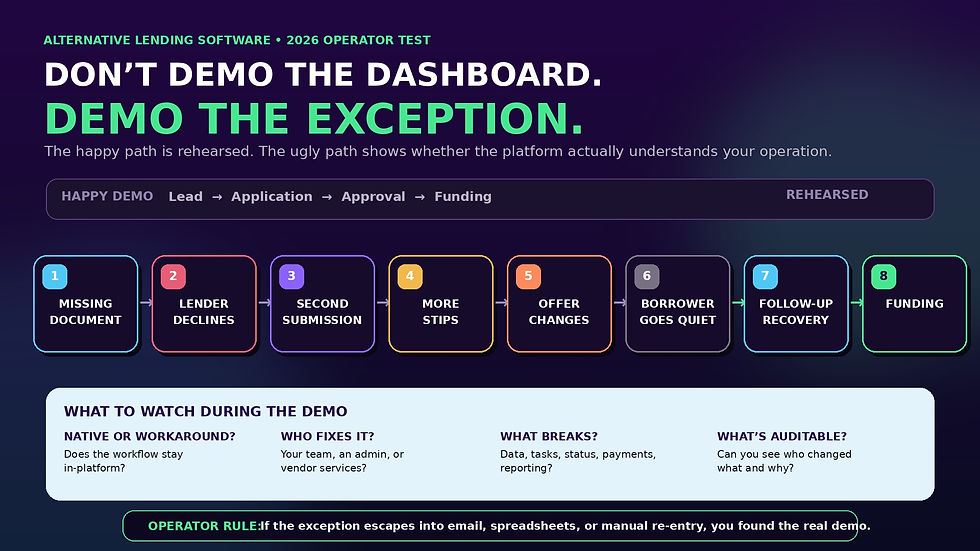
For a Broker
A borrower submits incomplete documents, one lender declines, another requests additional stips, a third changes its offer, and the borrower goes silent for five days.
For a Funder
A payment fails, the borrower requests a change, an internal exception is approved, the account enters collections and a syndicator needs updated reporting.
For a Fintech
A new product configuration requires different repayment logic, a new external data source and a new API-triggered customer experience.
Then watch what happens. Does the platform handle the exception natively? Does somebody have to leave the platform? Does the workflow require manual re-entry? Does an administrator make the change? Does the vendor need professional services?
That is your real demo.
The Hidden Cost: Implementation Debt
The monthly subscription is not the true cost of lending software.
Total Cost = Software + Implementation + Integration + Migration + Training + Ongoing Administration + Workarounds + Exit Cost
The last two get ignored constantly.
🧩 Workaround Cost
Every missing capability eventually becomes one of the following:
a spreadsheet
a manual reconciliation
another SaaS tool
custom middleware
an employee doing copy-paste work
an automation nobody wants to touch because its creator left years ago
That cost does not appear on the invoice. It still exists.
🚪 Exit Cost
Ask how your data leaves the platform. Not just: “Can we export contacts?” Ask whether you can export borrowers, businesses, applications, loan data, payment history, lender submissions, documents, notes, activities, commission records, syndication records, custom fields and audit history.
Then ask what format you get. “Your data belongs to you” sounds great until it arrives as 37 unrelated CSV files and a zip folder called documents_final_v7.
API-First Is Not Automatically Better
APIs have become a status symbol in fintech. They matter. But an API is useful only when there is something valuable on the other side of it.
A small brokerage with four users and a straightforward process may get more value from a configurable all-in-one platform than from a gorgeous API reference. A fintech embedding credit into its own software may reach exactly the opposite conclusion.
🔌 Ask Better API Questions
Do not ask: “Do you have an API?” Ask questions that expose whether the API is infrastructure or brochureware.
Can we create and update borrowers?
Can we create applications?
Can we retrieve documents?
Can we read underwriting status?
Can we trigger workflows?
Can we receive webhooks when states change?
Can we access payment and servicing events?
Are there rate limits?
Is there a sandbox?
Which capabilities exist in the API but not the UI—and vice versa?
27 AI Tools Every Loan Broker Should Know in 2026
Lending software is only one part of the stack. Explore the AI, CRM, document, automation and operations tools brokers can layer around it.

AI Readiness Is Becoming a Software Requirement
The next generation of lending software will not only be used by people clicking dashboards. It will increasingly be used by AI copilots, workflow automation, APIs, internal agents, reporting systems, document intelligence and lender-fit engines.
That changes the buying criteria. You should care about whether the system exposes structured data, whether actions are available programmatically, whether permissions are granular and whether automated activity leaves an audit trail.
The question is not whether the vendor has placed “AI” somewhere on its homepage. The question is: Can our future automation safely read from and act on this system without creating a second shadow database?
That is a much higher bar.
One Source of Truth Per Domain
This is one of the most important operating principles in the entire article. Do not let five tools own the same fact.
CRM owns: opportunity stage, relationship and next action.
Lender matrix owns: lender criteria and product availability.
Document system owns: borrower files and document state.
LOS owns: application, underwriting and approval state.
Servicing platform owns: balances, payments and account activity.
Accounting system owns: financial books.
Automation layer owns: movement between systems—not the underlying truth.
The problems begin when HubSpot says the deal is “Approved,” the LOS says “Conditional,” the spreadsheet says “Submitted” and the processor says: “I think Steve is handling it.”
The goal is not one tool for everything. The goal is one authoritative home for each important fact.
Do You Even Need Dedicated Lending Software Yet?
Not every brokerage does. A smaller operation can run surprisingly well with a disciplined modular stack: CRM + application + document storage + lender matrix + automation + reporting.
That may be enough. Purpose-built lending software starts creating disproportionate value when operational complexity increases.
You should seriously evaluate it when deal information is being entered multiple times, lender submissions are difficult to track, documents are scattered, commissions require manual reconciliation, nobody knows why deals are stalled, partner channels are growing, or your company has begun funding and servicing its own transactions.
💡 The Better Buying Trigger
Do not buy new software because “we are growing.” Buy it because you can identify a measurable operational constraint.
Examples: “Every funded deal requires 42 minutes of duplicate data entry.” “We lose 18% of applications during document collection.” “Two people spend Friday reconciling commissions.” “We cannot reliably tell which lender has which version of the file.”
Now software has an economic target. That is much easier to justify.
Build vs. Buy: When Custom Infrastructure Actually Makes Sense
Most funding companies should not build their own LOS. That is not because custom software is impossible. It is because lending infrastructure contains far more edge cases than the original product brief usually admits.
Payments. Reversals. Documents. User permissions. Audit logs. Credit rules. Exceptions. Account changes. Calculations. Disclosures. Servicing adjustments. Collections. Data migrations.
The “simple internal platform” gets interesting fast.
🛠️ Build Around the Core Before Rebuilding the Core
A stronger model for many operators is: Buy commodity infrastructure. Build your proprietary advantage around it.
Buy the CRM, LOS or servicing engine. Build the lender-routing logic. Build the scoring layer. Build the referral workflow. Build your internal intelligence. Build the borrower experience that differentiates you. Build the data model your team understands better than anyone else.
That gives you ownership where ownership creates leverage.
A 30-Day Software Evaluation Sprint
Do not start with vendor demos. Start with your current operation.
Week 1 — Map
Document the actual transaction lifecycle from lead to funding and beyond. Identify each system, spreadsheet, manual handoff and source of truth. Find the five places where work gets lost, duplicated or delayed.
Week 2 — Requirements
Separate your requirements into Must have, Useful, Future and Do not care. This prevents a vendor from winning because it has 200 features you never asked for.
Week 3 — Controlled Demos
Give each finalist the same real-world scenarios. Score them using the 100-point framework. Record unresolved questions instead of accepting “yes, we can do that.”
Week 4 — Economics
implementation cost
migration effort
integration cost
administration
time saved
errors reduced
headcount avoided
revenue capacity gained
exit cost
Then make the decision. Software should improve the economics of the operation. Otherwise you just bought nicer screens.
Red Flags During an Alternative Lending Software Demo
🚩 Everything requires professional services. Configuration is good. Dependency is not.
🚩 The salesperson cannot explain data export. That question should not be mysterious.
🚩 The API exists but key business objects are missing. A partial API may not solve your integration problem.
🚩 The software cannot model one-to-many lender submissions. For brokers, this can be a structural problem.
🚩 Servicing is treated as an afterthought. For funders, servicing is the operation after origination.
🚩 AI claims are stronger than the audit controls. If a platform automates consequential decisions, you should understand how the decision is produced and reviewed.
🚩 Every workflow looks perfect in the demo. Ask to break something.
The Bigger 2026 Shift: Lending Software Is Becoming an Operating Layer
The most interesting change in lending technology is not another dashboard. It is convergence.
CRM, origination, decisioning, documents, payments, servicing, APIs and AI are moving closer together. That changes where competitive advantage lives.
The advantage is increasingly not: “We bought software.” Everybody can buy software.
The advantage is: We designed a better operating system around the software.
The broker who knows which deals to prioritize. The lender whose criteria stay structured and current. The team whose documents arrive complete. The operator whose data does not get trapped in employee inboxes. The company whose automations remove administrative labor without quietly automating consequential mistakes.
That is the real technology moat.
Final Verdict
There is no universal winner in alternative lending software. There are better architectural matches.
LendingWise is a strong starting point for commercial brokers and private lenders that want a purpose-built lending environment without jumping directly into enterprise infrastructure. Centrex deserves serious consideration for alternative-finance businesses whose operations span brokerage, funding, ISOs, commissions, servicing and syndication.
FUNDINGO is strategically compelling when Salesforce is already the organization’s operating backbone. TurnKey Lender is designed for lenders that want substantial end-to-end automation across the credit lifecycle. HES LoanBox stands out where configurability, partner channels, deployment flexibility and API access matter.
LoanPro moves beyond traditional LOS thinking into API-first lending infrastructure for sophisticated lending and embedded-credit programs. MCA Track is particularly relevant for direct MCA funders that need purpose-built post-funding operations. MCA Suite is compelling for MCA brokers and ISOs managing multi-funder submissions, commissions and syndication workflows.
Choose the software that matches how money, data and responsibility actually move through your company.
Not the platform with the longest feature list. Not the one with the coolest AI demo. Not the one your competitor bought. Map the operation first. Then buy the machine.
Frequently Asked Questions
What is alternative lending software?
Alternative lending software is technology used by non-bank lenders, commercial finance companies, loan brokers, MCA funders and fintech platforms to manage activities such as borrower intake, CRM, loan origination, underwriting, lender placement, servicing, payments and portfolio management.
What is the best alternative lending software for commercial loan brokers?
LendingWise and Centrex are strong candidates for commercial brokers because both are designed around lending workflows rather than generic sales pipelines. The better fit depends on product mix, lender-submission requirements, servicing needs and whether the company also funds transactions directly.
What is the difference between a broker CRM and loan origination software?
A broker CRM focuses primarily on relationships, pipeline, communication, lender submissions and sales workflow. Loan origination software manages the credit process from application through underwriting, approval and closing. Some alternative lending platforms now combine both.
What software do MCA funders use?
Purpose-built MCA platforms include MCA Track, MCA Suite and Centrex. These systems support MCA-specific workflows such as factor-rate structures, ACH repayment, broker commissions, renewal tracking and syndication that generic CRMs may not model natively.
Can HubSpot or Salesforce replace lending software?
Sometimes. A broker can run a capable operation on a general CRM when the primary needs are lead management, communication, pipeline and workflow automation. Dedicated lending platforms become more valuable as underwriting, lender submissions, servicing, payments, partner management and compliance complexity increase.
How much does alternative lending software cost?
Pricing varies dramatically. Broker-oriented platforms may begin in the low hundreds of dollars per month, while enterprise lending platforms often use custom pricing based on users, modules, volume, implementation and integrations. Total operating cost is usually more meaningful than the subscription price alone.
What should loan brokers look for in lending software?
Loan brokers should focus on borrower intake, lending-specific CRM, document management, lender records, multi-lender submissions, offer tracking, follow-up automation, commission tracking, reporting, partner portals, integrations and data portability.
What should direct lenders look for?
Direct lenders should add underwriting, decisioning, funding, payments, servicing, collections, portfolio reporting, audit controls and appropriate compliance infrastructure to the evaluation.
Does alternative lending software use AI?
Many lending platforms now include AI, machine-learning or automation capabilities for tasks such as credit analysis, workflow routing, document processing, servicing and collections. Buyers should evaluate exactly what the AI does, which data it uses, how decisions can be reviewed and whether consequential actions remain auditable.
Should a lender build its own software?
Usually not the entire lending core. Custom development makes more sense around proprietary workflow, routing, data, borrower experience or decision-support layers when those capabilities create strategic differentiation. Commodity infrastructure is often cheaper and safer to buy.
Build the Operating System Around the Software
Software alone is not the moat. The advantage comes from the workflow, lender knowledge, review rules, data structure and operating discipline wrapped around it. If you are building a funding capability rather than just shopping for another dashboard, move from tool selection into operating-system design.
Additional Resources
This article is for informational and operational-planning purposes only. Product features, pricing, integrations and availability can change. Verify current vendor documentation and evaluate legal, compliance, security and operational requirements before implementation.

Comments