AI for Business Loan Brokers: What to Automate, What to Keep Human, and What Can Get You in Trouble

AI is changing how business loan brokers work — but not everything should be handed off to a machine. This guide breaks down which tasks AI handles best, where human judgment still wins, and the compliance landmines you need to avoid before you automate anything.

AI for business loan brokers is not about replacing the broker. It is about replacing the chaos.
★ The missed follow-up.
★ The lead sitting untouched in the CRM like a sad little orphan.
★ The borrower who never sent bank statements.
★ The file that died because nobody remembered to ask for the updated driver’s license.
★ The lender submission that looked like it was assembled during a gas station tornado.
That is where AI can help. But here is the part the software bros do not put in the demo: lending is not a toy category. You are dealing with money, trust, business survival, sensitive documents, repayment pressure, underwriting decisions, and sometimes desperate people trying to keep the lights on.
So yes, AI can make business loan brokers faster. It can also make bad brokers louder, sloppier, and more dangerous.
This guide breaks down what business loan brokers should automate, what should stay human, and what can get you in trouble if you let the robot run around the funding shop with scissors.
Direct Answer: How Should Business Loan Brokers Use AI?
AI for business loan brokers works best when it supports
➤ lead intake
➤ CRM updates
➤ follow-up reminders
➤ document checklists
➤ deal summaries
➤ pipeline visibility
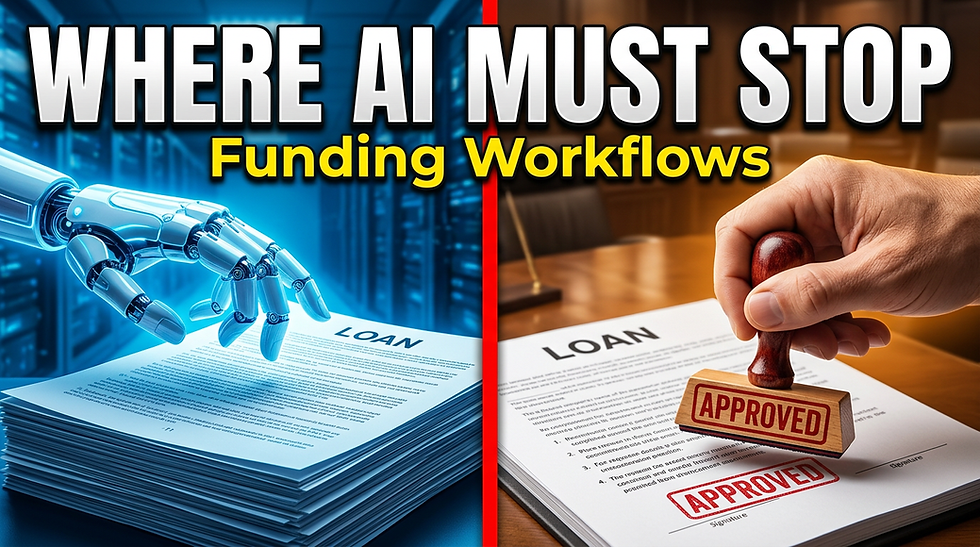
Brokers should keep human judgment involved in borrower fit, lender selection, pricing conversations, compliance-sensitive communication, and final recommendations. AI should assist the broker, not impersonate the broker.
At a Glance: AI for Business Loan Brokers
Area | Should You Automate It? | Human Review Needed? |
|---|---|---|
ℹ️ Lead intake summaries | Yes | Light review |
ℹ️ CRM notes and tagging | Yes | Light review |
ℹ️ Follow-up reminders | Yes | Light review |
ℹ️ Document checklist creation | Yes | Yes |
ℹ️ Deal summaries | Yes | Yes |
ℹ️ Borrower fit assessment | Partially | Always |
ℹ️ Lender matching | Partially | Always |
ℹ️ Pricing conversations | No full automation | Always |
ℹ️ Approval or denial language | Be extremely careful | Always |
ℹ️ Legal documents or disclosures | No blind automation | Always |
ℹ️ Sensitive borrower data handling | Only with secure systems | Always |
The sweet spot is simple:
Automate the admin.
Assist the analysis.
Human-review the money talk.
Audit everything.
That is the broker AI doctrine.
Why Generic AI Advice Fails Business Loan Brokers
Most AI advice sounds like it was written by someone whose closest experience with lending was financing a gaming chair.
“Use ChatGPT to write emails.”
Cool. Thanks, Professor Obvious. 🥴
Business loan brokers do not just need better emails. They need cleaner workflows.
They need:
🚨 Faster lead response
🚨 Better borrower intake
🚨 Cleaner CRM stages
🚨 Fewer missing documents
🚨 Better lender-fit notes
🚨 Better follow-up discipline
🚨 Better deal summaries
🚨 Fewer dead files
🚨 Less manual copy-paste misery
🚨 Better visibility into which deals are real and which deals are cosplay
The average broker does not lose money because they forgot AI exists. They lose money because the pipeline leaks.
⚠️ A borrower fills out a form and nobody responds for six hours.
⚠️ A processor asks for docs but never follows up.
⚠️ The broker forgets which lender wanted what.
⚠️ The client ghosts because the next step was unclear.
⚠️ The CRM becomes a digital cemetery where “hot leads” go to become historical artifacts.
That is where loan broker automation gets useful.Not as a shiny AI trick. As pipeline plumbing.
The Wrong Automation Makes You Faster at Being Wrong
AI does not fix a broken business process. It accelerates it.
If your intake process is sloppy, AI will help you collect sloppy information faster. If your follow-up is vague, AI will help you send vague messages at scale. If your lender matching is weak, AI will help you confidently recommend the wrong direction with more professional formatting.
That is not automation. That is a high-speed faceplant with branding.
Before business loan brokers automate anything, they need to separate the workflow into three zones:
Tasks AI can safely automate
Tasks AI can assist but humans must approve
Tasks AI should not handle without serious oversight
That is the difference between building a funding machine and building a compliance piñata.
What Business Loan Brokers Should Automate With AI
AI is excellent at repetitive, text-heavy, rules-based, admin-heavy broker work.
If a task requires sorting, summarizing, reminding, routing, drafting, comparing, or checking for missing information, AI may help.
If a task requires trust, judgment, lender relationship knowledge, compliance nuance, or a difficult conversation, do not fully hand it to the machine.
Let’s break it down.
1. Lead Intake and Pre-Screening
AI lead generation for brokers should not mean blasting spam messages into the void and praying somebody with a pulse clicks. The better use case is lead intake and pre-screening. When a borrower submits a form, AI can help summarize the deal quickly:
Business name
Industry
Monthly revenue
Time in business
Funding amount requested
Use of funds
Existing debt
Credit range
Urgency level
Missing information
Possible product fit
Potential red flags
Instead of opening a raw form submission and playing “Where’s Waldo: Underwriting Edition,” the broker gets a clean snapshot.
Example AI Intake Summary
Borrower: ABC Plumbing LLC
Industry: Plumbing contractor
Time in business: 4 years
Monthly revenue: $85,000 average
Requested amount: $75,000
Use of funds: Equipment and payroll buffer
Urgency: Within 7 days
Possible fit: Working capital, equipment financing, revenue-based financing
Missing items: 4 months business bank statements, debt schedule, owner credit range
Potential red flags: Existing daily payment advance mentioned but not documented
That summary saves time. But it should not be treated as a final funding recommendation. It is a starting point. The broker still needs to verify the data, ask better questions, and decide whether the deal is real or just another “I need $250K by Friday with no revenue and a dream” situation.
2. CRM Automation for Loan Brokers
CRM automation for loan brokers is one of the highest-leverage AI use cases because most brokers do not have a lead problem. They have a follow-up and organization problem.
AI can help update CRM records from:
Form submissions
Call transcripts
Email replies
SMS messages
Uploaded documents
Bank-link status updates
Internal notes
Lender feedback
Instead of manually typing notes after every call, AI can create structured CRM updates:
Call summary
Borrower pain point
Funding request
Product interest
Missing documents
Next action
Follow-up date
Deal stage
Urgency level
Risk tag
Suggested CRM Stages for Loan Broker Automation
Use stages like:
ⓘ New Lead
ⓘ Contact Attempted
ⓘ Connected
ⓘ Pre-Screened
ⓘ Docs Requested
ⓘ Docs Partially Received
ⓘ File Complete
ⓘ Submitted to Lender
ⓘ Offers Received
ⓘ Offer Reviewed
ⓘ Funded
ⓘ Not Ready
ⓘ Lost / Nurture
ⓘ Do Not Pursue
AI can help move deals between these stages based on activity.
Example: If the borrower uploads 3 of 4 required bank statements, AI can update the stage to “Docs Partially Received” and trigger a follow-up asking for the missing month.
That is useful. What you do not want is an AI system blindly moving a borrower to “Qualified” without human review. The CRM can automate visibility. The broker still owns judgment.
3. Follow-Up Sequences and Next Actions
Client follow-up is where good brokers quietly print money and bad brokers donate deals to competitors.
AI can help with:
Missed-call follow-up
Incomplete application follow-up
Missing document reminders
Bank-link reminders
Offer review reminders
Re-engagement campaigns
“Not ready yet” nurture sequences
Referral partner follow-up
Lender update summaries
But the follow-up must sound like a human being with context, not a vending machine that learned sales from a LinkedIn guru.
Bad AI follow-up:
“Dear valued business owner, I hope this message finds you well. We are excited to assist you with your business funding needs.”
Nobody talks like that unless they are about to ask for your routing number and vanish into international waters.
Better AI-assisted follow-up:
“Hey Mike — quick heads up. We have 3 of the 4 bank statements needed to finish the file review. Still missing April. Once that is uploaded, we can see which funding options are realistic instead of guessing in the dark.”
That works because it is specific.
Good AI follow-up should include:
The borrower’s name
The exact missing item
The reason it matters
The next step
A clean CTA
No fake promises
No pressure that sounds like a hostage note
4. Document Collection Checklists
Document collection is one of the ugliest parts of funding. Not because borrowers are bad people. Because borrowers are busy, overwhelmed, and usually trying to solve a cash flow problem while running the business at the same time.
AI can help create borrower-specific document checklists based on:
Funding product
Industry
Time in business
Revenue level
Entity type
Use of funds
Lender requirements
Existing debt
Bank activity
Real estate or equipment collateral
Tax return needs
Ownership structure
Example Document Checklist for a Working Capital File
To continue the review, please upload:
Last 4 months business bank statements
Driver’s license for each owner
Voided business check
Existing advance or loan statements, if applicable
Business tax ID / EIN confirmation
Short use-of-funds summary
Preferred funding amount and timing
AI can generate the checklist. A human should confirm it before sending, especially if the file is heading toward a specific lender with specific requirements.
Do not let AI hallucinate lender document requirements. That is how you create confusion, delays, and angry borrowers wondering why they uploaded a blood sample and a notarized photo of their fax machine.
5. Deal Summaries for Lenders
AI deal summaries are one of the best broker workflow automation use cases. A clean deal summary helps lenders understand the file quickly.
It can include:
Business overview
Industry
Time in business
Monthly revenue
Deposit trends
Average daily balance
Negative days
Existing debt
Funding request
Use of funds
Owner credit notes
Collateral, if relevant
Strengths
Concerns
Broker notes
Example AI-Assisted Deal Summary
ABC Plumbing LLC is a 4-year-old plumbing contractor requesting $75,000 for equipment and payroll timing. The business averages approximately $85,000 in monthly deposits based on provided statements. Revenue appears consistent, with seasonal spikes tied to larger commercial jobs. Current concerns include an existing daily-payment advance and two recent negative balance days. Broker recommends reviewing for working capital or equipment financing depending on payoff requirements and lender appetite.That is useful. But again: verify the numbers. AI can summarize documents. It can also misread them, skip context, or present incomplete information with the confidence of a man selling beachfront property in Nebraska.
Use AI to draft. Use human review to protect the deal.
What Business Loan Brokers Should Keep Human
The best broker automations do not remove the human. They remove the junk work so the human can focus on what actually matters.
Here is what should stay human.
1. Borrower Fit and Funding Strategy
AI can flag whether a borrower might fit certain general criteria. But a broker should decide whether the borrower should:
Apply now
Wait and improve the file
Clean up bank statements
Pay down existing debt
Gather more documentation
Consider a different product
Avoid taking expensive capital
Review business credit first
Build a funding plan over 30, 60, or 90 days
This is where human touch in financial services matters. A desperate borrower may ask for fast money. A responsible broker may need to say:
“You might be able to get funded, but this structure could put more pressure on your cash flow. Let’s review whether there is a better path before you take the first offer.”
AI can help draft that conversation. It should not be the one making the call.
2. Lender Selection
Lender matching is not just a spreadsheet exercise. It depends on:
˗ˋˏ$ˎˊ˗ Lender appetite
˗ˋˏ$ˎˊ˗ Industry restrictions
˗ˋˏ$ˎˊ˗ Revenue quality
˗ˋˏ$ˎˊ˗ Bank statement behavior
˗ˋˏ$ˎˊ˗ Existing positions
˗ˋˏ$ˎˊ˗ Credit profile
˗ˋˏ$ˎˊ˗ Use of funds
˗ˋˏ$ˎˊ˗ Collateral
˗ˋˏ$ˎˊ˗ Timing
˗ˋˏ$ˎˊ˗ Underwriting quirks
˗ˋˏ$ˎˊ˗ Relationship history
˗ˋˏ$ˎˊ˗ Whether the borrower can realistically handle repayment
AI can assist lender-fit comparisons. But experienced brokers know the difference between “technically eligible” and “this is actually a sane submission.”
Those are not the same.
A borrower can look good on paper and still be a bad fit for a certain lender. A borrower can look messy and still have a fundable story if the broker knows how to package it.
That is not just data. That is judgment.
3. Pricing and Repayment Conversations
Do not let an AI chatbot explain repayment terms, pricing, factor rates, APR equivalents, fees, liens, guarantees, or stacking risk without human review. That is where brokers can lose trust fast. Money conversations need clarity.
Borrowers should understand:
What they are applying for
What documents are needed
What the offer means
What repayment could look like
What risks exist
What alternatives may be available
What is not guaranteed
AI can help prepare a plain-English explanation. The broker should review and deliver it. If a borrower is confused, overwhelmed, or making a major decision under pressure, that is not the time to hide behind a chatbot named FundBot 3000.
4. Declines and “Not Yet” Conversations
Sometimes the best thing a broker can do is not push the file. Some businesses are not ready.
💰 Maybe deposits are too weak.
💰 Maybe overdrafts are heavy.
💰 Maybe revenue is inconsistent.
💰 Maybe the owner is already overleveraged.
💰 Maybe the business needs bookkeeping cleanup before funding.
💰 Maybe another advance would be financial duct tape on a cracked engine block.
AI can help generate a respectful “not yet” message. But a human should handle the relationship.
Example: “Based on what we are seeing right now, I do not want to push you into an option that could create more cash flow pressure. The better move may be to clean up the next 60–90 days of bank activity, reduce negative days, and revisit with a stronger file.”
That builds trust. That is how you become the broker people come back to.
What Can Get Loan Brokers in Trouble With AI
Now let’s talk about the landmines. AI is useful, but it can also create problems if brokers use it recklessly. Especially in financial services.
1. False or Unsupported Funding Claims
Do not let AI-generated marketing make claims like:
Guaranteed approval
Everyone qualifies
No credit check ever
Instant funding for any business
Get $100K with no revenue
Approval in minutes
No documents needed
Bad credit does not matter
Become a broker and make $10K your first week
Passive income guaranteed
AI closes deals for you
That is how you invite regulators, angry clients, and the ghost of common sense to your doorstep.
Better language:
Funding options may be available
Eligibility varies
Approval is not guaranteed
Terms depend on business profile and lender review
Documentation may be required
Some programs may use soft-pull prequalification
Funding speed depends on file completeness and lender process
Broker income depends on effort, referrals, qualification, and funded deals
AI can draft marketing copy. But the broker or agency needs to review every claim. If the claim sounds too sexy, check it twice. If it sounds like a screenshot from a rented Lamborghini webinar, delete it.
2. AI-Generated Loan Documents
AI-generated loan documents are dangerous if used carelessly.
AI can help create:
Intake forms
Document checklists
Email templates
Call scripts
Deal summary formats
Internal SOPs
Borrower education drafts
FAQ drafts
AI should not blindly create or alter:
Loan agreements
Binding disclosures
Guarantees
Authorization forms
ACH agreements
Confession of judgment language
Legal disclaimers
State-specific lending documents
Lender-specific contracts
Privacy policies
Compliance notices
If a document creates legal obligations, affects borrower rights, explains repayment terms, authorizes data access, or changes lender commitments, get qualified review.
Do not let ChatGPT play attorney in a trench coat.
3. AI Making Credit or Underwriting Decisions
✨ AI can help organize the file.
✨ AI can help summarize the file.
✨ AI can help identify missing items.
✨ AI can help flag obvious questions.
But brokers should be extremely careful about allowing AI to independently approve, decline, rank, or recommend funding decisions without oversight.
Why? Because financial decisions need explainability.
If a borrower asks, “Why was I declined?” or “Why did you recommend this product?” the answer cannot be:
“The spreadsheet goblin said so.”
Even if the broker is not the lender, your communication still matters. If you are explaining options, representing lender feedback, or guiding a borrower’s next move, accuracy matters.
AI should support review. It should not become the unaccountable underwriter hiding behind a loading spinner.
4. Mishandling Borrower Data
Business loan brokers handle sensitive information. That may include:
Bank statements
Tax returns
Driver’s licenses
EINs
SSNs
Ownership records
Bank account details
Revenue data
Debt schedules
Payroll information
Credit reports
Lender offers
Internal underwriting notes
Do not paste sensitive borrower information into random AI tools without understanding the tool’s privacy, security, data retention, and access settings.
💡 Use secure systems.
💡 Limit what data is shared.
💡 Redact unnecessary sensitive information.
💡 Control who has access.
💡 Do not upload full borrower files into tools that are not approved for that purpose.
The faster the workflow, the easier it is to leak data at scale. That is not innovation. That is a lawsuit with Wi-Fi.
5. Robotic Outreach That Sounds Like a Scam
AI chatbots and automated outreach can help loan brokers respond faster. They can also make you sound like a fake IRS agent with a Canva subscription. Bad automation damages trust.
Watch for:
Overly generic messages
No context
Fake personalization
Aggressive urgency
Misleading approval language
Repeated messages after opt-out
Messages that ignore prior replies
Scripts that sound like spam
Chatbots pretending to be licensed professionals
A good AI chatbot for loan brokers should help with:
Basic FAQs
Intake routing
Appointment booking
Document reminders
Status updates
General education
Collecting non-sensitive preliminary information
It should not handle:
Final funding recommendations
Pricing explanations without review
Legal advice
Tax advice
Accounting advice
Approval promises
Decline explanations
Sensitive borrower disputes
Anything requiring empathy and judgment
AI can be the front desk. Do not make it the managing partner.
The Broker AI Safety Framework
Use this simple framework before automating anything in your funding business.
Step 1: Automate the Admin
Good automation targets:
Lead capture
CRM creation
Tagging
Call summaries
Follow-up tasks
Missing-doc reminders
Appointment reminders
Internal notes
Pipeline dashboards
These tasks are repetitive and low-risk when properly reviewed. This is where AI shines. Let the machine do the janitor work.
Step 2: Assist the Analysis
AI can help with:
Bank statement summaries
Revenue trend notes
Missing document flags
Deal strengths
Deal weaknesses
Lender-fit comparison drafts
Product-fit notes
Borrower readiness summaries
This is useful, but it must be checked. AI can assist analysis. It should not replace underwriting judgment, lender guidance, or broker experience.
Step 3: Human-Approve the Money Talk
Any borrower-facing message involving funding options, pricing, repayment, eligibility, approval odds, decline reasons, risks, or lender recommendations should be reviewed by a human.
This includes:
Offer explanations
Product comparisons
Decline messages
“You may qualify” messages
“You are not ready yet” messages
Renewal offers
Refinance conversations
Debt consolidation discussions
Stacking warnings
If the message can influence a borrower’s financial decision, human review belongs in the workflow.
Step 4: Audit the Output
Every AI-assisted broker workflow should have an audit trail.
Track:
🤔 What AI generated
🤔 What data it used
🤔 Who reviewed it
🤔 What was sent
🤔 When it was sent
🤔 What stage changed
🤔 What follow-up was triggered
🤔 What the borrower saw
🤔 What the lender received
This is not bureaucracy. This is how you avoid “the bot did it” as your official crisis management strategy.
Step 5: Protect the Data
Before using AI in your broker workflow, ask:
❓ What data is being collected?
❓ Is sensitive data being uploaded?
❓ Is it necessary?
❓ Is it secure?
❓ Who can access it?
❓ Can the output be reviewed?
❓ Can the system be corrected?
❓ Can the borrower opt out of automated communication?
❓ Are records retained properly?
❓ Does this comply with your internal policies and vendor requirements?
Speed is good. Secure speed is better.
Practical Workflow: Safe AI Broker Automation
Here is a simple AI-assisted workflow for business loan brokers.
Stage 1: Lead Comes In
A borrower submits an intake form.
AI creates a lead summary and flags missing information.
Output:
Borrower snapshot
Requested funding amount
Use of funds
Revenue range
Time in business
Urgency
Missing fields
Possible next step
Human role: Review the summary before making any qualification claim.
Stage 2: CRM Record Is Created
The CRM automatically creates or updates the borrower record.
AI tags the lead by:
Industry
Funding amount
Product interest
Urgency
File status
Lead source
Missing documents
Risk flags
Human role: Confirm the stage and next action.
Stage 3: First Follow-Up Goes Out
AI drafts the message. The broker-approved message asks for the next step.
Example: “Hey Sarah — thanks for submitting your funding request. Based on what you shared, the next step is to review recent business bank activity so we can see what options may be realistic. Please upload the last 4 months of business bank statements here when ready.”
Human role: Approve templates and monitor replies.
Stage 4: Documents Are Tracked
AI monitors the checklist. If docs are missing, the system triggers reminders.
Example: “Quick reminder — we still need March and April bank statements to finish the initial review. Once those are in, we can package the file properly instead of guessing.”
Human role: Handle exceptions, confused borrowers, and sensitive cases.
Stage 5: Deal Summary Is Created
AI generates an internal deal summary.
The broker reviews it before sending anything to a lender.
Human role: Correct numbers, add context, choose lender direction, and prevent hallucinated nonsense from entering the file.
Stage 6: Lender Submission Is Reviewed
The broker decides where to submit.
AI can help compare options or prepare submission notes.
Human role: Final lender selection, borrower communication, and file packaging.
Stage 7: Borrower Gets Status Updates
AI can help send basic updates.
Example: “Your file is under lender review. We will update you when we have feedback or if additional documentation is requested.”
Human role: Handle offers, declines, pricing, and lender feedback.
Stage 8: Post-Decision Follow-Up
If funded:
Update CRM
Trigger onboarding
Ask for referral
Schedule renewal reminder
Track repayment milestone
If not funded:
Create improvement plan
Tag nurture sequence
Schedule follow-up in 30–90 days
Offer business credit or funding readiness resources
Human role: Keep the relationship alive.
A declined borrower today may become a funded borrower later if you do not treat them like expired inventory.
Want the templates instead of starting from a blank screen?
The Funding Agency Automation Pack includes the broker automation checklist, CRM stage map, intake prompts, missing-document scripts, AI safety checklist, deal-summary prompt, decision matrix, workflow map, and referral follow-up templates.
AI Chatbot for Loan Brokers: Useful or Dangerous?
An AI chatbot for loan brokers can be useful if it stays in its lane.
Good chatbot tasks:
Answer basic questions
Explain the process
Collect preliminary info
Route leads
Book calls
Remind borrowers about documents
Share general funding readiness tips
Direct interested brokers to partner information
Risky chatbot tasks:
Promise approval
Quote exact terms
Recommend a specific lender
Interpret contracts
Explain legal obligations
Discuss tax consequences
Handle disputes
Collect highly sensitive data without proper controls
Pretend to be a human broker
Pressure borrowers into applying
The rule is simple: If the chatbot is helping people find the next step, good. If the chatbot is making financial promises, kill it with fire. Professionally, of course.
AI for Existing Loan Brokers
If you are already a loan broker, AI can help you make your operation cleaner and more consistent.
Start with the boring stuff first:
Intake
CRM updates
Follow-up
Document collection
Deal summaries
Referral partner tracking
Renewal reminders
Borrower nurture
Pipeline reporting
Do not start with fully automated underwriting, chatbot closers, or AI-generated contracts. That is like teaching a toddler to juggle knives before they can hold a spoon. The fastest win is usually a broker workflow automation system that makes sure every lead gets a next action.
Every borrower should have:
A current stage
A required next step
An owner
A follow-up date
A missing-doc checklist
A communication history
A product-fit note
A clear status
That alone can rescue deals that would otherwise disappear into the CRM swamp.

AI for New Funding Brokers and Agency Builders
If you are interested in starting your own funding agency or becoming a business loan broker, AI can help you build cleaner systems from day one. But do not confuse automation with expertise.
You still need to learn:
Funding products
Borrower qualification
Lead sourcing
Referral partner development
Intake discipline
Document collection
Lender packaging
Follow-up
Compliance basics
Ethical borrower communication
AI can help you move faster. Training helps you avoid moving faster into a wall.


Best For / Not For
Best For
AI for business loan brokers is best for:
Brokers with messy pipelines
Funding agencies with inconsistent follow-up
ISOs managing multiple lead sources
Referral partners who need better intake
Broker teams with too much manual admin
Existing loan brokers who want CRM automation
New funding brokers building systems from scratch
Agencies that want every deal to get a next action
Not For
AI broker automation is not for:
Brokers looking for guaranteed approvals
People who want AI to replace licensing, compliance, or judgment
Agencies making unsupported income claims
Anyone planning to spam business owners
Brokers who refuse to review AI output
Teams that do not protect borrower data
Operators who think “the AI said it” is a defense strategy. (Spoiler: it is not.)
Pros and Cons of AI for Business Loan Brokers
Pros | Cons |
|---|---|
✅ Respond faster | ❌ Bad data can create bad recommendations |
✅ Reduce manual admin | ❌ AI can hallucinate lender requirements |
✅ Improve CRM hygiene | ❌ Automated messages can sound spammy |
✅ Standardize follow-up | ❌ Sensitive borrower data can be mishandled |
✅ Reduce dropped leads | ❌ False marketing claims can create regulatory risk |
✅ Track missing documents | ❌ Borrowers may lose trust if automation feels fake |
✅ Improve pipeline visibility | ❌ Human judgment can get lazy if the system looks too polished |
✅ Create cleaner deal summaries | |
✅ Support referral partner workflows | |
✅ Build repeatable broker systems |
AI is leverage. Leverage helps strong operators. It exposes sloppy ones.
The Broker Automation Decision Matrix
Use this before automating a workflow.
Broker Task | Automate? | Human Review? | Risk Level |
|---|---|---|---|
New lead notification | Yes | No | Low |
Intake summary | Yes | Yes | Low-Medium |
CRM tagging | Yes | Light review | Low |
Missing document reminder | Yes | Template review | Low-Medium |
Deal summary draft | Yes | Always | Medium |
Bank statement summary | Assist only | Always | Medium |
Product-fit suggestion | Assist only | Always | Medium-High |
Lender recommendation | Assist only | Always | High |
Offer explanation | Draft only | Always | High |
Decline explanation | Draft only | Always | High |
Legal document drafting | Avoid blind automation | Qualified review | High |
Final funding decision | No | Human / lender process | High |
Earnings claim for broker program | No blind automation | Compliance review | High |
When in doubt, automate the task around the decision, not the decision itself. That sentence should be tattooed on every AI funding workflow. Maybe not literally. Unless you are really committed to the bit.

Want the Actual AI Loan Broker Stack?
Knowing what to automate is one thing. Building the operating system is another.
The AI Loan Broker Stack — 2026 Operator Playbook maps the broker workflow from lead intake through funding and follow-up, including the recommended technology stack, human checkpoints, implementation sequence, and operating scorecard.

Prefer to dig through the source material? Browse the full operator playbook and supporting resources in Google Drive.
Practical Asset: Broker AI Prompt Pack
Use these prompts as starting points for internal workflows. Review all outputs before using them with borrowers or lenders.
Prompt 1: Borrower Intake Summary
Summarize this borrower intake form for a business funding broker. Extract the business name, industry, time in business, monthly revenue, funding amount requested, use of funds, urgency, missing information, possible product-fit notes, and potential red flags. Do not make approval promises. Do not recommend a final funding product. Format the output as an internal broker summary.Prompt 2: Missing Document Checklist
Create a borrower-facing document checklist based on this funding request. Use plain English. Include only documents that are relevant to the stated funding type and business profile. Do not invent lender-specific requirements. Include a note that additional documents may be requested after review.Prompt 3: Follow-Up Message
Draft a concise follow-up message to a borrower who started a business funding request but has not completed the required next step. Mention the specific missing item, explain why it matters, and include a simple call to action. Do not guarantee approval or quote terms.Prompt 4: Deal Summary for Internal Review
Create an internal deal summary for broker review. Include business overview, revenue notes, funding request, use of funds, document status, strengths, concerns, and questions for the broker to verify. Do not make a final approval or lender recommendation.Prompt 5: Compliance Review of AI Output
Review this borrower-facing message for risky claims. Flag any language that implies guaranteed approval, fixed terms, no documentation, misleading urgency, unsupported earnings, legal advice, tax advice, or final credit decisions. Suggest safer wording.
Reality Check: What AI Can and Cannot Do
AI can help brokers:
Move faster
Organize information
Draft messages
Summarize calls
Track next steps
Identify missing docs
Improve CRM consistency
Create reusable workflows
Reduce admin drag
AI cannot responsibly replace:
Broker judgment
Lender underwriting
Legal review
Compliance review
Ethical borrower guidance
Relationship-building
Sensitive financial conversations
Accurate explanation of offers
Human accountability
The best brokers will not be replaced by AI. They will be replaced by brokers who use AI better. But only if those brokers keep their judgment intact.
How This Connects to Funding, Growth, and Cash Flow
Broker automation is not just an operations upgrade. It affects revenue.
Cleaner workflows can help:
Respond to leads faster
Reduce dropped files
Improve borrower experience
Package stronger submissions
Catch missing docs sooner
Keep referral partners updated
Improve renewal timing
Nurture not-ready borrowers
Track funded and unfunded opportunities
Build a more scalable funding agency
🔥 For borrowers, that can mean clearer next steps.
🔥 For brokers, it can mean fewer dead deals.
🔥 For agencies, it can mean a pipeline that behaves less like a junk drawer and more like an actual business system.
That is the real promise of AI for business loan brokers. Not magic. Mechanics.
Final Takeaway
AI for business loan brokers should be used to automate admin, organize deal flow, strengthen follow-up, support CRM hygiene, and improve file packaging. It should not replace human judgment, lender expertise, borrower trust, compliance review, or sensitive money conversations.
Use AI like a sharp tool. Not like a drunk intern with admin access. Start with intake, CRM updates, missing-doc reminders, deal summaries, and pipeline reporting.
Keep humans involved in borrower fit, lender matching, pricing, offer explanations, legal documents, and anything that could influence a borrower’s financial decision.
Build the machine. Keep the judgment.
Compare 15 Active Financing Partner Programs
See public commission terms, qualification requirements, partner models, and which programs disclose payout rates only after approval..

Ready to Build or Automate Your Funding Agency?
If you are interested in starting your own funding agency, becoming a business loan broker, or improving automation inside your existing broker operation, start here:
You can also explore the Moonshine Capital partner program here.
FAQ: AI for Business Loan Brokers
How can business loan brokers use AI?
Business loan brokers can use AI for lead intake, CRM updates, follow-up reminders, document checklists, call summaries, lender submission notes, deal summaries, and pipeline reporting. AI works best when it supports broker workflow automation, not when it replaces human judgment or makes final funding recommendations.
What should loan brokers automate first?
Loan brokers should usually automate lead intake, CRM tagging, missing document reminders, follow-up tasks, appointment reminders, and internal deal summaries first. These tasks are repetitive, high-volume, and easy to review. Brokers should avoid fully automating pricing, lender recommendations, approval language, or legal documents.
Can AI replace a business loan broker?
AI should not replace a business loan broker. AI can help organize data, draft messages, and summarize files, but brokers still need human judgment for borrower fit, lender selection, offer explanation, trust-building, compliance-sensitive communication, and difficult financial conversations.
Is it safe to use AI-generated loan documents?
AI-generated loan documents should not be used without qualified human review. AI may help draft intake forms, checklists, email templates, or internal SOPs, but contracts, disclosures, authorization forms, guarantees, legal notices, and lender-specific documents require proper review.
What are the compliance risks of AI for loan brokers?
Business lending compliance risks include false funding claims, unsupported approval promises, misleading marketing, mishandled borrower data, inaccurate offer explanations, AI-generated legal documents, and automated messages that imply credit decisions. Brokers should review AI output before it reaches borrowers or lenders.
Can loan brokers use AI chatbots?
Loan brokers can use AI chatbots for basic FAQs, intake routing, appointment booking, document reminders, and status updates. Chatbots should not promise approval, quote exact terms, recommend specific lenders, interpret legal documents, provide tax or accounting advice, or handle sensitive borrower disputes without human oversight.
Should AI make funding recommendations?
AI can assist with funding-fit analysis, but it should not make final funding recommendations without broker review. A human broker should verify borrower information, lender requirements, repayment suitability, pricing, timing, and risk before recommending a funding path.
How does CRM automation help loan brokers?
CRM automation for loan brokers helps keep every lead organized with a stage, owner, next action, follow-up date, document checklist, and communication history. This can reduce dropped leads, improve borrower experience, and make the pipeline easier to manage.
What is the safest way to use AI in a funding agency?
The safest way to use AI in a funding agency is to automate admin tasks, assist analysis, require human approval for borrower-facing money conversations, audit AI-generated output, and protect sensitive borrower data. AI should support the funding workflow, not operate as an unsupervised broker.
Additional Resources
27 AI Tools Every Loan Broker Should Know in 2026 — practical AI tools for lead generation, automation, documents, sales, and broker operations.
Human-in-the-Loop AI Funding Workflows: Where Automation Must Stop — the human checkpoints that responsible funding workflows should never remove.
Lender Fit Scorecard: Match Funding Products Without Guessing — a repeatable framework for using data and AI assistance without pretending a machine can guarantee lender fit.
Funding Product Matrix for Brokers — compare MCA, lines of credit, equipment financing, AR financing, and credit-building options by borrower need.
AI Funding Data Room: The One Folder That Makes Your Business Look Fundable — use AI to organize borrower documents and funding files without creating document chaos.
AI Customer Follow-Up for Small Business — build smarter follow-up systems that recover missed opportunities without sounding like a bot.
Best MCP Servers for Lending & Loan Brokers in 2026 — advanced infrastructure for brokers exploring AI agents, financial data, origination, document review, and lending workflows.


Comments