How to Qualify for an Online Business Acquisition Loan as a First-Time Buyer
- Jason Feimster

- 4 days ago
- 8 min read
Updated: 2 days ago
Buying an online business is one of the fastest ways to skip the startup grind — but most first-time buyers hit a wall when it comes to financing. This guide breaks down exactly what lenders look for, what documents to prepare, and how to position yourself for approval even without prior acquisition experience.

You Found a Deal. Now the Bank Wants 47 Things.
Buying an online business sounds like the cleanest path to ownership. No employees on day one. No lease. Revenue coming in before you touch the product. And unlike a brick-and-mortar, you can run diligence from your laptop.
Then you go to get an online business acquisition loan and reality lands hard.
The bank wants three years of tax returns, a personal financial statement, proof of management experience, an operator plan, a business plan, collateral — and oh, by the way, the business needs to have been operating for at least two years and the seller needs to agree to a carry.
You're a first-time buyer. You've never bought a business. The broker told you it "cashflows great." And now you're staring at a lender checklist that reads like a tax audit.
This guide fixes that. By the end, you'll know exactly what lenders want, how to position yourself as a fundable buyer, and how to structure your first deal to actually close.
Why Most First-Time Buyers Don't Get Funded
Let's be honest about how most people approach this.
They find a listing on Acquire.com or Empire Flippers, fall in love with the revenue number, and then go looking for money to make it happen. That's backwards. And it's the main reason deals die before they start.
Here's what's actually going wrong:
They confuse revenue with cash flow. A business doing $800k in revenue might have $120k in Seller's Discretionary Earnings (SDE) — the actual money a single owner-operator takes home. Lenders fund cash flow, not top-line numbers.
They treat addbacks like real money. Addbacks are one-time or non-recurring expenses the seller adds back to make earnings look cleaner. Lenders scrutinize these hard. "I expensed my car, my phone, and my dog's vet bills" is not a clean addback. Lenders will cut it.
They assume pre-qualification means something. A pre-qual letter says "you might be eligible." It is not a commitment. Underwriting is where deals die.
They've never talked to a lender before making an offer. So the bank controls the timeline, and the seller gets nervous, and the deal falls apart.
They have no operator narrative. Lenders want to know: who is running this thing after close? If your answer is "me, probably" — that's not a plan.
Generic advice says "get your finances in order and apply for an SBA loan." That's not wrong. It's just useless without the specifics.
The 3 Plays That Actually Get You Funded
Play 1: Run the Financeability Screen Before You Fall in Love
Before you do anything else — before you email the broker, before you sign an NDA — run a quick financeability check.
What it is: A 10-minute filter that tells you whether a deal is bankable on paper.
Why it works: Most deals that "die at underwriting" were never fundable to begin with. Screening early saves you weeks of wasted diligence.
How to do it:
Get the asking price and the listed SDE or EBITDA.
Calculate the Debt Service Coverage Ratio (DSCR) — this is the ratio of annual cash flow to annual debt payments. Lenders typically want 1.25x or higher. That means for every $1.00 in debt payments, the business needs to generate $1.25 in cash flow.
Check the business age. SBA lenders typically require 2+ years of operating history with documented financials. Online businesses with less than 24 months of tax returns are tougher to finance.
Check for customer concentration. If one client = 40%+ of revenue, that's a red flag. Lenders hate single-point-of-failure revenue.
Check the industry. SBA lenders avoid certain categories — think adult content, cannabis, crypto, some speculation-heavy e-commerce.
Quick Example:
Asking price: $600k. SDE: $120k. Loan amount (at 90% LTV via SBA): $540k. At a 10-year term and ~7.5% rate, annual debt service ≈ $77k. DSCR = $120k / $77k = 1.56x. That's bankable. Now check the addbacks.Financeability Screen Checklist
[ ] SDE or EBITDA documented in tax returns (not just P&Ls)
[ ] DSCR of 1.25x or better after loan payments
[ ] Business operating for 2+ years with filed returns
[ ] No single customer exceeding 30–35% of revenue
[ ] Industry not on SBA ineligible list
[ ] Seller willing to provide representations & warranties
[ ] Clean bank statements (deposits match reported revenue)
Play 2: Build Your Lender Package Before You Need It
Most first-time buyers show up to a lender conversation empty-handed. They say "I'm looking to buy a business, maybe $500k to $1M." The lender smiles, hands them a checklist, and they disappear for 6 weeks.
What it is: A pre-assembled personal financial package that makes you look like a serious operator, not a tourist.
Why it works: Lenders approve people as much as they approve businesses. If you look prepared, you look lower-risk. That affects speed, terms, and whether they return your calls.
How to build it:
Personal financial statement — assets, liabilities, net worth. Most banks have a template. Fill it out before anyone asks.
Two years of personal tax returns — lenders will pull this anyway. Have it ready.
Liquidity proof — show you have 10–20% of the purchase price liquid for a down payment. SBA 7(a) typically requires 10% equity injection from the buyer.
Bio / operator resume — one page. Relevant experience. Industry knowledge. Any prior P&L ownership, even in a W-2 role.
Acquisition criteria doc — one page explaining what you're buying, why, and how you'll run it. This is your operator narrative.
Lender Intro Email Template:
Subject: SBA Business Acquisition Inquiry — [Your Name]

Hi [Lender Name],

I'm a prospective buyer actively evaluating online business acquisitions in the $400k–$900k range. I'm focused on asset-light, service or content-based businesses with 2+ years of documented cash flow.

I have [X]% equity available for injection, a strong personal credit profile (7xx), and prior experience managing [relevant function — e.g., P&L, team, ops].

I'd love a 20-minute call to understand your SBA 7(a) acquisition appetite and criteria. I'll bring my personal financial statement and a deal criteria summary.

Do you have time this week?

[Your Name]
That email gets responses. It signals: I'm not wasting your time.
Play 3: Structure the Deal to Survive Underwriting
The purchase price isn't the deal. The structure is the deal.
What it is: How you stack equity, debt, and seller contributions to make a deal work — even when the bank won't fund 100% of the gap.
Why it works: A deal that fails at 100% bank financing might close beautifully at 80% bank + 10% seller note + 10% buyer equity.
The Typical SBA Acquisition Stack:
Layer | Source | Typical % |
Senior debt | SBA 7(a) lender | 70–80% |
Equity injection | Buyer cash | 10–15% |
Seller note | Seller carry | 5–15% |
Seller financing means the seller lends you part of the purchase price, repaid over time. It's common in small business deals. SBA allows seller notes — but they often need to be on full standby (no payments) for 24 months post-close.
Earnouts are milestone-based payments. You pay the seller more if the business hits agreed targets post-close. Use sparingly — they create disputes. But they're useful when you and the seller disagree on value.
One key LOI clause every first-time buyer should include:
"Seller agrees to carry a note of no less than [X]% of the purchase price, subordinated to senior lender requirements, for a term of [Y] years at [Z]% interest, with payments commencing [24 months post-close or upon lender release]."Lock this in early. Sellers who say no to any carry are telling you something.
Reality Check: Who Wins, Who Loses
Here's who gets funded and closes deals:
Operators with process. They talk to lenders before they're under LOI. They screen deals for financeability first. They have their documents ready. They've done the math on DSCR before they make an offer.
Here's who doesn't:
Spreadsheet poets. They've modeled 40 deals and made zero offers. They're still "learning." They talk about deals on forums but have never called a broker.
Acquisition tourists. They read one book, attended one conference, and now "want to buy a business." They don't know what SDE means, can't explain DSCR, and are surprised when a lender asks for tax returns.
This market rewards consistent action: weekly deal flow, a standing lender relationship, and a diligence process you can run in 30 days. That's it.
Your Next Move
Pick one. Do it today.
Send the lender intro email above to two SBA-preferred lenders in your market this week. Not to apply — just to introduce yourself and understand their acquisition appetite. You want a lender who knows your name before you're under LOI.
The buyers who close their first deal aren't smarter. They're just more prepared — and they started the lender conversation 90 days before everyone else.
That's your edge. Use it.
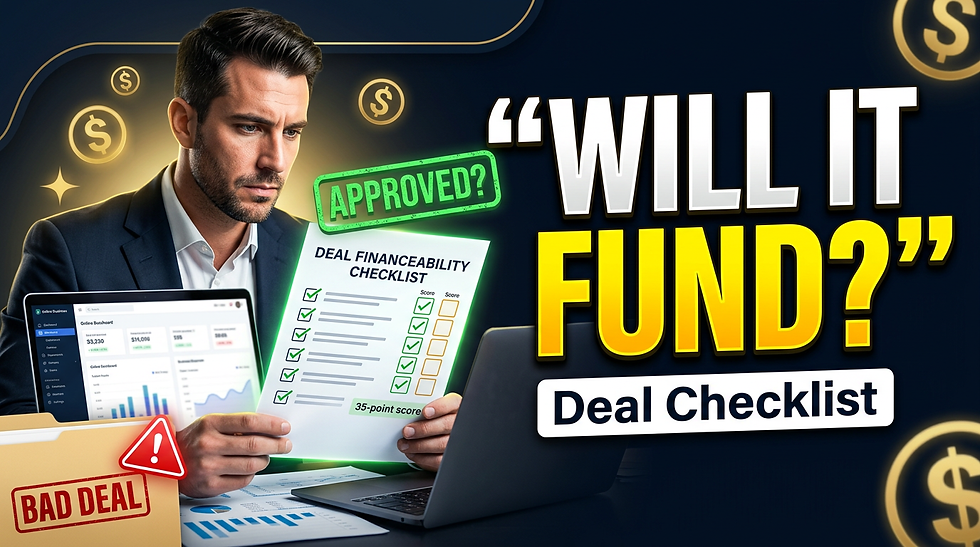
Deal Financeability Checklist
Run every deal you look at through it before you email a broker.
FAQ: Online Business Acquisition Loans for First-Time Buyers
Q: Can I get a loan to buy an online business?
Yes. Several financing options exist specifically for acquiring online businesses, including SBA 7(a) loans, seller financing, and specialized acquisition lenders. Approval depends on the business's cash flow history, your creditworthiness, and the deal structure.
Q: What credit score do I need to qualify for a business acquisition loan?
Most traditional lenders and SBA-approved lenders look for a personal credit score of at least 680–700. Some alternative lenders may work with scores as low as 620, but lower scores typically mean higher interest rates and stricter terms.
Q: What is a debt service coverage ratio and why does it matter for acquisition loans?
The debt service coverage ratio (DSCR) measures whether a business generates enough net operating income to cover its loan payments. Lenders typically require a DSCR of at least 1.25, meaning the business earns 25% more than what's needed to service the debt.
Q: Do I need a down payment to buy an online business?
Yes. Most lenders require a down payment of 10–30% of the purchase price. SBA 7(a) loans typically require 10%, while conventional acquisition loans may require more depending on the deal size and buyer profile.
Q: Can I use an SBA loan to buy a website or online business?
Yes. The SBA 7(a) loan program can be used to acquire online businesses, including e-commerce stores, SaaS products, and content sites — provided the business has verifiable revenue and the seller can supply proper documentation.
Q: What documents do lenders require when applying for a business acquisition loan?
Lenders typically require 2–3 years of the business's profit and loss statements, tax returns, a seller's discretionary earnings (SDE) breakdown, a purchase agreement or letter of intent, and your personal financial statements and tax returns.
Q: How do lenders evaluate an online business before approving a loan?
Lenders assess the business's revenue consistency, traffic sources, customer concentration risk, platform dependency (e.g., reliance on a single marketplace), and whether earnings are verifiable through bank statements and tax records.
Q: Is seller financing a good option for first-time buyers of online businesses?
Seller financing can be a strong option for first-time buyers, especially when traditional lenders are hesitant. It typically involves the seller carrying 10–30% of the purchase price, which also signals their confidence in the business's continued performance.
Q: What are the biggest reasons first-time buyers get denied for acquisition loans?
Common denial reasons include unverifiable or inconsistent revenue, over-reliance on a single traffic or revenue source, insufficient down payment, a weak personal credit profile, or a business that lacks clean financial documentation.
Q: How long does it take to get approved for an online business acquisition loan?
SBA loans can take 30–90 days from application to funding. Seller financing deals can close in as little as 2–4 weeks. Alternative or private lenders may fall somewhere in between, often completing the process in 2–6 weeks.


Comments