Human-in-the-Loop AI Funding Workflows: Where Automation Must Stop

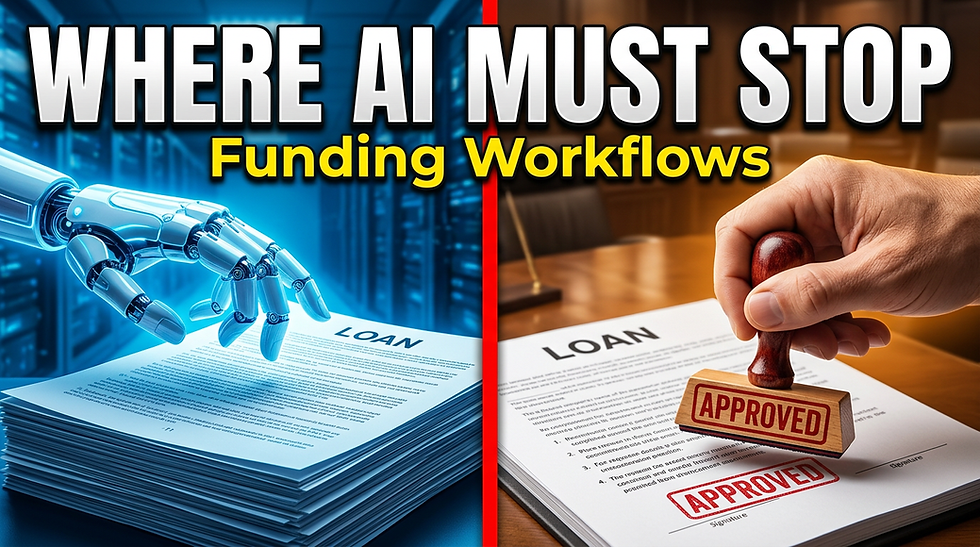
AI can summarize, sort, flag, and draft. It should not approve, deny, promise, or play underwriter cosplay. This guide maps the human checkpoints every responsible AI funding workflow needs.
Funding teams want faster intake, cleaner documents, quicker decisions, and fewer hours spent hunting through email threads like financial archaeologists.
AI can help.
It can summarize applications, extract figures from bank statements, identify missing documents, organize deal notes, flag inconsistencies, recommend follow-up tasks, and draft communications.
Then somebody gets greedy.
The assistant becomes a “virtual underwriter.” A lead score turns into a rejection. A generated sentence becomes a funding promise. A suspicious transaction gets labeled fraud. Nobody knows why the system made the call, but the workflow moved fast, so everyone claps until the screenshots arrive.
That is exactly why human-in-the-loop AI funding matters.
Direct answer: Human-in-the-loop AI funding is a workflow design in which AI handles repetitive analysis, organization, and drafting while qualified humans review defined exceptions and retain authority over high-impact decisions. AI can prepare the file. It should not invent terms, make unsupported promises, or quietly become the underwriter.At a Glance
AI can support | Humans must control |
Data extraction and normalization | Final accountability |
Document classification | Exceptions and conflicting evidence |
Missing-document detection | Approval authority and policy interpretation |
Deal summaries | Binding terms and promises |
Follow-up drafts | Complaints, disputes, and appeals |
Anomaly flags | Fraud determinations |
Prequalification support | Adverse-action accuracy |
Workflow routing | Overrides and escalations |
The operating rule is simple:
Automate the preparation. Escalate the uncertainty. Assign the decision. Record what happened.
Best For
This framework is useful for:
Funding brokers and ISOs building automated intake systems
Agencies routing deals across several funding products
Processors reviewing documents and missing information
Fintech teams deploying AI assistants or agents
Lenders adding AI-supported analysis
Consultants building CRM, n8n, or client-portal workflows
Not For
This is not permission to:
Let a public chatbot make credit decisions
Upload sensitive financial data into random AI tools
Manufacture approval odds
Label an applicant fraudulent because a model felt suspicious
Send automated denials with generic reason codes
Replace legal, compliance, underwriting, or lending judgment with prompt engineering and good vibes

What Human-in-the-Loop Actually Means
Human-in-the-loop does not mean placing a button labeled “Approve AI Output” in front of an exhausted processor.
Meaningful human oversight requires five things:
Authority: The reviewer can stop, change, or reject the automated action.
Context: The reviewer can see the source data, not merely the AI summary.
Competence: The reviewer understands the workflow and the decision being reviewed.
Time: The system allows actual review rather than forcing a ceremonial click.
Traceability: The organization records the recommendation, decision, evidence, and any override.
Without those controls, the human is not in the loop. The human is decorative furniture.
NIST’s generative-AI guidance recommends clearly defined human-AI roles, independent evaluations proportional to risk, acceptable-use policies for decision-making tasks, and mechanisms for feedback and recourse.
Does the Law Require a Human to Click Every Decision?
Not necessarily.
There is no universal rule saying every automated credit decision must include a manual click from a human. The real issue is whether the organization remains accountable for the process, uses lawful criteria, manages its models properly, and can explain required decisions accurately.
Regulation B covers business credit as well as consumer credit. The CFPB has also stated that creditors using complex algorithms must still provide specific and accurate principal reasons when taking adverse action. “The model is too complicated” is not an acceptable excuse.
For brokers and referral partners, the safer boundary is even clearer: do not impersonate the creditor. A broker’s AI can prepare, route, and summarize a submission. It should not present itself as having authority to approve, deny, set binding terms, or guarantee funding.
Legal responsibilities vary by organization, product, jurisdiction, and role. This article is an operational framework, not legal advice.

The Three Automation Zones
Every funding task should be assigned to one of three zones.
Green Zone: Administrative Automation
These actions are generally low risk when the underlying data and systems are properly secured:
Creating CRM records
Deduplicating leads
Naming and sorting files
Scheduling appointments
Sending neutral reminders
Transcribing calls
Summarizing notes
Identifying blank fields
Routing tasks to staff
Creating a document checklist
A human does not need to manually approve every filename change. That would be less “responsible AI” and more “expensive digital babysitting.”
Yellow Zone: Decision Support
These actions may influence a financial outcome and should include defined review triggers:
Prequalification estimates
Product matching
Lead scoring
Bank-statement observations
Cash-flow analysis
Fraud or anomaly flags
Eligibility comparisons
Compliance scans
Suggested reason codes
Recommended next actions
Calculated repayment scenarios
AI may analyze and recommend. The reviewer must be able to inspect the evidence and reject the recommendation.
Red Zone: Binding or High-Impact Actions
These actions require an accountable owner and the strongest controls:
Promising approval
Denying or discouraging an applicant
Communicating binding terms
Changing pricing or repayment requirements
Declaring documents fraudulent
Issuing final compliance conclusions
Sending adverse-action explanations
Submitting altered or unverified information
Authorizing closing or disbursement
Resolving disputes, complaints, or appeals
For a broker, this is usually where automation stops and the file moves to an authorized human or funding provider.
For a creditor using automated decisioning, this is where governance, validation, explainability, monitoring, and accountability become most critical.

The Eight Human Checkpoints Every AI Funding Workflow Needs
1. Data and Consent Checkpoint
AI can capture form submissions, normalize company names, format phone numbers, identify duplicate leads, and create CRM records.
Human review should be triggered when:
Consent language is missing or ambiguous
The applicant disputes how the information was collected
Data arrived from an unapproved source
Sensitive information appears in an unrestricted field
The system proposes outreach through a channel the applicant did not authorize
The goal is not to review every intake manually. It is to stop questionable data from becoming permanent CRM mythology.
2. Document Quality Checkpoint
AI can classify bank statements, tax returns, identification, invoices, leases, and other funding documents. It can also extract dates, revenue figures, balances, deposits, and missing pages.
A human should review:
Illegible or incomplete documents
Conflicting business names or addresses
Numbers that do not reconcile
Suspected alterations
Password-protected files
Documents assigned a low confidence score
Information that materially affects eligibility
The AI should say, “These figures do not appear consistent.”
It should not say, “The applicant committed fraud.”
One is a review flag. The other is a serious conclusion requiring evidence and authority.
3. Eligibility and Product-Fit Checkpoint
AI can compare applicant information against documented funding criteria and organize possible options.
It may support questions such as:
Does the business meet the stated minimum time in business?
Does reported revenue fit the provider’s published range?
Are required documents present?
Which funding categories appear relevant?
What information still needs verification?
Human review remains important when:
Provider criteria may have changed
Multiple products have materially different costs or structures
The applicant’s stated goal conflicts with the recommended product
The recommendation relies on estimated or missing information
The broker has a financial incentive that could affect the recommendation
Product matching should help the applicant navigate. It should not become a commission-powered sorting hat.
4. Risk and Anomaly Checkpoint
AI is useful for finding patterns humans may overlook:
Duplicate submissions
Unusual deposit changes
Repeated returned payments
Mismatched ownership information
Inconsistent dates
Sudden changes in revenue
Reused documents
Conflicting application answers
But an anomaly is not a verdict.
Every risk flag should show:
The source
The exact observation
The confidence level
The rule or pattern that triggered it
The human reviewer assigned
The approved next action
Do not create an invisible “bad borrower score” that nobody can explain.
5. Credit or Funding Decision Checkpoint
AI can calculate, organize, compare, and summarize information used by an authorized decision-maker.
It can prepare a decision memo containing:
Verified business details
Revenue and cash-flow observations
Existing obligations
Document status
Policy criteria
Exceptions
Open questions
Supporting evidence
The final authority must be explicit.
The reviewer should know whether they are:
Confirming document completeness
Recommending a product
Making a credit decision
Communicating a provider’s decision
Escalating an exception
Those are different jobs. Mixing them inside one vague “AI Review Complete” status is how accountability disappears.
6. Communication and Disclosure Checkpoint
AI can draft:
Missing-document reminders
Scheduling messages
Neutral status updates
Follow-up emails
Application summaries
Call preparation notes
Explanations of the next procedural step
Human approval should be required for messages that:
Promise approval or funding speed
Describe final pricing
Communicate a denial
Explain adverse action
Address a complaint
Discuss suspected fraud
Interpret legal obligations
Deviate from approved templates
Include sensitive applicant information
Creditors cannot use model opacity as an excuse for inaccurate adverse-action explanations. The reasons given must reflect the factors actually used.
7. Final Terms and Closing Checkpoint
Before signatures, closing, or disbursement, an accountable reviewer should verify:
Applicant identity and business details
Funding amount
Product type
Pricing and fees
Payment structure
Repayment frequency
Term or estimated duration
Use-of-funds representations
Required disclosures
Final documents
Any changes since the original application
AI may compare versions and highlight changes. It should not quietly substitute one agreement, amount, or payment schedule for another.
8. Monitoring, Override, and Feedback Checkpoint
Human oversight continues after deployment.
Track:
Which AI recommendations were accepted
Which were rejected
Why reviewers overrode the system
Common false positives
Common missed risks
Complaint patterns
Model or prompt changes
Vendor updates
Incident reports
Cases where the workflow should have stopped but did not
The Federal Reserve, FDIC, and OCC issued revised model-risk guidance in April 2026 emphasizing a risk-based approach, effective challenge, validation, governance, documented responsibilities, monitoring, and controls. The guidance is aimed primarily at larger banking organizations and does not directly cover generative or agentic AI, but it states that broader governance practices should guide controls for tools outside its formal scope.
Five Tactical Plays for Building Human Review Without Killing Speed
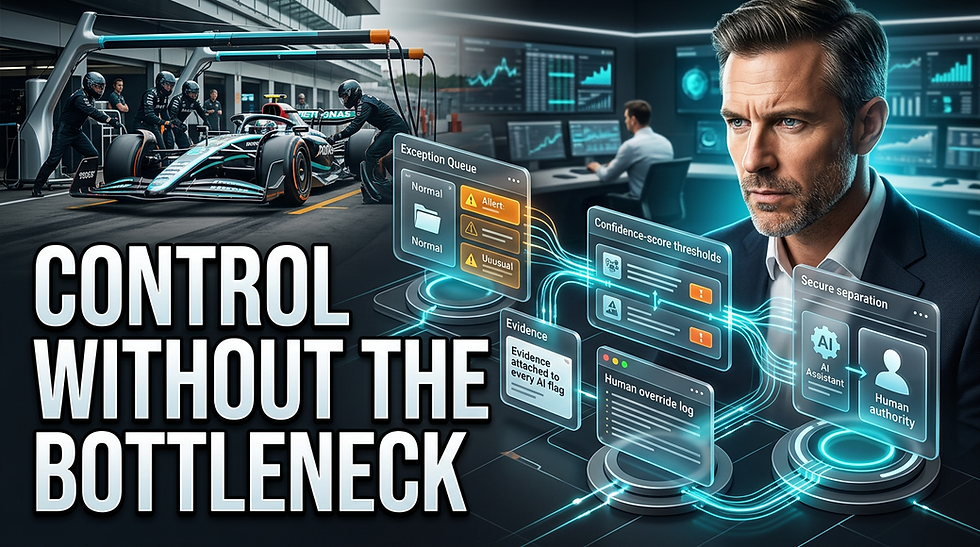
Play 1: Build an Exception Queue, Not a Human Tollbooth
Do not require a person to approve every automated step.
Route only defined exceptions for review:
Low-confidence extraction
Conflicting data
Missing consent
Material policy exception
High-impact communication
Suspected document alteration
Recommendation outside approved parameters
Routine files keep moving. Weird files stop before they become expensive.
Play 2: Create Confidence Thresholds
Every AI-supported action should have a confidence or certainty rule.
Example:
Confidence level | Workflow action |
95% or higher | Continue administrative processing |
80%–94% | Continue, but mark for quality sampling |
60%–79% | Route to human review |
Below 60% | Stop and request clarification |
Do not blindly copy these percentages. Test thresholds against your own workflow, error rates, volume, and risk.
Play 3: Require Evidence With Every Flag
Bad output:
Revenue appears unstable.
Better output:
Deposits in March were 42% below the three-month average. Source: March bank statement, pages 2–4. Manual verification recommended.
The AI should show its work. Mystery scores belong in carnival games, not funding operations.
Play 4: Log Human Overrides
When a reviewer overrides the AI, capture:
Original recommendation
Reviewer’s decision
Reason for override
Supporting evidence
Date and reviewer
Whether workflow rules should be updated
Overrides are not failures. They are training data for improving the process.
The failure is allowing overrides to happen inside texts, Slack messages, or somebody’s memory.
Play 5: Separate the Assistant From the Authority
Use different system roles:
AI operations assistant
Organizes information
Detects missing data
Drafts summaries
Routes tasks
Produces questions
Authorized reviewer
Interprets exceptions
Confirms material facts
Approves communications
Makes or communicates authorized decisions
Accepts accountability
Do not give the assistant an underwriter costume because the demo looks cooler.
Practical Asset: Human Review Checkpoint Record
Use this structure in Notion, Airtable, HubSpot, your CRM, or an n8n workflow:
workflow_stage:
ai_action:
source_data:
risk_level: green | yellow | red
confidence_score:
review_trigger:
assigned_reviewer:
review_deadline:
evidence_required:
allowed_ai_actions:
forbidden_ai_actions:
human_decision:
override_reason:
communication_approved_by:
audit_log_url:
policy_version:
escalation_path:
final_status:
Recommended Review Queue Statuses
AI Processing
AI Prepared — No Exception
Human Review Required
Waiting for Applicant Information
Escalated to Authorized Reviewer
Approved for Next Workflow Step
Returned for Correction
Closed — No Decision Made
Decision Communicated
Incident Review Required
Copy/Paste AI Review Prompt
You are an operations support assistant for a business funding workflow.

Your role is to organize information for human review. You are not a lender, underwriter, attorney, compliance officer, or final decision-maker.

Review the supplied application data and documents.

Return only:

1. Verified facts supported by the supplied materials
2. Missing or unreadable information
3. Conflicts between sources
4. Calculations with the source values shown
5. Possible workflow or policy exceptions
6. Questions a qualified reviewer should answer
7. Recommended next administrative step

Do not:

- Approve or deny funding
- Predict guaranteed eligibility
- Invent lender criteria
- Accuse anyone of fraud
- Generate binding terms
- Provide legal conclusions
- Create adverse-action reasons not directly supported by the actual decision factors
- Hide uncertainty

For every observation, cite the source field, document, page, or record used.
Label uncertain information clearly.
Route high-impact or ambiguous issues to human review.
Reality Check: Humans Are Not Magic Either
Adding a person does not automatically make a workflow fair, accurate, or compliant.
Humans can:
Rubber-stamp recommendations
Miss contradictory documents
Apply rules inconsistently
Be influenced by incentives
Ignore warning signs
Override systems without documentation
Trust confident AI output too quickly
The answer is not “AI bad, humans good.”
The answer is a controlled workflow where:
Machines handle scale and repetition
Humans handle context and accountability
Policies define authority
Evidence supports decisions
Overrides are recorded
Applicants have a path for clarification or recourse
Human review should be a control system, not corporate theater.
How Human Review Improves Funding Operations
A properly designed human-in-the-loop AI funding workflow may help teams:
Process clean files faster
Catch missing documents earlier
Reduce inconsistent data
Avoid unsupported funding promises
Improve product routing
Create clearer deal summaries
Escalate unusual cases sooner
Reduce rework between brokers and providers
Preserve applicant trust
Document how important actions were made
The goal is not maximum automation.
The goal is maximum useful automation without surrendering judgment, authority, or accountability.
What to Do Next
Take one existing funding workflow—lead intake, document collection, prequalification, product matching, or follow-up—and mark every action green, yellow, or red.
Then answer four questions:
What can the AI do?
What triggers human review?
Who has authority to decide?
Where is the evidence recorded?
Anything without a clear answer is not ready for autonomous execution.
Download the Human Review Checkpoint Map and audit your workflow before the robot gets promoted without a background check.
Explore the Funding Agency Automation Pack to build faster intake, follow-up, document collection, and CRM workflows with the human checkpoints left intact.
Open the Funding Agency Automation Pack, then download the files or save copies to your own Google Drive.
FAQs: Human-in-the-Loop AI Funding
What is human-in-the-loop AI funding?
Human-in-the-loop AI funding is a workflow in which AI supports tasks such as document extraction, analysis, summaries, routing, and drafting while qualified humans review exceptions and retain authority over high-impact actions. The exact checkpoints depend on whether the organization is a broker, lender, fintech provider, processor, or referral partner.
Where should AI stop in a funding workflow?
AI should stop or escalate when the action could create a binding commitment, materially affect an applicant, communicate a denial, label suspected fraud, change terms, interpret compliance obligations, or rely on conflicting or uncertain information.
Can AI approve or deny a business loan?
Some creditors use automated decision systems, but automation does not remove their legal and operational accountability. Brokers and referral partners should not represent their own AI output as a lender approval or denial. Creditors must still comply with applicable credit, notice, discrimination, and recordkeeping requirements.
Is human review legally required for every AI credit decision?
No universal rule requires a human click for every credit decision. Requirements depend on the organization, product, jurisdiction, and process. However, creditors must be capable of complying with obligations such as providing specific and accurate reasons for adverse action, regardless of the technology used.
Can AI draft an adverse-action notice?
AI may support drafting, but the creditor must ensure that the stated reasons are specific, accurate, and based on the factors actually used in the decision. A generic or invented reason code is not fixed by adding a human signature afterward.
What is the difference between AI underwriting and AI underwriting support?
AI underwriting suggests that the system participates directly in evaluating or deciding credit risk. AI underwriting support is narrower: the system extracts data, performs calculations, identifies patterns, prepares summaries, or routes exceptions to authorized decision-makers.
How many human checkpoints should a funding workflow have?
There is no magic number. A basic workflow may need checkpoints for data consent, document quality, eligibility, risk flags, decision authority, communications, final terms, and monitoring. Higher-risk or more complex workflows generally require stronger oversight.


Comments