Lender Fit Scorecard: Match Funding Products Without Guessing

Guessing which lender fits a deal is how brokers burn time and borrowers lose trust. A lender fit scorecard gives you a repeatable system to match funding products to borrower profiles — based on actual criteria, not instinct. Here's how to build one that works without pretending AI can guarantee approvals.

A borrower asks what they qualify for.
The rookie broker starts naming products from memory. The desperate broker submits the file everywhere. The sloppy broker promises that one lender is “definitely going to love this deal.”
Then reality enters the chat wearing steel-toe boots.
A lender fit scorecard gives brokers and business owners a more disciplined way to compare a borrower’s profile with available funding products. It does not predict approval. It organizes the facts, applies known eligibility rules, identifies conflicts, and ranks the options that appear most aligned for human review.
Direct Answer: What Is a Lender Fit Scorecard?
A lender fit scorecard is a structured system for comparing a borrower’s revenue, time in business, credit profile, cash flow, industry, funding purpose, urgency, documentation, and repayment capacity against the known requirements of funding products or lenders. It helps prioritize likely matches but cannot guarantee approval or replace underwriting.
At-a-Glance
Question | Practical Answer |
|---|---|
What does it do? | Ranks potential funding products based on borrower and deal characteristics. |
Who should use it? | Brokers, funding agencies, processors, consultants, and informed business owners. |
Does it guarantee approval? | No. It supports routing and preparation, not underwriting decisions. |
What should it score? | Eligibility, revenue, cash flow, credit, industry, purpose, timing, documents, cost, and repayment fit. |
Can it be automated? | Yes, after the criteria and human-review rules are clearly defined. |
What is the biggest risk? | Using stale lender criteria or treating a score like an approval decision. |
Best For
Brokers comparing multiple products
Funding agencies with large lender or product networks
Teams that need consistent deal-routing rules
Processors preparing lender submission packages
Business owners trying to understand product differences
Referral partners who need to avoid sending every lead into the same funnel
Agencies building lender match automation
Not For
Guaranteeing approvals
Replacing lender underwriting
Giving borrowers fabricated rates or terms
Hiding disqualifying information
Submitting the same file everywhere and calling it “distribution”
Treating every high-revenue business as a good credit risk
Ranking products solely by broker commission
That last one deserves emphasis. A scorecard built around commission instead of borrower fit is not a routing system. It is a trust-destruction machine with conditional formatting.

Funding Readiness and Lender Fit Are Not the Same Thing
A funding-readiness scorecard asks:
Does this business appear prepared to pursue funding?
A lender fit scorecard asks:
Which available product structures appear most compatible with this borrower, purpose, timeline, and risk profile?
A borrower might have strong general funding readiness but still be a weak fit for a specific product.
For example, a company may have:
Two years in business
Stable monthly revenue
Organized bank statements
Acceptable credit
Positive cash flow
That business may appear fundable. But the best product could still depend on whether the owner needs to:
Purchase equipment
Cover a temporary payroll gap
Finance invoices
Buy inventory
Refinance expensive debt
Fund a long-term expansion
Access revolving working capital
Readiness gets the borrower onto the field.
Fit helps determine which play might make sense.

Why the Usual Lender-Matching Process Fails
Most bad matching systems fail for one of four reasons.
1. The broker matches from memory
Experienced brokers develop useful instincts. But memory is not a database.
Programs change.
Risk tolerances shift.
Industries move in and out of favor.
Minimums vary.
Documentation requirements evolve.
A product you used six months ago may no longer work the same way.
Human judgment matters, but it should sit on top of organized information—not replace it.
2. The system only checks minimum qualifications
Passing minimum requirements does not automatically make a product suitable.
A borrower may technically qualify for a payment structure that puts unnecessary pressure on cash flow. Another product may take longer but offer a structure better aligned with the use of funds.
“Eligible” and “appropriate” are two different words for a reason.
3. Every factor receives the same weight
Time in business, recent negative bank activity, funding purpose, documentation readiness, and urgency do not always deserve equal importance.
A missing driver’s license can be fixed.
A prohibited industry usually cannot.
A functional scorecard separates hard stops from softer preferences.
4. The score becomes a fake approval engine
This is where the robot starts drinking on the job.
A 91% lender-fit score does not mean a 91% chance of approval. It means the deal aligns with the criteria included in that particular model.
Underwriting may still uncover:
Undisclosed debt
Tax liens
Identity or ownership issues
Inconsistent deposits
Excessive negative days
Unusual transaction activity
Recent defaults
Industry risks
Incomplete documentation
Conflicting application information
The score helps decide where to look. It does not decide what a lender will do.

How a Lender Fit Scorecard Works
A useful scorecard should operate in five stages:
Normalize the borrower profile.
Apply hard eligibility gates.
Score product fit.
Flag risks and assumptions.
Send the ranked options to a human reviewer.
Stage 1: Normalize the Borrower Profile
Before matching anything, convert the intake data into consistent fields.
At minimum, collect:
Business Profile
Legal business name
Entity type
State
Industry
Time in business
Ownership percentage
Number of employees
Business location
Website or online presence
Financial Profile
Average monthly revenue
Annual revenue
Average bank balance
Number of monthly deposits
Recent negative days
Existing debt payments
Outstanding funding positions
Accounts receivable
Gross margin, when available
Estimated free cash flow
Owner Profile
Estimated personal credit range
Ownership history
Relevant guarantor information
Prior defaults or bankruptcies, when lawfully and appropriately collected
Residency or identity requirements relevant to the product
Funding Request
Requested amount
Minimum useful amount
Use of funds
Desired funding timeline
Preferred payment frequency
Preferred term
Collateral available
Willingness to provide a personal guarantee
Willingness to connect bank data
Documents currently available
Do not paste Social Security numbers, complete bank account numbers, passwords, API keys, or unredacted identity documents into a general-purpose AI tool.
The matching model usually needs structured characteristics—not the borrower’s entire financial identity dumped into a chatbot like a digital junk drawer.
Stage 2: Apply Hard Eligibility Gates
Hard gates should be checked before weighted scoring.
A failed hard requirement means the product should normally be removed from the primary recommendation list or placed into an exception-review queue.
Potential hard gates include:
Unsupported industry
Unsupported state or geography
Insufficient time in business
Revenue below the current program minimum
Funding request outside program limits
Required collateral unavailable
Required invoice structure unavailable
Prohibited use of funds
Unacceptable ownership structure
Required documentation unavailable
Existing position limit exceeded
Example Eligibility Gate Table
Requirement | Borrower Profile | Product Rule | Result |
|---|---|---|---|
Time in business | 18 months | 12-month minimum | Pass |
Monthly revenue | $42,000 | $25,000 minimum | Pass |
Industry | Construction | Accepted with review | Review |
Requested amount | $150,000 | Maximum $100,000 | Fail |
Geography | Virginia | Eligible states include Virginia | Pass |
Existing positions | Two | Maximum one | Fail |
That product should not receive a glowing score simply because the borrower has strong revenue. The hard failures matter first.
Stage 3: Calculate the Product Fit Score
After removing obvious non-matches, score the remaining options.
Here is a practical 100-point model.
Lender Fit Scorecard Framework
Scoring Category | Weight | What It Measures |
|---|---|---|
Core eligibility fit | 20 points | Alignment with revenue, time in business, industry, geography, and requested amount |
Cash-flow and repayment fit | 20 points | Whether the projected payment structure appears supportable |
Funding-purpose fit | 15 points | Whether the product structure matches how the capital will be used |
Credit and risk fit | 15 points | Alignment with the known credit and risk profile accepted by the program |
Timing fit | 10 points | Whether the likely process matches the borrower’s actual deadline |
Documentation fit | 10 points | Whether required documents are available, complete, and consistent |
Cost and structure fit | 10 points | Whether term, payment frequency, collateral, and estimated cost structure fit the borrower’s priorities |
Total | 100 points | Ranked product alignment for human review |
Suggested Score Interpretation
Score | Routing Interpretation |
|---|---|
85–100 | Strong apparent fit; prioritize for human review |
70–84 | Potential fit; review conditions, exceptions, and tradeoffs |
55–69 | Weak or conditional fit; investigate missing information |
Below 55 | Poor current fit; consider alternatives or readiness improvements |
Hard-gate failure | Do not score normally; route to exception review or remove |
These bands are operational labels, not approval probabilities.
A score of 87 means “the known facts align well with this model.”
It does not mean “87% chance of funding.”
Stage 4: Add Risk Flags and Confidence Levels
A single number can hide a lot of nonsense.
Every score should be accompanied by:
Risk flags
Missing information
Conflicting information
Assumptions
Data freshness
Confidence level
Human-review instructions
Example Output
Product: Equipment financing
Fit score: 88/100
Confidence: High
Strengths: Clear equipment purchase, established business, equipment can support the transaction, complete financial package
Risks: Existing monthly obligations need verification
Missing: Final equipment invoice
Next action: Obtain invoice and verify existing debt schedule before submission
Compare that with:
Product: Unsecured working capital
Fit score: 73/100
Confidence: Medium
Strengths: Revenue and time in business appear aligned
Risks: Daily payment may pressure current cash flow
Missing: Current month-to-date bank activity
Next action: Review recent balances and compare weekly-payment alternatives
Now the broker has a decision aid rather than a decorative number.
Stage 5: Require Human Review Before Routing
The final ranked list should answer four questions:
Which products appear most aligned?
Why did each product rank where it did?
What could disqualify or weaken the match?
What should happen next?
The reviewer should then:
Verify current lender criteria
Review the source documents
Resolve conflicting facts
Compare projected payment burden
Confirm the use of funds
Discuss tradeoffs with the borrower
Select the appropriate submission path
Document why that route was chosen
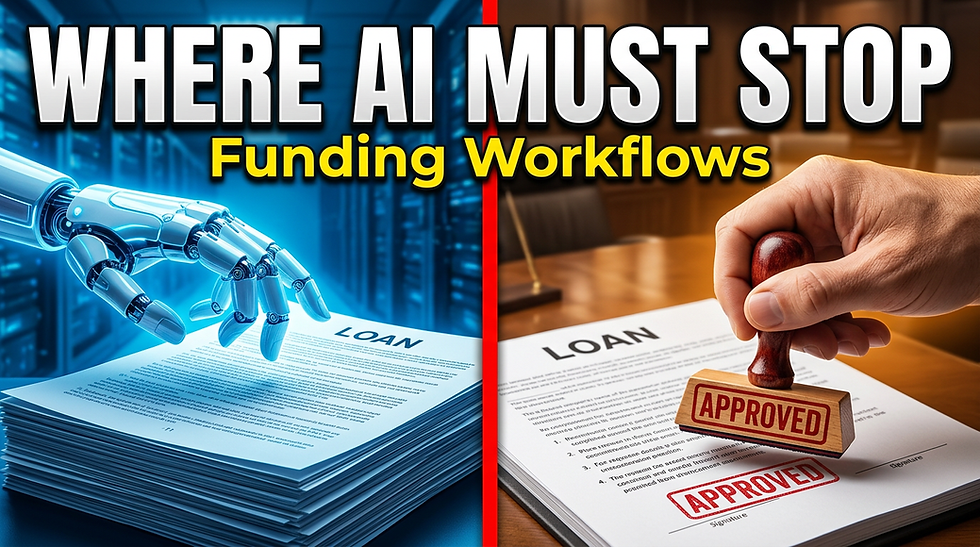
AI can help organize the briefing. A qualified human still owns the recommendation and submission decision.

Product Fit Is More Important Than Product Popularity
The “best” funding product depends on the business problem.
Business Line of Credit
May fit businesses that need:
Recurring access to working capital
Flexibility rather than one large lump sum
Support for uneven expenses
A reusable capital facility
Potential concerns:
Variable rates or terms
Draw requirements
Personal guarantee requirements
Lower limits than the borrower expects
Qualification standards that may be stricter than short-term products
Term Loan
May fit businesses that need:
A defined amount
A predictable repayment schedule
Capital for a specific expansion
A longer repayment horizon
Potential concerns:
Longer application process
More documentation
Stronger credit or financial-history expectations
Prepayment or collateral provisions
Equipment Financing
May fit businesses purchasing:
Vehicles
Machinery
Medical equipment
Restaurant equipment
Construction equipment
Revenue-producing technology or hardware
Potential concerns:
Funds may be restricted to the equipment purchase
Equipment value and condition matter
Down payment may be required
The equipment may secure the financing
Invoice Financing or Factoring
May fit businesses that:
Sell to other businesses
Have outstanding eligible invoices
Experience long customer-payment cycles
Need to bridge receivables rather than cover permanent losses
Potential concerns:
Customer concentration
Invoice eligibility
Customer creditworthiness
Fees and collection arrangements
Whether the product is recourse or non-recourse
Revenue-Based or Short-Term Working Capital
May fit businesses that:
Have consistent revenue
Need capital quickly
Can support frequent repayments
Have a short-duration opportunity or timing gap
Potential concerns:
Higher cost
Frequent payment pressure
Stacking risk
Poor fit for businesses already struggling to maintain balances
Using short-term capital for long-term problems
SBA-Related or Bank Financing
May fit businesses that:
Can support a longer process
Have organized financials
Need longer-term capital
Want to pursue a potentially lower-cost structure
Meet program and lender requirements
Potential concerns:
Longer timelines
Documentation burden
Eligibility rules
Collateral or guarantee requirements
The possibility that urgency and process length do not match
The scorecard should compare products based on the borrower’s situation—not crown one product as the universal king of money mountain.

Five Tactical Plays for Better Lender Matching
Play 1: Separate Hard Rules From Preferences
Create two columns in the product matrix:
Hard requirements
Minimum time in business
Minimum revenue
Eligible industries
Eligible states
Amount range
Collateral requirements
Existing-position limits
Preferences
Preferred credit range
Preferred average balance
Preferred deposit frequency
Preferred documentation level
Preferred borrower profile
Why it works:
A preference may lower the score. A hard failure may eliminate the route entirely. Mixing them creates false matches.
Play 2: Score the Use of Funds Before the Credit Profile
Brokers often begin with credit. Start with the business problem.
Ask:
What exactly will the money purchase?
How long will that asset or expense produce value?
Is the need recurring or one-time?
Is this a timing gap or a structural loss?
When must the funds be available?
What repayment schedule can the business realistically support?
Financing a five-year asset with a five-month product may solve today’s problem by creating tomorrow’s hostage situation.
Product duration should make sense relative to the useful life of the expense whenever possible.
Play 3: Add a Payment-Pressure Test
Do not rank a product solely because the borrower meets the minimum revenue threshold.
Estimate how the payment could affect cash flow.
Basic Payment-Pressure Formula
Estimated Payment Pressure =
Projected Monthly Debt Payments
÷
Average Monthly Free Cash Flow
When reliable free-cash-flow data is unavailable, use a conservative proxy and clearly label the limitation.
The purpose is not to perform underwriting. It is to identify deals where repayment frequency or estimated payment size may deserve additional review.
Payment-Pressure Questions
Would the payment fall before major customer deposits?
Does the business experience frequent low-balance days?
Is revenue seasonal?
Are current advances already pulling from the same account?
Would weekly payments fit better than daily payments?
Is the borrower using new debt to cover payments on old debt?
Does the projected return justify the financing cost?
A lender may approve a product that the business should still think twice about accepting.
Approval is not the same as affordability.
Play 4: Create an Exception Queue
Not every unusual deal should be discarded.
Create a status for:
Borderline revenue
Short time in business
Restricted or specialized industry
Missing documentation
Recent credit event
High customer concentration
Seasonal revenue
Large request relative to revenue
Strong compensating factors
Then route exceptions to a senior reviewer rather than allowing the automation to invent confidence.
Suggested statuses:
Strong Match
Conditional Match
Exception Review
Readiness Work Needed
No Current Match
More Information Required
This keeps the system useful without pretending every deal fits neatly inside a dropdown menu.
Play 5: Feed Outcomes Back Into the Model
A lender fit scorecard should improve over time.
Track:
Product recommended
Lender selected
Submission date
Approval or decline
Approved amount
Final structure
Decline reason
Additional documents requested
Time to decision
Borrower acceptance
Funding completion
Early repayment issues, when appropriately available
Renewal eligibility
Manual override reason
Do not blindly train automation on every historical outcome.
Historical data may contain:
Outdated lender rules
Biased routing habits
Inconsistent notes
Missing decline reasons
Products no longer offered
Broker preferences disguised as borrower fit
Use outcomes to review the model—not to fossilize old mistakes into software.
Practical Asset: Lender Fit Scorecard Template
Use the following structure in Airtable, Notion, Google Sheets, a CRM, or an internal application.
Borrower Fields
Field | Type |
|---|---|
Borrower ID | Unique identifier |
Business name | Text |
Industry | Select |
State | Select |
Time in business | Number |
Monthly revenue | Currency |
Annual revenue | Currency |
Average bank balance | Currency |
Negative days | Number |
Deposit count | Number |
Estimated credit range | Select |
Existing obligations | Currency |
Existing funding positions | Number |
Requested amount | Currency |
Minimum useful amount | Currency |
Use of funds | Multi-select |
Funding deadline | Date |
Preferred payment frequency | Select |
Collateral available | Multi-select |
Documents available | Multi-select |
Missing documents | Multi-select |
Risk flags | Multi-select |
Data last verified | Date |
Product or Lender Fields
Field | Type |
|---|---|
Product ID | Unique identifier |
Product type | Select |
Provider or lender | Text |
Minimum revenue | Currency |
Minimum time in business | Number |
Amount minimum | Currency |
Amount maximum | Currency |
Eligible industries | Multi-select |
Restricted industries | Multi-select |
Eligible states | Multi-select |
Credit guidance | Text or range |
Collateral requirement | Text |
Personal guarantee requirement | Text |
Payment frequency | Select |
Typical documentation | Multi-select |
Typical process length | Range |
Existing-position rules | Text |
Use-of-funds restrictions | Multi-select |
Criteria last verified | Date |
Criteria source | URL or internal reference |
Human reviewer | Person |
Active status | Checkbox |
Match Output Fields
Field | Type |
|---|---|
Hard-gate result | Pass / Fail / Review |
Core eligibility score | Number |
Cash-flow fit score | Number |
Purpose fit score | Number |
Credit-risk fit score | Number |
Timing fit score | Number |
Documentation score | Number |
Cost-structure score | Number |
Total lender fit score | Formula |
Confidence level | High / Medium / Low |
Missing information | Multi-select |
Assumptions | Text |
Recommended next action | Select |
Human decision | Select |
Override reason | Text |
Copy-and-Paste AI Prompt for Initial Product Matching
You are assisting with business-funding product routing.

You do not approve loans, predict approval, guarantee funding, invent lender requirements, or replace underwriting judgment.

Using only the borrower profile and product criteria provided:

1. Normalize the borrower information into consistent fields.
2. Identify missing, conflicting, or stale information.
3. Apply hard eligibility rules before calculating any score.
4. Remove products that clearly fail hard requirements, but list the exact reason.
5. Score the remaining products using this framework:
   - Core eligibility fit: 20 points
   - Cash-flow and repayment fit: 20 points
   - Funding-purpose fit: 15 points
   - Credit and risk fit: 15 points
   - Timing fit: 10 points
   - Documentation fit: 10 points
   - Cost and structure fit: 10 points
6. Do not treat the final score as an approval probability.
7. For each product, provide:
   - Fit score
   - Hard-gate result
   - Confidence level
   - Reasons for the score
   - Risk flags
   - Missing information
   - Assumptions
   - Recommended next action
8. Rank the three strongest apparent matches.
9. Include a “No Current Match” result when the available products do not appear suitable.
10. End with a human-review checklist.

BORROWER PROFILE:
[Paste a redacted, structured borrower profile]

PRODUCT MATRIX:
[Paste the current, verified product criteria]
The prompt is only as trustworthy as the product matrix behind it. Feeding stale requirements into a sophisticated AI model produces highly organized wrong answers.
Fancy garbage is still garbage.
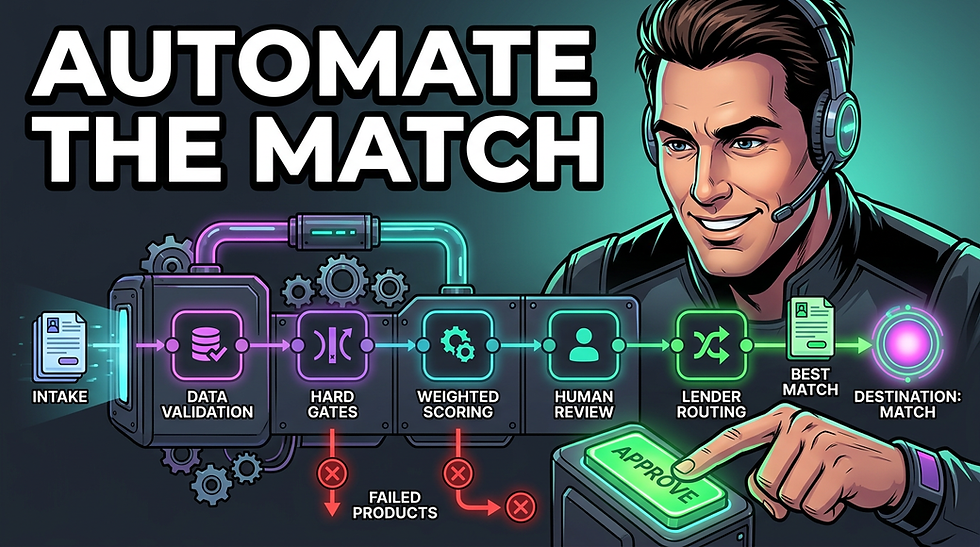
Lender Match Automation Workflow
A basic automated workflow can follow this sequence:
Funding Intake Submitted
        ↓
Validate Required Fields
        ↓
Normalize Revenue, Industry, State, Purpose, and Timing
        ↓
Check for Missing or Conflicting Data
        ↓
Apply Product Eligibility Gates
        ↓
Score Remaining Products
        ↓
Generate Ranked Match Summary
        ↓
Send to Human Review Queue
        ↓
Approve, Override, or Request More Information
        ↓
Create Submission Checklist
        ↓
Update CRM and Track Outcome
Suggested Automation Tools
The workflow may be built with:
Tally, Wix Forms, or another intake form
Airtable, Notion, Google Sheets, or a CRM
n8n, Make, or Zapier
A controlled AI model for normalization and summaries
Secure document storage
Human approval checkpoints
A maintained funding product matrix
The scoring rules should live in a structured database or configuration file—not be buried inside a 900-word prompt nobody remembers to update.
Human Review Checklist
Before routing or submitting the deal, confirm:
Borrower identity and ownership information are consistent
Revenue figures match the available records
Time in business has been verified
Industry classification is accurate
Requested amount is realistic
Use of funds is specific
Existing obligations have been disclosed
Current bank activity has been reviewed where appropriate
Product requirements are current
Restricted industries and states have been checked
Payment structure has been discussed
Required documents are available
Missing information is clearly labeled
No approval guarantee has been communicated
The borrower understands that final terms depend on underwriting
Any automated recommendation has been reviewed by a qualified human

Reality Check: What AI Can and Cannot Do
AI Can Help
Normalize intake information
Compare structured criteria
Apply predefined eligibility rules
Calculate weighted scores
Detect missing fields
Highlight conflicting information
Summarize product tradeoffs
Generate submission checklists
Route exceptions
Draft borrower follow-up questions
Track outcomes and overrides
AI Cannot Reliably
Guarantee approval
Know undocumented lender preferences
Verify that every requirement is current
Detect every form of fraud
Decide whether a borrower should accept financing
Replace legal, tax, accounting, compliance, lending, or underwriting judgment
Understand missing context it was never given
Make a bad product affordable
Turn a structurally unprofitable business into a good funding candidate
The safest role for AI is assistant, analyst, and organizer.
Not oracle.
Not underwriter.
Not digital loan shark wearing a chatbot skin.

How a Lender Fit Scorecard Improves Funding Operations
A well-designed lender fit scorecard may help a funding operation:
Reduce random submissions
Shorten initial deal review
Improve processor consistency
Identify missing documents earlier
Explain product tradeoffs more clearly
Prioritize stronger matches
Route unusual deals to senior reviewers
Protect lender relationships
Improve borrower trust
Create cleaner CRM data
Track which recommendations actually perform
Identify gaps in the current product network
It may also reveal when the best recommendation is not an immediate application.
The appropriate next step could be:
Collect missing documents
Reduce existing obligations
Wait for additional operating history
Improve average balances
Clarify the use of funds
Correct application inconsistencies
Pursue a different product structure
Address a cash-flow leak before borrowing
A matching system becomes more valuable when it can say, “Not yet,” “Not this product,” or “We need more information.”
What to Do Next
Stop routing funding deals from memory, vibes, or whichever lender sent the last promotional email.
Build one borrower profile, one maintained product matrix, one hard-gate system, and one transparent scoring framework. Then put a human between the recommendation and the submission.
Free Resource
Download the Lender Fit Scorecard & Funding Product Matrix to create a repeatable product-routing workflow.

Eligibility varies. Product requirements, costs, terms, and availability may change. A fit score is an organizational tool—not a funding approval or offer.
Frequently Asked Questions
What is a lender fit scorecard?
A lender fit scorecard is a structured tool that compares a borrower’s business profile, funding request, cash flow, credit characteristics, documentation, timing, and risk factors with the known criteria of funding products or lenders. It ranks apparent matches for human review but does not guarantee approval.
How is a lender fit scorecard different from a funding-readiness score?
A funding-readiness score evaluates whether a business appears prepared to seek financing. A lender fit scorecard compares that business with specific funding products or lender criteria. A borrower can be generally funding-ready while still being a poor fit for a particular product.
Can AI match a business with a lender?
AI can help compare structured borrower information with verified product criteria, calculate scores, identify missing information, and rank potential matches. It cannot guarantee approval, know every undocumented underwriting preference, or replace lender and broker judgment.
What information should a lender-matching system collect?
The system should collect time in business, revenue, industry, state, funding amount, use of funds, desired timing, credit range, current obligations, cash-flow indicators, available collateral, preferred payment structure, and document readiness. Sensitive information should be handled through appropriate secure systems.
What is considered a good lender fit score?
A score of 85 or higher may indicate strong alignment within a specific model, while scores from 70 to 84 may indicate a conditional fit. However, scoring bands should reflect the organization’s actual criteria. The score is not an approval probability.
Should the lowest-cost funding product always rank first?
No. Cost is important, but timing, eligibility, documentation, repayment structure, collateral, funding purpose, and the borrower’s cash flow also matter. The lowest-cost option is useless when the business cannot complete the process before the capital is needed.
How often should lender criteria be updated?
Product criteria should be reviewed whenever a lender communicates a program change and on a regular operational schedule. High-volume funding teams may need frequent verification. Every product record should show when the criteria were last confirmed and by whom.
Can a lender fit scorecard prevent bad submissions?
It may reduce obvious mismatches by enforcing eligibility rules, highlighting missing information, and requiring human review. It cannot catch every issue or substitute for complete underwriting, document verification, and professional judgment.
Can business owners use a lender fit scorecard without a broker?
Business owners can use a simplified scorecard to compare product categories and prepare questions. However, product criteria and terms can change, and a scorecard cannot confirm approval. Owners should review actual offers carefully and consult qualified professionals when necessary.
What should happen when no lender is a strong match?
The system should return “No Current Match” rather than forcing a recommendation. It should explain the main gaps and suggest practical next steps, such as collecting documents, improving cash flow, reducing obligations, waiting for more operating history, or considering a different funding structure.



Comments