MCP for Ecommerce Finance: Connect Seller Data to AI Agents

MCP can give AI agents controlled access to the systems holding your ecommerce financial data. The real opportunity is not another chatbot—it is connecting orders, payouts, fees, inventory, payments, and banking data so an agent can analyze the business without another round of CSV exports.

MCP for ecommerce finance gives AI agents a standardized way to work with the systems holding your seller data instead of making you export another CSV every time you want an answer.
Done correctly, an ecommerce finance agent can pull together orders, payouts, payment activity, fees, inventory signals, banking information, and other financial context to help forecast cash flow, reconcile deposits, spot margin problems, and prepare for future funding needs.
But there is an important distinction:
MCP does not replace Shopify, Amazon, Stripe, banking APIs, or your accounting system. It gives AI agents a standardized layer for discovering and using those capabilities.
That distinction is the difference between a useful finance agent and a chatbot wearing an API trench coat.
The current Model Context Protocol architecture centers on servers exposing resources and tools that AI applications can discover and use. Tools can retrieve information or execute functions, while authorization determines what a particular connection is actually allowed to do. Model Context Protocol
MCP for Ecommerce Finance at a Glance
Layer | What It Does | Ecommerce Example |
AI agent | Interprets the question and decides which approved tools to use | “Will we have enough cash for the next inventory order?” |
MCP client | Connects the AI application to available MCP servers | ChatGPT, Claude, an internal finance agent, or another compatible client |
MCP server | Exposes approved data and actions as tools | Retrieve Stripe payments or query a custom Amazon finance connector |
Underlying API/system | Remains the actual source of truth | Shopify Admin API, Amazon SP-API, Stripe, bank data, accounting software |
Finance logic | Turns raw records into useful business decisions | Payout forecast, working-capital gap, margin analysis, funding trigger |
The payoff is not “AI connected to everything.”
The payoff is AI connected to the right financial context, with the right permissions, for a defined decision.
What Is MCP for Ecommerce Finance?
MCP for ecommerce finance is the use of Model Context Protocol servers to make ecommerce and financial systems accessible to an AI agent through a consistent interface.
Instead of manually downloading sales from Amazon, payouts from Shopify, transactions from Stripe, and balances from a bank account, an MCP-enabled architecture can let an agent retrieve approved information when the workflow requires it.
Think of the difference this way:
Without MCP
Amazon → custom integration
Shopify → another custom integration
Stripe → another integration
Bank → another integration
Accounting → another integration
AI app → custom logic for every one of them
With MCP
AI agent → MCP tools → approved underlying systems
MCP does not make the underlying APIs disappear. It standardizes how the AI side discovers and calls the functionality you expose.
For a deeper explanation of that distinction, see MCP vs. API for Financial Data: Which Should AI Builders Use?.

Why Ecommerce Finance Is a Natural MCP Use Case
Ecommerce businesses create a ridiculous amount of financial data in different systems.
Revenue may appear first in a marketplace dashboard. The payout lands later. Processing fees live somewhere else. Advertising is charged on a different schedule. Inventory was paid for weeks or months before the sale. Refunds and chargebacks can hit after the original revenue looked fantastic.
So a seller can be profitable on paper and still have no idea what cash will actually be available three weeks from Tuesday.
That is why ecommerce finance is unusually well suited to agent-based analysis.
The agent does not necessarily need another dashboard.
It needs context from multiple systems at the moment a financial decision is being made.
Useful questions include:
How much cash is actually available?
Which marketplace payouts are still pending?
How much revenue is tied up before settlement?
What fees reduced the last payout?
Which SKUs need to be reordered in the next 30 days?
How much cash will that inventory order consume?
Will ad spend create a working-capital gap before payouts arrive?
What happens if sales fall 15%?
When should we start looking at outside financing?
Which financial documents are already available if funding is needed?
That is a much stronger use case than “summarize this spreadsheet.”
For the broader ecommerce finance problem, see AI Finance Tools for Ecommerce Sellers: Cash Flow, Inventory & Funding Readiness.
AI Finance Tools for Sellers
See how ecommerce AI tools improve cash-flow visibility, inventory planning, and funding readiness.

Which Ecommerce Platforms Can MCP Connect to Today?
This is where the hype needs some adult supervision.
Different platforms are at very different stages of MCP adoption.
Stripe: Native MCP Is Already Real
Stripe has one of the clearest ecommerce-finance MCP implementations.
Stripe maintains an official remote MCP server and also provides a local MCP implementation. Its official tooling exposes Stripe functionality to compatible AI clients, with permissions controlled through authorization and restricted API credentials. Stripe official MCP implementation
For an ecommerce finance workflow, Stripe can potentially provide context around payment infrastructure without requiring your AI application to invent its own function-calling format.
Possible finance-agent questions include:
Which payments recently failed?
What refunds occurred this week?
What payment activity needs review?
What customer or transaction records relate to this issue?
Which payment events should be reconciled against bank deposits?
The exact tools available should always be checked against the current Stripe MCP implementation rather than assuming the full Stripe API is exposed.
Shopify: Native MCP Exists, but Seller Finance Is a Different Layer
Shopify is moving aggressively into agentic commerce.
On October 13, 2026, Shopify announced Shop MCP, allowing agents to search its catalog, retrieve product information, build carts, and initiate Shop Pay checkout. Shopify also provides Storefront MCP capabilities for AI shopping experiences. Shopify Shop MCP announcement
That is significant.
But it does not mean Shop MCP is automatically a merchant finance API.
For seller finance, Shopify's GraphQL Admin API remains the more relevant source. Shopify exposes merchant financial information including Shopify Payments balances, balance transactions, fees, adjustments, payout schedules, and payout history when the necessary permissions are granted. Shopify Payments account API
That creates a practical architecture:
AI agent → custom finance MCP server → Shopify GraphQL Admin API
The MCP layer can expose narrow tools such as:
get_current_shopify_balance
list_pending_payouts
get_payout_transactions
summarize_payment_fees
compare_orders_to_payouts
That is more useful for a CFO-style ecommerce agent than giving it broad access to the entire Shopify Admin API.
Amazon: SP-API Is the Core Seller Data Layer
Amazon's Selling Partner API is already built for programmatic seller-data access.
Amazon says SP-API can provide applications access to seller information including orders, shipments, payments, inventory, and other operating data. Amazon Selling Partner API
For financial analysis specifically, Amazon's Finances API provides transaction information relevant to a selling business. Its current finance workflows include retrieving recent transactions and determining which released transactions make up a payment. Amazon Finances API
This is important because Amazon sellers rarely need an agent to merely say:
“Sales were $87,000.”
They need:
“Sales were $87,000, but only $61,400 is expected to become usable cash during this period after marketplace transactions, timing differences, current inventory commitments, and other cash demands.”
Amazon's finance path therefore looks more like:
AI agent → MCP adapter → Amazon SP-API / Finances API
The underlying source remains SP-API. MCP makes those approved functions easier for an AI agent to discover and use.
Plaid: Understand What Its MCP Server Actually Does
Plaid also offers official MCP infrastructure, but sellers and builders should pay attention to scope.
Plaid's current Dashboard MCP server is designed around Plaid production diagnostics and analytics—such as debugging Items, reviewing Link conversion, and checking usage metrics. Plaid also offers local development-oriented MCP tooling. Plaid MCP documentation
That is useful for teams building financial applications.
It is not the same thing as saying:
“Connect the Plaid MCP server and ChatGPT can suddenly read every transaction in my business checking account.”
For an ecommerce finance agent that needs actual banking transactions, balances, or cash-flow inputs, the architecture may still rely on the appropriate Plaid products or another financial-data provider underneath a purpose-built MCP layer.
Again: MCP is the agent-access interface. The financial API remains the source of truth.
Native MCP vs. API-Backed MCP for Ecommerce Sellers
Platform | Native MCP Position | Best Finance Data Path |
Stripe | Official MCP available | Native Stripe MCP where its available tools fit the workflow |
Shopify | Native commerce-oriented MCP exists | Shopify Admin GraphQL API wrapped by narrowly scoped MCP finance tools |
Amazon | Seller data is primarily exposed through SP-API | MCP adapter over Amazon SP-API / Finances API |
Plaid | Official Dashboard/developer MCP exists | Use relevant Plaid data APIs behind MCP when actual account data is required |
Other ecommerce systems | Varies | Existing API → controlled MCP server → agent |

This mixed architecture is likely to be normal for a while.
You do not need every platform to ship a perfect native MCP server before MCP becomes useful.
You need stable APIs and a secure MCP layer that exposes only the capabilities your agent actually needs.
MCP vs. API Explained
Understand when native MCP works and when custom API-backed financial tools are required.

What Can an Ecommerce Finance Agent Actually Do?
The most valuable workflows are not “autonomous CFO” theater. They are narrow jobs with measurable outputs.
1. Build a Rolling Cash-Flow Forecast
A finance agent could combine:
current available cash
expected Shopify payouts
Amazon financial transactions
Stripe payment activity
recurring operating expenses
planned ad spend
supplier deposits
inventory purchase commitments
loan or card payments
Then answer:
“What is our lowest projected cash balance during the next 60 days?”
That is materially more useful than looking at revenue alone.
Amazon Cash Flow Tools
See how Amazon sellers can track payouts, inventory timing, and working-capital gaps with AI-assisted cash-flow tools.

2. Reconcile Payouts Automatically
Payout reconciliation is exactly the kind of tedious finance work agents are good at assisting with.
A workflow could:
retrieve the marketplace payout
retrieve the transactions contributing to it
compare expected versus actual amounts
identify fees, refunds, adjustments, or other differences
match the resulting deposit against banking data
flag anything that does not reconcile
Shopify's financial APIs expose payout amounts, status, fees, balance transactions, and associated order information where access is authorized. Shopify Payments payout API
Amazon's Finances API similarly provides transaction-level information that can be used to determine what makes up a seller payment. Amazon Finances API use-case guide
The agent does not need to “control your money” to save hours of finance work. Read access alone can produce real value.
Audit Your Platform Fees
Find where Shopify, Amazon, Stripe, and marketplace fees are eating into contribution margin.

3. Find the Margin Leaks Hiding Inside Platform Fees
Revenue is vanity if you do not know what survived the trip.
An ecommerce finance agent can combine order data, payment transactions, marketplace fees, refunds, advertising, fulfillment expenses, and product costs to identify where contribution margin is getting smoked.
Questions could include:
Which SKUs generate revenue but weak contribution margin?
Which platform has the highest effective transaction cost?
Did payment fees increase this month?
Are refunds concentrated in particular products?
Are marketplace deductions rising faster than sales?
4. Forecast Inventory Funding Before the Cash Crunch
Inventory creates one of ecommerce's nastiest timing problems: You pay before you sell.
A finance agent can watch:
sales velocity
current inventory
supplier lead times
supplier payment terms
seasonal demand
marketplace payout timing
ad-spend plans
current cash
Then estimate:
“We need to order $42,000 of inventory by November 10, but projected free cash on that date is only $26,500. Expected funding gap: approximately $15,500.”
That is when financing becomes strategic instead of desperate.
The goal is not to automatically borrow money. The goal is to see the capital gap while you still have choices.
5. Maintain Funding Readiness Continuously
Most small businesses treat funding readiness like a fire drill.
Someone needs money. Suddenly everyone is hunting for statements, sales records, debt balances, and P&Ls.
An MCP-enabled finance workflow can help maintain a continuously updated view of:
monthly revenue
recent deposits
payment volume
marketplace sales
outstanding liabilities
cash balance
inventory exposure
cash-flow trends
supporting financial documents
An agent could then generate a lender-facing summary or flag weak spots before a financing request becomes urgent.
That does not guarantee approval. It reduces information chaos.

A Practical Ecommerce Finance MCP Architecture
You do not need to connect everything on day one.
Start with the decision you want the agent to improve.
Layer 1: Choose One Finance Question
Good: “Will we have enough cash to fund the next 45 days?”
Bad: “Build me an autonomous AI CFO connected to my entire company.”
The second version is how six-month software projects are born.
Layer 2: Identify the Minimum Required Data
For a cash-flow agent, that might be:
bank balance
recent sales
expected payouts
recurring expenses
inventory purchases
ad spend
debt payments
Nothing else gets connected until it is needed.
Layer 3: Use Native MCP Where It Makes Sense
If Stripe's MCP server already provides the function required, use it.
Do not rebuild functioning infrastructure because custom code makes you feel important.
Layer 4: Wrap Existing APIs Where Native MCP Is Missing
For Amazon seller data, build or use an MCP server that calls the appropriate SP-API operation.
For Shopify merchant finance, expose narrow finance tools over the Admin API.
The MCP server becomes the translator and policy boundary.
Layer 5: Normalize the Data
One system calls something a payout. Another calls it a settlement. Another calls it a balance transaction.
Your agent should not improvise accounting definitions every time.
Normalize important concepts such as:
gross sales
refunds
fees
net revenue
pending payouts
available cash
inventory commitment
advertising spend
accounts payable
debt service
projected working-capital gap
The smarter the normalization layer, the less “smart” the model needs to pretend to be.
Layer 6: Add Human Approval Before Consequential Actions
Reading a payout is not the same risk as issuing a refund.
Reading cash balances is not the same risk as moving money.
Drafting a financing recommendation is not the same risk as submitting an application.
Use different permission classes.
Connect Your Financial Data
Follow a practical guide to connecting approved financial systems to an AI agent with MCP.

How Should MCP Permissions Work for Ecommerce Finance?
The safest default for a finance agent is simple: Give it the least authority required to complete the job.
The current MCP specification continues to strengthen authorization controls, but protocol-level authorization does not remove your responsibility to scope the underlying systems correctly. MCP official updates
A useful hierarchy is:
Level 1 — Read
Examples:
list transactions
retrieve orders
retrieve payouts
read balances
pull reports
This is where many analytics workflows should begin.
Level 2 — Analyze
The agent can combine retrieved information and produce:
forecasts
reconciliations
alerts
summaries
scenarios
recommendations
No external financial action occurs.
Level 3 — Prepare
The agent can prepare an action for approval:
draft refund
prepare supplier payment
prepare funding package
prepare accounting adjustment
prepare transfer request
A human approves or rejects it.
Level 4 — Execute
The system can perform the financial action.
That should be the last permission you add, not the first.
Stripe's local MCP implementation explicitly supports restricting tool permissions through restricted API credentials, illustrating why the underlying credential design still matters even when MCP is the access layer. Stripe MCP security

What MCP Does Not Fix
MCP can improve access. It cannot rescue garbage data.
An agent connected to six inconsistent systems can become a very efficient generator of confidently wrong answers.
MCP does not automatically solve:
inconsistent accounting categories
duplicate transactions
broken product-cost data
inaccurate inventory counts
missing supplier obligations
delayed bookkeeping
bad unit economics
unclear financial definitions
weak access controls
You still need a source-of-truth strategy.
For many ecommerce businesses, the better architecture is not: connect everything to AI.
It is: decide which system owns each financial fact, then let the agent retrieve that fact when needed.
MCP vs. Another Ecommerce Dashboard
This is the bigger strategic shift.
Traditional SaaS says:
Log into our dashboard.
Agentic software increasingly says:
Ask for the outcome.
Instead of opening five dashboards to answer:
“Can we afford another $25,000 inventory order?”
an agent could gather the approved inputs and produce:
“Current available cash is X. Expected marketplace payouts before the supplier deadline are Y. Scheduled obligations are Z. The proposed inventory purchase would reduce projected cash below your operating threshold during week three.”
That does not eliminate dashboards. It changes where the work begins.
The interface becomes the question. The systems underneath become tools. And MCP is one of the standards making that architecture practical.
For a broader implementation walkthrough, see How to Connect Financial Data to AI Agents With MCP.
Compare Finance MCP Servers
Compare finance-focused MCP servers for banking, lending, credit, payments, and financial-data workflows.

Should Ecommerce Sellers Build an MCP Finance Stack Now?
Most sellers should not begin by commissioning a giant custom MCP infrastructure project.
Start when you have:
a recurring financial question
data trapped across multiple systems
an API-accessible source of truth
enough repetitive analysis to justify automation
clear permissions
a measurable business outcome
The strongest first project might be one question:
“What will my cash position look like 30, 60, and 90 days from now?”
Connect only what is needed to answer that accurately. Then expand.
Possible next workflows might include:
payout reconciliation
fee monitoring
inventory forecasting
exception alerts
automated management reporting
Do not build the robot CFO before you have built the calculator.
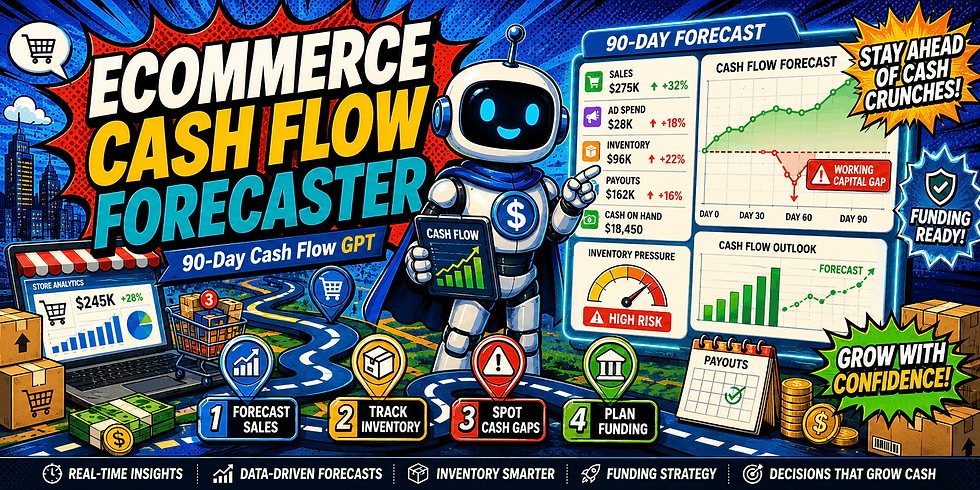
Try the Ecommerce Cash Flow Forecaster
If your immediate problem is cash-flow visibility rather than building MCP infrastructure, start with the decision first.
The Ecommerce Cash Flow Forecaster is designed to model 90-day ecommerce cash flow, inventory purchases, advertising spend, and potential working-capital needs.
Once you know which decisions matter repeatedly, you have a much better blueprint for what an ecommerce finance agent should eventually connect to.
Frequently Asked Questions
What is MCP for ecommerce finance?
MCP for ecommerce finance uses Model Context Protocol servers to give AI agents standardized access to approved ecommerce and financial capabilities. Those MCP tools can sit in front of systems such as payment processors, marketplace APIs, banking infrastructure, accounting systems, or custom financial-data services.
Does Shopify support MCP?
Yes. Shopify now provides MCP capabilities for agentic commerce, including Storefront MCP and the newly launched Shop MCP for product discovery, carts, and checkout. Merchant finance data such as Shopify Payments balances, transactions, and payouts is exposed through Shopify's administrative APIs and may require a separate MCP integration for finance-specific agent workflows.
Can an AI agent access Amazon seller financial data with MCP?
Amazon provides seller financial and operational data through its Selling Partner API, including the Finances API. An MCP server can expose approved SP-API functions to an AI agent, allowing the agent to work with Amazon seller data through an MCP interface while Amazon SP-API remains the underlying data source.
Does Stripe have an MCP server?
Yes. Stripe maintains an official MCP implementation and hosts a remote MCP server. Stripe also provides a local MCP package, with permissions tied to the credentials and authorization supplied to the server.
Can MCP connect ecommerce data to ChatGPT or other AI agents?
Yes, provided the AI application supports the relevant MCP connection and the MCP server exposes authorized tools for the data source. The exact setup varies by AI client, authentication method, and underlying platform.
Is MCP the same as an API?
No. An API exposes data or application functionality. MCP standardizes how AI clients discover and invoke tools, resources, and other context. Many ecommerce MCP servers ultimately call conventional APIs underneath.
Is MCP safe for financial data?
MCP can be used securely, but using MCP does not automatically make a financial integration safe. Security still depends on authentication, credential storage, underlying API scopes, tool design, user authorization, logging, and whether consequential actions require human approval.
Should an ecommerce finance agent have write access?
Usually not at first. Read-only data access plus analysis can handle forecasting, reconciliation, reporting, and monitoring without allowing the agent to initiate financial actions. Write access should be introduced only where the workflow genuinely requires it and should use narrowly scoped permissions and human approval where appropriate.
Additional Resources
Model Context Protocol — Current Specification — protocol architecture, tools, resources, and authorization.
Shopify Shop MCP — Shopify's agentic shopping MCP implementation.
Shopify Payments GraphQL API — merchant balances, payouts, fees, and balance transactions.
Amazon Selling Partner API — seller orders, payments, reports, inventory, and operating data.
Stripe MCP — Stripe's official MCP infrastructure for AI tools.
AI Finance Tools for Ecommerce Sellers — seller cash-flow analysis and funding readiness.
MCP vs. API for Financial Data — when native MCP or API-backed connectors make sense.
How to Connect Financial Data to AI Agents — practical finance-agent architecture.
This article is for educational purposes and does not constitute financial, accounting, lending, legal, or cybersecurity advice. API capabilities, access requirements, permissions, and MCP implementations can change. Verify current platform documentation and security requirements before connecting financial systems to an AI agent.
Comments