How to Buy a Small Business: The Complete Guide for First-Time Buyers

Want to know how to buy a small business without getting buried in bad deals or financing surprises? This complete guide walks first-time buyers through defining acquisition criteria, finding opportunities, valuing a business, securing financing, conducting due diligence, negotiating terms, and planning a successful ownership transition.

Buying an existing business can let you skip one of entrepreneurship’s ugliest stages: spending years trying to figure out whether anyone actually wants what you're selling.
Instead of starting with a logo, a laptop, and optimism, you can acquire something that already has customers, revenue, employees, equipment, processes, vendor relationships, and — ideally — cash flow.
But buying a business isn't as simple as finding a profitable company, getting a loan, and signing some paperwork.
You're buying an operating system.
And sometimes you're buying someone else's problems with a P&L attached.
If you're trying to figure out how to buy a small business for the first time, this guide walks through the process from defining your acquisition criteria to evaluating opportunities, structuring financing, conducting due diligence, negotiating the deal, and taking control after closing.
Not sure what kind of business you should buy?
Use The Business Buyer’s Blueprint to turn your goals, capital, experience, and acquisition criteria into a clearer buyer strategy.

How Do You Buy a Small Business?
At a high level, buying a small business typically follows this sequence:
Define what kind of business you should buy.
Determine how much you can realistically afford.
Find businesses for sale — including off-market opportunities.
Screen opportunities before wasting time on deep diligence.
Analyze the company's financial performance and valuation.
Submit an indication of interest or letter of intent.
Conduct financial, operational, legal, and commercial due diligence.
Build the acquisition capital stack.
Negotiate the purchase agreement and final terms.
Close the transaction.
Execute the ownership transition.
That sounds orderly.
Financing affects valuation. Due diligence changes financing. Seller expectations affect deal structure. New information changes your offer. Lenders request documents the seller hasn't prepared.
The process is less like climbing a staircase and more like solving a Rubik's Cube while the previous owner asks whether you're "really serious."
That's why buyers need a framework.
Step 1: Decide What Kind of Business You Should Buy
The first mistake many buyers make is searching business-for-sale marketplaces before developing acquisition criteria.
That's backwards.
Before looking at listings, build a buyer thesis.
Your thesis doesn't need to resemble a private equity investment memo. It simply needs to define what a good acquisition looks like for you.
Consider:
Industry
Which industries do you understand, enjoy, or have an advantage entering?
You don't necessarily need industry experience, but complexity matters.
Buying a straightforward service company is very different from acquiring a heavily regulated healthcare company, manufacturing operation, or sophisticated SaaS business.
Geography
Can the business operate remotely?
Are you willing to relocate?
Does the company require an owner physically present every day?
Revenue and Cash Flow
Determine the minimum level of cash flow necessary to support:
your compensation;
acquisition debt payments;
reinvestment;
working capital;
unexpected expenses; and
future growth.
Revenue gets attention.
Cash flow pays the acquisition loan.
Owner Dependence
Ask a dangerous question early:
What happens to this business if the current owner disappears tomorrow?
If the seller personally handles every major customer, prepares every quote, manages every employee, approves every purchase, and knows every important process from memory, you may not be buying a business.
You may be buying their job.
Business Characteristics
Other acquisition criteria might include:
recurring or repeat revenue;
low customer concentration;
experienced employees;
documented processes;
predictable margins;
limited capital expenditure requirements;
stable industry demand;
financing eligibility; and
opportunities for operational improvement.
The goal isn't finding the "perfect business."
It is knowing what you're looking for before somebody else's listing convinces you that you want it.
Run the Numbers
Estimate how buyer equity, acquisition debt, and seller financing affect the cash required to close.

Step 2: Determine How Much Business You Can Afford
First-time buyers frequently confuse purchase price with cash required to close.
They're not the same number.
A business acquisition may be financed using several sources of capital, including:
buyer equity;
SBA-backed financing;
conventional bank financing;
seller financing;
investor equity;
partner capital;
equipment financing;
working-capital facilities; or
combinations of several sources.
This combination is your capital stack.
Example
Suppose you're evaluating a business with a $1 million purchase price.
The transaction might theoretically include:
Capital Source | Amount |
Acquisition loan | $750,000 |
Seller note | $150,000 |
Buyer equity | $100,000 |
Total | $1,000,000 |
That does not mean every $1 million acquisition can be purchased with $100,000.
Deal structure depends on the business, lender requirements, borrower qualifications, transaction structure, collateral, cash flow, seller participation, and current lending rules.
You also need to account for expenses beyond the purchase price.
Those can include:
professional fees;
lender fees;
closing costs;
working capital;
inventory;
deposits;
licensing;
insurance; and
post-closing reserves.
A business that costs $1 million may therefore require more than $1 million in total transaction capitalization.
Buyer rule: Don't ask only, "Can I afford the down payment?"
Ask:
Can this transaction support its debt, pay me appropriately, survive a bad quarter, and still have enough capital to operate?
That's a much better question.
Step 3: Find Small Businesses to Buy
Once your acquisition criteria are defined, you can begin building a pipeline.
There are two broad markets.
On-Market Businesses
These are businesses actively advertised for sale through:
business brokers;
M&A advisors;
business-for-sale marketplaces;
industry-specific marketplaces;
local intermediaries; and
professional networks.
Listings make discovery easier, but good opportunities can attract multiple buyers.
Off-Market Businesses
An off-market acquisition begins before the owner publicly lists the company.
Buyers may identify businesses through:
direct outreach;
industry relationships;
accountants;
attorneys;
lenders;
local business organizations;
suppliers;
professional associations; and
referral networks.
Off-market does not automatically mean "better deal."
It means you're sourcing differently.
And sometimes the most attractive acquisition is a boring company whose owner has quietly been wondering how to retire for three years.
Step 4: Screen the Business Before Doing Full Due Diligence
One of the most valuable acquisition skills is learning how to say no quickly.
You don't need a 60-page financial model for every listing.
Start with a fast deal screen.
At minimum, examine:
Financial Performance
Review available information about:
revenue;
gross profit;
operating expenses;
net income;
seller's discretionary earnings (SDE);
EBITDA;
owner compensation;
historical growth; and
cash-flow consistency.
Asking Price and Valuation Multiple
Compare the asking price against the appropriate earnings measure.
For many owner-operated small businesses, sellers and brokers frequently discuss valuation using SDE.
Larger businesses are more commonly evaluated using EBITDA.
Neither number should be accepted blindly.
Adjustments matter.
Customer Concentration
If one customer represents 40% of revenue, losing that customer could fundamentally change the economics of your acquisition.
Seller Dependence
Determine how deeply the seller is embedded in daily operations.
Employee Risk
Identify:
key employees;
compensation;
tenure;
management responsibilities; and
whether critical personnel are likely to remain.
Industry Risk
Consider technological disruption, regulation, cyclicality, declining demand, supplier dependence, and competitive pressure.
Financing Feasibility
A theoretically attractive acquisition becomes significantly less attractive if the transaction cannot reasonably be financed.
This is where first-time buyers should separate interesting businesses from financeable businesses worth investigating.
Pressure-Test the Valuation
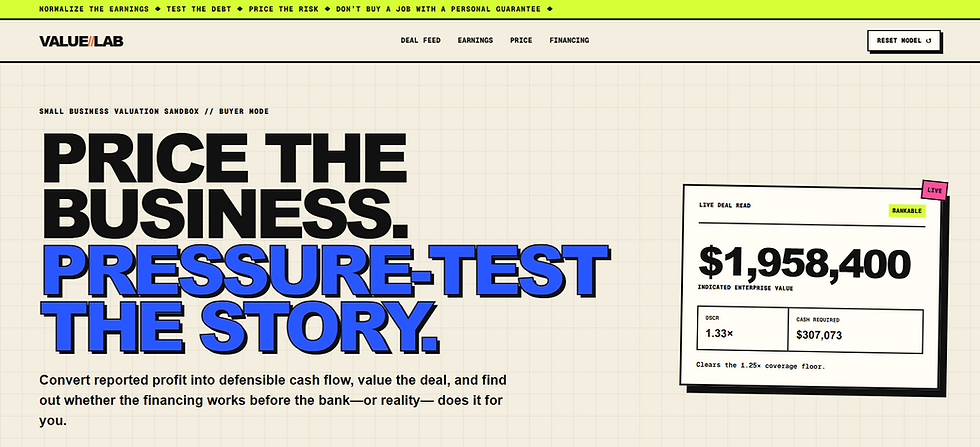
An asking price is only the beginning. VALUE//LAB lets you normalize seller earnings, challenge add-backs, model SDE or EBITDA valuation, account for working capital and debt, and test whether the proposed acquisition can actually support its financing.
Step 5: Understand What the Business Is Actually Worth
Price and value are not synonyms.
A seller may want $2 million.
That does not make the company worth $2 million.
Business valuation can incorporate:
SDE;
EBITDA;
revenue;
recurring revenue;
assets;
industry multiples;
growth;
customer concentration;
owner dependence;
management depth;
margins;
competitive positioning; and
transaction-specific risk.
For many small businesses, a simplified valuation might begin with:
Normalized Earnings × Appropriate Multiple = Estimated Enterprise ValueBut the hard part is hidden inside both variables.
Normalizing Earnings
Seller financial statements may include expenses that wouldn't continue under new ownership.
Those could include legitimate owner-related expenses or one-time costs.
Those adjustments are often called add-backs.
Treat them carefully.
Every add-back increases adjusted earnings.
And every dollar added to earnings can dramatically increase a valuation when multiplied.
If somebody manages to turn every expense on the income statement into an "add-back," congratulations: you've discovered acquisition alchemy.
Your lender will probably be less impressed.
Verify material adjustments.
Step 6: Analyze the Deal — Not Just the Business
A good company can still be a bad acquisition.
Imagine a company producing $400,000 in annual normalized cash flow.
That sounds attractive.
But what happens after accounting for:
acquisition debt;
replacement management;
buyer compensation;
required capital expenditures;
working capital;
taxes;
seller obligations; and
necessary reinvestment?
The question isn't simply:
How much money does this company make?
The better question is:
What cash flow remains for me after buying it?
Your acquisition analysis should test multiple scenarios.
Base Case
What happens if historical performance continues?
Downside Case
What happens if revenue declines 10% after the transition?
Severe Downside
What happens if you lose a major customer or key employee?
Upside Case
What happens if your planned improvements actually work?
Notice the order.
Don't build the upside case first and then reverse-engineer a purchase price that makes your spreadsheet happy.
That's not underwriting.
That's financial fan fiction.
Run a Quick Fundability Check
A business can look profitable on paper and still produce a lousy acquisition once purchase price, debt service, buyer equity, and deal structure enter the picture.
Use the Micro-Acquisition Fundability Calculator below to run a quick first-pass test before spending serious time or money on diligence.
Use this as an initial screening tool, not a substitute for lender underwriting, professional valuation, or financial due diligence.Step 7: Understand Your Financing Options
Financing is often one of the biggest barriers facing first-time business buyers.
Fortunately, you don't necessarily need enough cash to purchase the company outright.
SBA Acquisition Financing
SBA-backed loans can be an important financing option for qualifying U.S. small-business acquisitions.
They can potentially finance significant portions of eligible transactions, subject to lender underwriting and SBA requirements.
Factors typically considered include:
borrower qualifications;
business cash flow;
debt-service coverage;
purchase price;
valuation;
equity injection;
management experience;
transaction structure; and
business eligibility.
Do not wait until the week before closing to determine whether your transaction can qualify.
Financing strategy should begin much earlier.
Seller Financing
Seller financing means the seller accepts part of the purchase price over time rather than receiving the entire amount at closing.
For example:
Purchase price: $1,000,000
Bank financing: $700,000
Buyer equity: $150,000
Seller note: $150,000
Seller financing can reduce the amount of outside financing required and sometimes help bridge valuation disagreements.
It can also align incentives.
A seller willing to leave meaningful capital in the transaction is making a very different statement from a seller demanding every dollar in cash on closing day.
Investor or Partner Capital
Some buyers bring in investors or operating partners.
This can increase purchasing power but introduces another consideration:
ownership.
Cheap capital isn't always cheap when you're giving away equity.
Evaluate the long-term economics rather than focusing exclusively on getting the transaction closed.
Step 8: Submit an LOI
Once you've sufficiently evaluated an opportunity and want to proceed, the next major step is often a Letter of Intent (LOI).
An LOI typically outlines proposed transaction terms such as:
purchase price;
transaction structure;
financing assumptions;
seller financing;
working capital;
exclusivity;
due diligence;
expected closing timeline; and
important contingencies.
An LOI is not simply a ceremonial document.
It establishes the economic architecture of the proposed acquisition.
This is where qualified legal, accounting, lending, and transaction advisors become increasingly important.
You don't need an army of consultants analyzing every listing you bookmark.
But trying to save a few thousand dollars by avoiding professional advice during a seven-figure acquisition can become spectacularly expensive.
Step 9: Conduct Due Diligence
Due diligence is where the seller's story meets evidence.
You are trying to determine whether the company you've been presented is actually the company you're buying.
Financial Due Diligence
Review items such as:
tax returns;
profit-and-loss statements;
balance sheets;
bank statements;
accounts receivable;
accounts payable;
payroll;
debt;
inventory;
capital expenditures; and
claimed add-backs.
Compare records against each other.
Numbers should reconcile.
Operational Due Diligence
Investigate:
workflows;
equipment;
suppliers;
technology;
employees;
facilities;
inventory;
licensing;
customer acquisition;
management responsibilities; and
owner involvement.
Commercial Due Diligence
Evaluate:
customers;
competition;
market position;
pricing;
reputation;
customer concentration;
demand trends; and
growth assumptions.
Legal Due Diligence
Your legal advisors may examine:
contracts;
leases;
litigation;
intellectual property;
employment matters;
corporate records;
licenses;
regulatory issues; and
transaction documents.
Due diligence isn't about proving you were right to like the business.
It's about trying to prove yourself wrong before your money becomes trapped inside the deal.
Step 10: Decide Between an Asset Purchase and Equity Purchase
Small-business acquisitions are frequently structured as either an asset purchase or an equity purchase.
Asset Purchase
The buyer purchases specified assets and potentially assumes specified liabilities.
Depending on the transaction, assets might include:
equipment;
inventory;
intellectual property;
customer relationships;
contracts;
goodwill; and
other operating assets.
Equity Purchase
The buyer acquires ownership interests in the legal entity itself.
The appropriate structure can materially affect:
taxes;
liabilities;
contracts;
licenses;
financing;
employee matters; and
legal risk.
This is not a section where a blog article should pretend to replace your attorney and CPA.
Get transaction-specific professional advice before choosing a structure.
Step 11: Negotiate More Than the Purchase Price
First-time buyers naturally focus on price.
Experienced buyers focus on terms.
Two transactions with identical purchase prices can have radically different economics.
Negotiable terms may include:
cash at closing;
seller financing;
interest rate;
seller-note maturity;
earnouts;
working-capital requirements;
inventory;
transition assistance;
consulting agreements;
non-compete provisions;
representations and warranties;
financing contingencies; and
closing conditions.
Consider a seller asking $1.2 million while you believe the company is worth $1 million.
Instead of arguing endlessly about $200,000, the transaction might potentially bridge the gap using contingent consideration or seller financing.
Good dealmaking isn't always about forcing the other side to lose.
It's about discovering which terms each party values differently.
Step 12: Prepare for the Transition Before Closing
Closing is not the finish line.
It's when the business becomes your problem.
The transition plan should address:
seller handoff;
employee communication;
customer communication;
vendor relationships;
banking;
payroll;
insurance;
technology access;
passwords;
contracts;
licenses;
operating procedures;
key-person retention; and
immediate working-capital requirements.
Ideally, determine the first 30, 60, and 90 days before you take ownership.
And resist the urge to "fix everything" during your first week.
The company survived long enough for you to pay money for it.
Spend some time understanding why.
How Long Does It Take to Buy a Small Business?
There is no universal acquisition timeline.
A buyer may spend months finding the right opportunity before entering a serious transaction.
Once a deal progresses toward an LOI, additional time is required for:
due diligence;
valuation;
financing;
lender underwriting;
legal documentation;
negotiations; and
closing requirements.
Straightforward transactions can move relatively quickly.
Complicated transactions can take months.
Your timeline also depends heavily on how organized both parties are.
A seller with clean financial records, organized documents, responsive advisors, and realistic expectations is very different from a seller whose bookkeeping system appears to consist primarily of "ask Gary."
How Much Money Do You Need to Buy a Small Business?
There is no single minimum.
The amount of buyer cash required depends on factors including:
purchase price;
financing structure;
lender requirements;
seller financing;
business cash flow;
collateral;
buyer qualifications;
transaction expenses; and
required working capital.
This is why acquisition financing should be modeled at the transaction level, not reduced to a universal down-payment percentage.
A buyer with $100,000 available does not simply need to search for "$1 million businesses."
They need to determine what transactions their $100,000 can responsibly support.
Can You Buy a Business With No Money Down?
Occasionally, transactions are marketed this way.
Treat the phrase carefully.
A business can theoretically be acquired using creative combinations of seller financing, outside capital, earnouts, partner equity, or other structures.
But someone is providing capital or accepting risk somewhere.
There is no magical "CTRL + ALT + ACQUIRE" button.
More importantly, minimizing your initial cash contribution should not necessarily be your primary objective.
The better objective is:
Acquire a strong business using a capital structure the business can actually support.Maximum leverage can produce maximum returns when everything goes right.
It can also produce maximum headaches when revenue decides not to cooperate with your spreadsheet.
What Should First-Time Buyers Look for in a Business?
Different buyers need different businesses, but several characteristics deserve attention:
Characteristic | Why It Matters |
Consistent cash flow | Supports operations and acquisition debt |
Repeat customers | Improves revenue predictability |
Low customer concentration | Reduces dependence on individual accounts |
Strong employees | Makes ownership transition easier |
Documented processes | Reduces dependence on institutional memory |
Reasonable owner involvement | Makes transferability more realistic |
Stable margins | Helps support forecasting |
Clean financial records | Improves diligence and financing |
Defensible market position | Reduces competitive vulnerability |
Multiple growth opportunities | Creates upside without requiring miracles |
Don't confuse "boring" with "bad."
A 25-year-old commercial service company with repeat customers, competent employees, predictable demand, and consistent cash flow might not generate many LinkedIn posts about disruption.
That's fine.
You can't deposit disruption at the bank.
Common First-Time Buyer Mistakes
Falling in Love With the Business
Your job isn't to prove why you should buy it.
Your job is to determine whether you should.
Trusting the Asking Price
An asking price is an invitation to negotiate, not independent evidence of value.
Underestimating Working Capital
Buying the company and immediately starving it of cash is a particularly creative way to destroy your new investment.
Accepting Add-Backs Without Verification
Normalize earnings carefully.
Ignoring Owner Dependence
If customers are buying primarily because of the seller's relationships, determine whether those relationships will transfer.
Waiting Too Long to Think About Financing
A signed LOI is a bad time to discover that your capital stack doesn't work.
Modeling Only the Upside
Every acquisition looks fantastic when revenue grows 20%, margins expand, nobody quits, customers stay, and nothing breaks.
Model what happens when reality develops a personality.
Doing Everything Alone
First-time buyers often need some combination of:
acquisition lender;
transaction attorney;
CPA;
insurance advisor;
industry expert;
broker or intermediary; and
experienced acquisition advisor.
The exact team depends on the transaction.
A Better Framework for Buying Your First Business
Rather than bouncing randomly between listings, lenders, spreadsheets, and brokers, move through a defined acquisition process:
Explore → Prepare → Package → Match → TransitionExplore: Define your acquisition thesis and investigate opportunities.
Prepare: Establish financial capacity, financing readiness, and acquisition criteria.
Package: Organize your buyer profile, financial information, lender requirements, and deal assumptions.
Match: Evaluate businesses against your criteria and financing capacity.
Transition: Complete diligence, financing, closing, and ownership handoff.
This is also the logic behind the Seller Transition Exchange buyer pathway.
Instead of treating business acquisition as a giant pile of listings, the pathway helps buyers move from "I want to buy a business" toward "This specific transaction makes financial and operational sense."
Start Your Buyer Pathway
You don't need another afternoon scrolling through businesses for sale.
You need to know:
What should I buy?
What can I afford?
How should I finance it?
Is this particular deal actually any good?
What needs to happen next?
The Seller Transition Exchange buyer ecosystem is designed around those decisions — connecting buyer preparation with acquisition opportunities, valuation intelligence, deal analysis, financing readiness, and transition resources.
Use the Buyer Pathway to establish your acquisition criteria and move through the process systematically.
From there, deeper tools can help you evaluate opportunities through Deal Reality Check, valuation analysis, capital-stack modeling, buyer-equity analysis, seller-note scenarios, deal comparisons, and financing resources.
Because the goal isn't to buy a business.
It's to buy a business whose economics still make sense after the excitement wears off and the first loan payment hits.
→ Start the Buyer Pathway on Seller Transition ExchangeFrequently Asked Questions About Buying a Small Business
What is the first step to buying a small business?
Start by defining your acquisition criteria rather than immediately searching listings. Determine your target industry, geography, business size, cash-flow requirements, available capital, desired owner involvement, and financing capacity.
Is buying an existing business better than starting one?
Neither is universally better. Buying an existing business can provide immediate revenue, customers, employees, infrastructure, and operating history, but requires acquisition capital and exposes the buyer to existing operational risks. Starting a company generally requires less acquisition capital but involves building demand and infrastructure from scratch.
How do I know if a business is worth buying?
Evaluate normalized cash flow, valuation, customer concentration, employee stability, owner dependence, market conditions, capital requirements, financing feasibility, and expected returns. Then conduct thorough due diligence before closing.
How are small businesses valued?
Many owner-operated businesses are valued using a multiple of normalized Seller's Discretionary Earnings, while larger companies may be evaluated using EBITDA multiples. Asset value, recurring revenue, growth, industry conditions, customer concentration, management depth, and risk can also affect valuation.
Can an SBA loan be used to buy a business?
SBA-backed financing can be used for qualifying business acquisitions when the borrower, business, transaction, and structure meet applicable lender and SBA requirements. Buyers should evaluate financing eligibility early in the acquisition process.
What is seller financing?
Seller financing occurs when the seller agrees to receive part of the purchase price over time rather than receiving the entire amount at closing. The resulting seller note becomes one component of the transaction's capital structure.
Should I use a business broker?
A broker can help buyers discover opportunities and navigate transactions, but buyers should understand whom the broker represents and conduct independent analysis. Brokers do not replace your attorney, accountant, lender, or due-diligence process.
What documents should I review before buying a business?
Typical due-diligence materials include tax returns, financial statements, bank statements, payroll records, customer information, contracts, leases, debt schedules, employee information, inventory records, corporate documents, licenses, insurance policies, and other records relevant to the specific company.
What happens after buying the business?
Ownership transition begins. Buyers need to manage seller handoff, employees, customers, vendors, banking, systems, licenses, insurance, working capital, and operational continuity. A detailed transition plan should ideally exist before closing.
The Bottom Line
Learning how to buy a small business isn't primarily about learning how to search listings.
It's learning how to make decisions under imperfect information.
1️⃣ Find the right business.
2️⃣ Verify the cash flow.
3️⃣ Understand the valuation.
4️⃣ Stress-test the economics.
5️⃣ Build a realistic capital stack.
6️⃣ Investigate what can go wrong.
7️⃣ Negotiate the terms.
8️⃣ Prepare the transition.
9️⃣ And maintain the discipline to walk away when the numbers don't work.
There will always be another business.
There may not be another pile of your capital waiting around after you buy the wrong one.
Start with the Buyer Pathway. Evaluate before you acquire.


Comments