Wix Seller Financing Alternatives: Funding Beyond Wix Capital

Wix Capital isn't your only funding option. From revenue-based financing and business lines of credit to inventory loans, here are five ways to fund your Wix store—and how to decide which actually makes financial sense.
Your Wix store is generating sales. Your best products are moving. Maybe your advertising campaigns are finally producing consistent returns.
There's just one problem: growth needs cash before it produces more cash.
Your supplier wants payment before your next inventory shipment. Advertising platforms charge you before customers buy. And your bank balance doesn't always reflect the revenue your store is generating.
Wix Capital offers eligible merchants a way to access funding against future sales. But what happens if you're ineligible, the amount offered isn't enough, or the repayment terms don't fit your business?
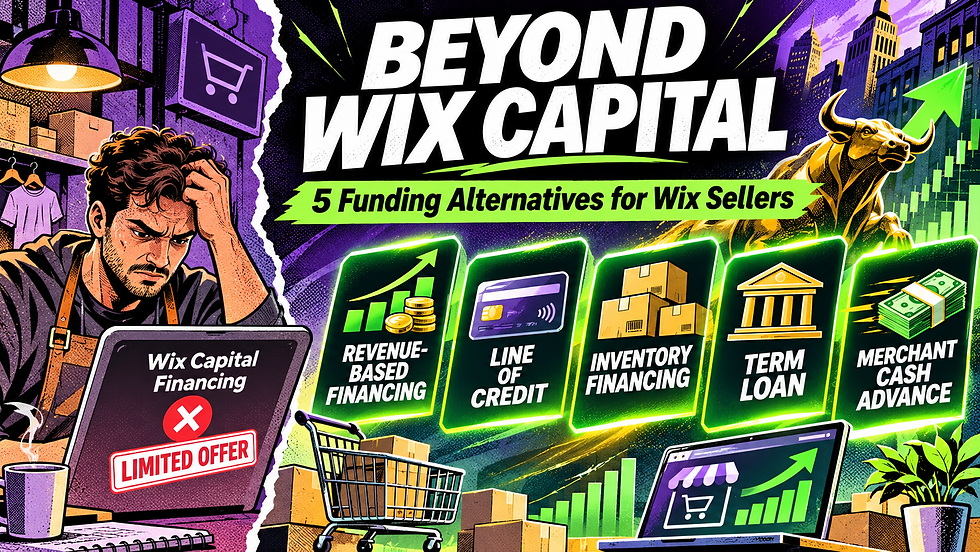
Wix seller financing alternatives include independent revenue-based financing, business lines of credit, inventory financing, traditional business loans, and third-party merchant cash advances. These options can help qualified merchants fund growth without depending on an offer inside their Wix dashboard.
The question isn't simply where you can get approved.
It's which financing structure solves your cash-flow problem without creating a bigger one.
Wix Seller Financing Alternatives at a Glance
Financing option | Best for | Repayment structure | Main limitation |
Revenue-based financing | Established sellers funding inventory or proven marketing campaigns | Revenue-linked or scheduled payments, depending on agreement | Fees and remittance obligations can consume margin |
Business line of credit | Recurring cash-flow gaps and seasonal purchases | Draw-based payments; often revolving | Credit, revenue, and business-history requirements |
Inventory financing | Purchasing proven, high-turnover products | Loan or facility tied to inventory | Inventory may be collateral; unsold stock creates risk |
Business term loan or SBA financing | Planned expansion and larger investments | Scheduled principal and interest payments | More documentation and potentially longer underwriting |
Independent merchant cash advance | Urgent funding when conventional options are unavailable | Percentage of sales or scheduled withdrawals | Potentially high costs and aggressive repayment |
Our recommendation: Start with the financing structure that matches your use of funds and repayment capacity—not whichever provider promises the fastest decision.
If your Wix store has predictable revenue, a line of credit or term loan deserves consideration before a high-cost cash advance.
If the business has strong sales but limited conventional borrowing options, a revenue-based product may be worth evaluating.
And if your biggest problem is an upcoming supplier payment, inventory financing could be more appropriate than borrowing against all your future sales.
What Is Wix Capital, and Why Might Sellers Need Alternatives?
Wix Capital is a financing program available to eligible Wix merchants. Rather than a conventional installment loan, its core offering is a merchant cash advance (MCA).
Eligible businesses receive an advance and agree to remit that amount plus a fixed fee. Wix collects a specified percentage of qualifying daily sales until the agreed total has been remitted.
This structure has an obvious attraction: payments generally move with sales activity rather than following a conventional fixed monthly loan schedule.
But there's a catch.
Wix collects its percentage from sales revenue—not from whatever profit remains after inventory, shipping, payroll, advertising, and operating expenses.
That distinction matters when margins are thin.
How Wix Capital works
According to Wix's official Capital documentation:
Eligible businesses can review available cash advance offers in their Wix dashboard.
Merchants select an advance amount and review the fixed fee and remittance terms.
Wix reviews submitted requests, typically within one to three business days.
Approved funds may be available immediately through Wix Checking or generally within three to five business days after approval through connected Wix Payments bank payouts.
A percentage of qualifying sales is collected until the advance and fixed fee have been remitted.
Wix also supports eligible merchants processing payments through certain third-party providers, including Square, Stripe, and PayPal. The exact collection method depends on the payment setup.
Where is Wix Capital unavailable?
As of November 2026, Wix states that its Capital program is unavailable to businesses in:
Connecticut
Texas
Utah
Virginia
Wix Capital is also limited to eligible U.S. merchants. Availability and individual eligibility can change.
Being able to operate a Wix store does not automatically make your business eligible for Wix Capital.
Four reasons to look beyond Wix Capital
1. You don't have an eligible offer. Wix evaluates business activity and other risk factors. Having sales does not guarantee access to capital.
2. The available amount doesn't cover the project. A partial advance may not solve a large inventory or expansion requirement.
3. The total financing cost doesn't justify the opportunity. A convenient offer can still be expensive relative to the profit the borrowed money is expected to produce.
4. You need a different repayment structure. Some businesses are better suited to monthly installments, revolving credit, or financing secured by a specific asset.
For a broader explanation of the platform's financing ecosystem, see our Wix Seller Financing guide.
Understand Wix Seller Financing
Compare Wix Capital with other funding structures before deciding whether a platform offer fits your store.

1. Revenue-Based Financing: Capital Built Around Business Sales
Revenue-based financing (RBF) provides capital based partly on a business's existing or anticipated revenue.
Instead of relying exclusively on collateral and traditional credit underwriting, providers may analyze transaction history, deposits, sales trends, margins, and cash flow.
Depending on the contract, repayment may be linked to revenue or follow a predetermined schedule.
For Wix sellers, RBF can be relevant when there is enough historical revenue to demonstrate repayment capacity but conventional financing is difficult to obtain.
When revenue-based financing makes sense
Consider it when:
Your store has established, verifiable revenue.
You need capital for a proven inventory or marketing opportunity.
Your funding request is supported by realistic sales projections.
You can absorb the required remittances without disrupting essential operations.
Best for: Established e-commerce merchants with documented sales and a specific growth opportunity.
Not ideal for: Pre-revenue stores, speculative product launches, or businesses already struggling to cover operating expenses.
Which e-commerce funding companies should Wix sellers research?
Two recognizable providers illustrate why platform compatibility matters.
Wayflyer
Wayflyer provides financing for qualifying established businesses, including online sellers. Its June 2026 eligibility guidance specifies at least $10,000 in average monthly revenue over the preceding six months for U.S. applicants, along with other requirements.
However, Wayflyer's published direct integrations list Shopify, Amazon, WooCommerce, BigCommerce, and Stripe—not Wix.
That doesn't automatically eliminate a Wix business. Wayflyer says businesses on other platforms may be considered through banking and analytics connections, but support is not guaranteed.
Clearco
Clearco offers e-commerce invoice funding and cash advances. Its published eligibility criteria include more than $100,000 in monthly revenue for at least six months, U.S. incorporation, and qualifying financial documentation.
That makes it a potential research candidate for substantially larger merchants—not an automatic recommendation for smaller Wix stores. Platform compatibility and current product eligibility must be confirmed directly.
The tradeoff with RBF
Sales-based financing can help businesses that don't fit conventional underwriting, but variable repayments are not automatically inexpensive.
Ask the provider whether payments actually decrease when sales decline, whether there are minimum collections or reconciliation requirements, and what happens if sales are interrupted.
A repayment schedule that moves with revenue is useful only if the business retains enough cash to operate.
2. Business Lines of Credit: Flexible Funding Without Borrowing Everything Upfront
A business line of credit gives an approved merchant access to funds up to an established credit limit.
Unlike a one-time term loan, a revolving line can be used, repaid, and drawn again, subject to the agreement.
That flexibility makes a line of credit particularly useful for e-commerce businesses dealing with recurring cash-flow fluctuations.
Imagine that your Wix store needs $12,000 to restock inventory in March, another $5,000 for marketing in April, and nothing additional in May.
With an appropriate revolving credit line, you may be able to draw money as needed instead of accepting a larger advance all at once.
Why a line of credit can beat a cash advance
You can borrow according to actual business needs.
Revolving facilities may restore borrowing capacity as balances are repaid.
Some structures charge interest primarily on outstanding amounts rather than the entire approved limit.
A credit line can support recurring working-capital cycles rather than one isolated purchase.
However, draw fees, maintenance charges, repayment frequencies, variable rates, and other conditions differ among lenders.
Don't assume every line of credit operates like a conventional bank credit card.
What do lenders require?
Requirements vary.
As one concrete example, OnDeck's published baseline criteria include one year in business, $100,000 in annual revenue, a 625 personal FICO score, and a business checking account. It advertises revolving business lines of credit with limits up to $200,000.
These are OnDeck's criteria, not universal requirements for all business credit lines.
Best for: Established Wix stores managing recurring inventory, advertising, or seasonal working-capital needs.
Not ideal for: Businesses unable to qualify under a lender's credit or operating-history standards, or merchants likely to keep the line permanently maxed out.
3. Inventory Financing: Let Your Products Support Your Growth
Sometimes the problem isn't that your business lacks revenue.
It's that your money is sitting in products.
You've sold through your best-performing items, customer demand is still strong, and your supplier requires a substantial payment before replenishing stock.
Inventory financing is designed to address that kind of problem.
Depending on the lender, financing may be secured by existing inventory, structured around future inventory purchases, or tied to a broader asset-based lending facility.
When inventory financing makes sense
Consider a Wix merchant selling specialized fitness equipment.
The store has consistent demand for a particular product, but its manufacturer requires a minimum order worth $35,000.
Without additional capital, the business cannot maintain sufficient stock to meet expected demand.
Inventory financing may provide a way to purchase that inventory while preserving operating cash.
But approval depends on more than sales projections.
Lenders may evaluate:
Historical sales and inventory turnover.
Product margins and resale value.
Inventory condition and concentration.
Supplier invoices and purchase documentation.
Warehouse or fulfillment arrangements.
The merchant's ability to repay if products sell more slowly than expected.
The biggest risk: Inventory that doesn't move
Financing doesn't turn a weak product into a strong product.
If inventory doesn't sell, the borrowing obligation generally remains. Collateral may also be exposed to lender enforcement under the financing agreement.
This is why inventory financing is usually more compelling for replenishing proven products than gambling on an untested launch.
Best for: Sellers with proven SKUs, predictable restocking needs, and sufficient sales margins.
Not ideal for: Early-stage product testing, poorly documented stock, or products without established resale demand.
For the mechanics, collateral questions, and common pitfalls, read our Inventory Financing for Ecommerce guide.
Finance Your Next Restock
Learn how inventory-backed financing can support proven products without treating every supplier order as an emergency.

What about purchase order financing? It can be useful for certain businesses fulfilling qualifying customer orders, especially B2B transactions. It should not be confused with financing ordinary direct-to-consumer shopping-cart orders.
4. Business Term Loans and SBA Financing: Better for Planned Expansion
Not every funding requirement is urgent.
Sometimes you're planning to add a warehouse, purchase equipment, hire employees, develop a new product line, or expand into additional sales channels.
Those investments may create value over several years—not several weeks.
Using an expensive short-term cash advance to finance a long-term project can create an unnecessary repayment mismatch.
A business term loan offers a different structure: funds are advanced, then repaid under an agreed schedule, commonly through installments of principal and interest.
Why term loans may be worth the additional paperwork
For qualifying businesses, term loans can offer:
A defined repayment schedule.
Clear financing costs when properly disclosed.
Longer repayment periods than certain short-term advances.
Funding aligned with larger, planned business investments.
The drawbacks are equally important: credit standards, financial-documentation requirements, guarantees, collateral, and underwriting timelines can be more demanding.
Can a Wix store qualify for an SBA loan?
Potentially, yes.
Running an online store does not, by itself, exclude an otherwise eligible business from SBA financing.
The SBA 7(a) program supports several uses, including short- and long-term working capital, equipment purchases, and certain expansion needs.
For smaller requirements, the SBA Microloan program offers loans up to $50,000 through approved intermediaries. Eligible uses include working capital, inventory, supplies, and equipment.
Neither option guarantees approval. Businesses must meet the relevant eligibility and underwriting requirements.
Best for: Established sellers funding planned expansion, equipment, or business investments with a longer payback period.
Not ideal for: Merchants who need immediate funds and cannot accommodate more extensive underwriting.
5. Independent Merchant Cash Advances: Another Offer, Not Necessarily a Better Product
Here's the distinction many financing comparisons miss:
Wix Capital is already a merchant cash advance.
Getting an MCA from a different company doesn't automatically mean you've found a fundamentally different financing product.
An independent MCA provider may offer different advance amounts, eligibility requirements, fees, collection mechanics, or terms.
Those differences can matter. But they must be compared using actual written offers.
How third-party MCAs work
A merchant cash advance generally provides money upfront in exchange for an agreed amount of future business receipts.
The provider may collect a percentage of eligible sales or use scheduled withdrawals from the merchant's business checking account.
Some agreements involve fixed daily or weekly payments that do not automatically decline when revenue falls.
A merchant should understand precisely which structure is being offered.
Why independent MCAs require additional scrutiny
Review:
Total repayment compared with the amount deposited.
Fixed fees and factor-rate calculations.
Daily or weekly collection obligations.
Personal guarantees and business liens.
Default provisions and reconciliation rights.
Early-payoff treatment.
Existing financing restrictions.
The effect of combining the advance with other debt.
Independent MCA offers can be expensive. A short repayment period can make the annualized cost substantially higher than the stated fixed fee might suggest.
The Consumer Financial Protection Bureau's explanation of merchant cash advances provides additional context on factor rates, holdbacks, and repayment structures.
Best for: A narrowly defined, urgent funding requirement where the business can confidently support the contractual collections and less costly financing is unavailable.
Not ideal for: Long-term expansion, unproven advertising campaigns, chronic operating losses, or covering payments on another high-cost advance.
How Much Does Wix Seller Financing Actually Cost?
The most important number in a financing offer isn't necessarily the interest rate, advertised fee, or amount approved.
It's the relationship between:
Money received → Total repayment → Payment timing → Cash remaining to operate.
Consider a hypothetical store funding a $20,000 inventory order.
Example: A $20,000 sales-based advance
Assume a financing provider offers the following hypothetical terms:
Item | Illustrative amount |
Advance received | $20,000 |
Fixed financing fee | $3,000 |
Total amount to remit | $23,000 |
Remittance percentage | 12% of eligible sales |
Monthly eligible sales | $30,000 |
Approximate monthly remittance | $3,600 |

At that sales level, approximately $3,600 would be collected during a month.
That leaves $26,400 of gross sales receipts before accounting for inventory costs, advertising, shipping, employees, taxes, and other operating obligations.
If the store generates $7,500 in monthly contribution after variable operating costs, that $3,600 remittance would consume 48% of the contribution available before financing costs and remaining overhead.
The problem isn't necessarily the $3,000 fee.
It's whether the business can afford the collections while maintaining operations.
Actual daily collections and payoff duration depend on eligible sales, processing arrangements, and contract provisions. These numbers are illustrations—not a current Wix Capital offer or lender quote.
Fixed fees versus annual percentage rates
A fixed fee and an APR are not interchangeable.
For example, paying a $3,000 fee for access to $20,000 does not establish a 15% APR. The annualized financing cost depends heavily on the timing of payments and any additional charges.
When comparing offers, request:
The exact amount deposited into your account.
The total amount you must repay.
The estimated payment schedule under realistic sales conditions.
An APR or equivalent annualized cost comparison when available.
Written details of fees, guarantees, liens, and early repayment.
Two offers with the same advertised fee can have dramatically different cash-flow consequences.
Which Financing Alternative Is Best for Your Wix Store?
There is no single best lender for every Wix merchant.
A useful starting point is the reason you need capital.

If you need funding for proven advertising campaigns
Consider a business line of credit or appropriately structured revenue-based financing.
Before borrowing, calculate contribution margin after advertising costs—not just return on ad spend.
A profitable campaign before financing costs may become unattractive after fees and remittances.
If you need inventory before a peak sales period
Compare inventory financing with a line of credit.
Use historical SKU turnover, supplier lead times, expected margins, and realistic demand forecasts.
Don't finance a warehouse full of products simply because the supplier offered a discount.
If your store is new or has limited revenue
Start by assessing the financing products for which the business actually qualifies.
You may need to consider smaller financing amounts, SBA microloan intermediaries, supplier payment terms, or alternatives that do not depend solely on substantial operating history.
Some well-known e-commerce finance companies have minimum revenue requirements that newer stores won't meet.
If your store has strong sales but weak personal credit
Revenue-oriented underwriting may create additional possibilities.
However, business revenue does not eliminate underwriting. Providers may still review credit, banking history, existing obligations, and financial performance.
If you're expanding into multiple sales channels
Consider financing based on the performance of your overall business rather than assuming that one platform's sales represent your full financial position.
Lenders may need to reconcile transactions and deposits across multiple platforms.
For help organizing those records, see AI Finance Tools for Ecommerce Sellers.
More Funding For Wix Sellers
See the broader funding landscape for Wix store owners, including working capital and growth funding options.

What Should You Prepare Before Applying?
The fastest application is often the one that doesn't require repeated requests for missing information.
Before approaching an independent lender, prepare a concise financing package.
Business information
Registered business name, EIN, and ownership details.
Time in business and principal operating address.
Description of products, customers, and sales channels.
Financial records
Recent business bank statements.
Wix sales and payment-processing reports.
Profit-and-loss statements.
Revenue history and significant seasonal changes.
Current debts and outstanding financing obligations.
Funding plan
Exact amount requested.
How the proceeds will be used.
Expected return or business benefit.
Projected cash flow and repayment capacity.
A downside scenario if sales fall short of expectations.
For inventory financing, include supplier invoices, purchase orders where relevant, stock valuations, and inventory turnover information.
The goal is to demonstrate not only that your business generates revenue, but also that it can service the new financing while continuing to operate.
Can You Combine Wix Capital With Outside Business Funding?
Possibly, but don't assume that multiple financing arrangements are compatible.
Existing financing contracts may contain restrictions on additional indebtedness, liens, receivables assignments, or other payment obligations.
A second funder may also reject an application because of existing remittances or the priority of another creditor's claim.
Even where combining products is permitted, the economics can be dangerous.
If multiple providers collect percentages of the same revenue stream, the business may lose access to cash needed for suppliers, wages, refunds, or operating expenses.
Never treat approval for another advance as proof that your store can afford another advance.
Review existing contracts, disclose outstanding obligations, and model the combined repayment burden before accepting new funding.
How to Get Funding Beyond Wix Capital
You don't have to abandon Wix or move your store to another e-commerce platform to explore independent business financing.
Start with your financing objective.
If you're buying inventory, determine how quickly that stock can convert into collected cash.
If you're investing in advertising, calculate whether the campaign's contribution margin can support financing costs.
If you're expanding operations, compare the likely lifetime of the investment with the proposed repayment period.
Then compare available offers based on total cost, eligibility, payment structure, and the effect on cash flow.
Explore Funding Options for Your Wix Store
Moonshine Capital helps business owners explore financing options through its independent funding marketplace.
Depending on the business and provider requirements, those options may include working capital, business loans, revolving credit, and other financing structures.
You can also review our broader Ecommerce Funding Solutions.
Submitting an inquiry does not guarantee eligibility, approval, pricing, or funding.
Frequently Asked Questions About Wix Seller Financing Alternatives
Does Wix offer business loans?
Wix Capital offers merchant cash advances to eligible businesses. These are not the same as conventional installment loans. Merchants receive an advance and remit an agreed total that includes a fixed fee, generally through collections linked to qualifying sales.
Can I get business funding without a Wix Capital offer?
Yes, potentially. Independent lenders and financing providers may evaluate business bank deposits, credit history, operating performance, inventory, and other information. Their eligibility requirements are separate from Wix Capital's program.
Can Wix stores using PayPal, Stripe, or Square access Wix Capital?
Potentially. Wix documentation confirms that eligible merchants using those supported payment providers may qualify. Program eligibility still depends on business location, merchant activity, and other underwriting conditions.
What is the best financing alternative for a new Wix store?
There is no universal best option. Newer merchants often have fewer qualifying products because many financing providers require revenue history. Smaller financing programs, supplier terms, or preparing the business for future credit eligibility may be more appropriate than immediately pursuing expensive advances.
Can I get Wix seller financing with bad credit?
Possibly. Some financing providers evaluate business revenue and cash flow alongside credit history. However, weaker credit can limit available products or increase financing costs. No reputable provider should promise approval solely because a merchant has sales.
Is revenue-based financing cheaper than Wix Capital?
Not necessarily. Both can involve a fixed financing cost and repayment tied to business sales. Actual pricing varies by provider, applicant profile, and contract. Compare the total repayment, timing, fees, and cash-flow impact rather than assuming that an independent product is cheaper.
Can I use business financing for Facebook or Google Ads?
Many general working-capital products allow financing proceeds to be used for marketing, subject to their agreements. Inventory-specific facilities may restrict how funds are used. Advertising financed with borrowed money should be supported by realistic customer acquisition costs, contribution margins, and cash-flow projections.
Will applying for independent financing affect my credit score?
It depends on the provider and stage of the application. Some providers use soft credit inquiries for initial screening, while others may conduct hard inquiries during underwriting. Confirm the credit-check policy before submitting an application or authorizing a credit pull.
The Bottom Line: Your Store Shouldn't Depend on One Funding Source
Wix Capital can be useful when a merchant qualifies and the offer makes financial sense.
But platform convenience isn't a financing strategy.
An independent line of credit may be more appropriate for recurring expenses. Inventory financing may better match product restocking. A term loan may support longer-term growth. Revenue-based financing may fit established merchants with sufficient sales and manageable margins.
And a third-party merchant cash advance? It deserves particularly careful comparison because it may offer a different source of capital without solving the underlying cost problem.
The objective isn't to borrow the most money. It's to obtain the right amount, for the right purpose, under terms your business can realistically support.
Additional Resources
Disclosure: Moonshine Capital operates an independent financing marketplace and may receive compensation from financing partners for qualifying referrals or funded transactions. Moonshine Capital is not affiliated with Wix or Wix Capital. Financing availability, eligibility, pricing, and terms vary. This article is educational and does not constitute personalized financial, legal, or tax advice. All illustrative figures are hypothetical.
Comments